30th June – 13th July 2024
During the summer of 2024, we were lucky enough to spend almost three weeks in South Africa. We concluded our trip with a few amazing days exploring Kruger National Park, which you can read about here, but the first two weeks were spent driving the 800 or so kilometres from Gqeberha to Cape Town. Highlights included Addo Elephant National Park; making plenty of stops along the famous Garden Route; learning about wine at the Franschhoek vineyards; and the Cape Peninsula. So, if you wish to hear more about our trip then please continue reading…
Contents
Getting started
Flying from Europe via Doha, we first arrived into South Africa at O.R. Tambo International Airport in Johannesburg. From there we took an internal flight to Chief Dawid Stuurman International Airport in Gqeberha (formerly Port Elizabeth). This airport is reasonably small but still has a selection of car rental companies in cabins outside the main entrance. We actually took a taxi to our accommodation for the night and returned the following day to collect our car, as it was cheaper and more convenient than paying for the extra day’s car hire. We used Hertz, and had organised to be able to pick up the car in Gqeberha and return it prior to flying away from Cape Town International Airport. The process was pretty smooth, and it wasn’t long before we were on our way…
Gqeberha
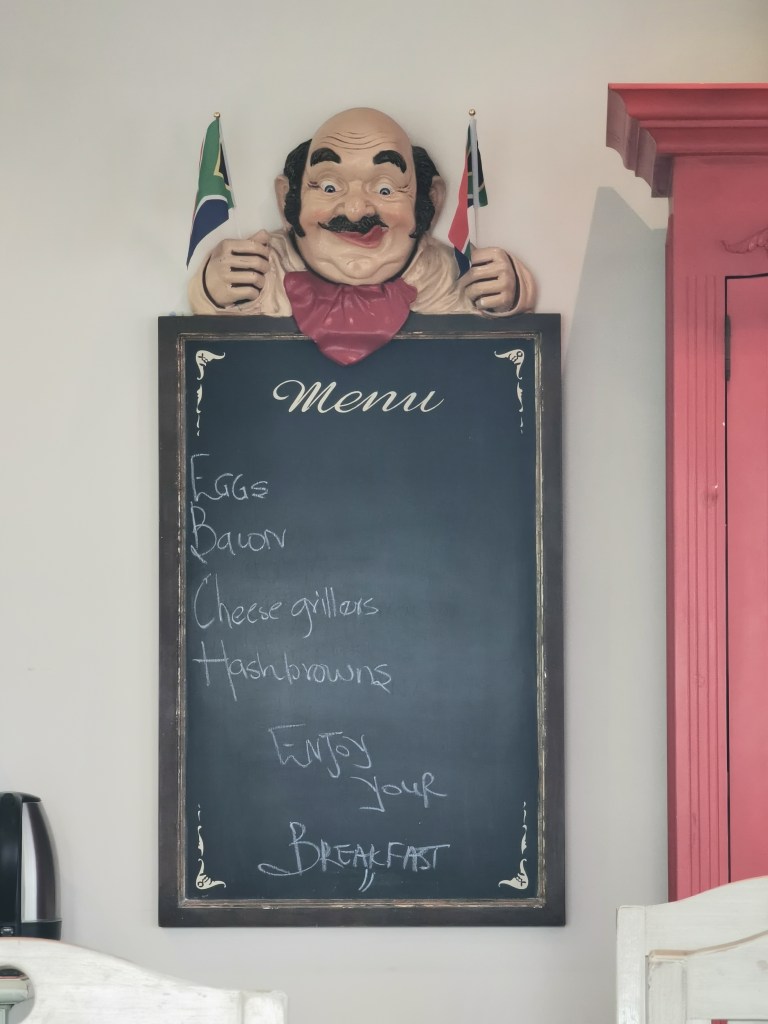
Gqeberha was formerly called Port Elizabeth until 2021, when a raft of changes to names of towns and airports was implemented. We chose to start our trip there because of the ease of access to the Garden Route, but also because it serves as the main port accessing Algoa Bay. This bay is famous for its marine wildlife, and we were going at at time when we would hopefully be able to see the whale migrations – with the chance to see Humpback and Southern Right Whales at that time of the year. So, the plan was to pick up the car early in the morning, drive to the port, take the morning wildlife watching cruise, and then drive onto Addo Elephant National Park in time to check-in to our accommodation mid-afternoon. Unfortunately, however, it was not to be, as high winds and ocean swells meant that no boat trips would be running on the day we needed, and were unlikely to be running at all that week. So, whilst it was disappointing, it meant that we did not need to rush regarding picking up the car, we were able to pick up cooking supplies for our road trip, and with breakfast we learned that “cheese grillers” are not grilled cheese sandwiches as we thought, but rather very tasty little pork sausages with cheese in them…
Addo Elephant National Park
Despite having a couple of nights booked in Kruger National Park at the end of our trip, we had read nice things about Addo Elephant National Park, so we decided to book one night in the park and have a look around, and we’re so glad that we did…
Getting there – the drive from Gqeberha to the entrance to the National Park ended up being relatively straight forward. The only issues we had linked in to moving between the major roads whilst getting out of Gqeberha itself. From there, the route matched Google Maps well and we were able to get to the entrance without any further problems. When selecting the route, however, you need to make sure that you avoid taking the R335 when it leaves the N2 due to it not being safe to drive through. There was a map in the Hertz office warning us of this (see below) and when we put the destination into Google Maps, it selected the route that we were supposed to take, despite the route on the R335 being the shorter journey. Please note that this does happen throughout South Africa. So if it seems that Google isn’t picking the most direct route – that could well be due to issues with safety.

Entering the Park – Addo Elephant National Park is one of the many National Parks that falls under the South African National Parks umbrella. Their website allows you to research the different parks and view the accommodations available. As well as being able to book accommodation (at a slightly cheaper rate), you can also see what activities are available and also book these. Regardless of whether you’re staying in the parks or not, you will need to pay a Conservation fee for entering the park. These fees last for 24hrs from when you have purchased them, and the cost depends on which park you are visiting. This is one of the reasons that we’d planned on entering the park in the early afternoon and leaving by noon the following day – it would mean that we’d only have to pay fees for one day (24hr period) rather than two. However, when we were getting ourselves organised in Gqeberha, we came across the ‘Wildcard’, which can also be purchased from the SANParks website. There are different options but basically this is an entry pass for a year to any of the parks under the SANParks umbrella. The reason we hadn’t looked more closely at it earlier is that the ‘foreigner’s pass’ seemed to be very expensive, so we didn’t think there was any point in getting a years pass. But when we sat down and actually did the maths based on the number of national parks we wanted to visit, it actually made financial sense. It also meant that getting into the National Parks was much quicker and more straightforward. So, we’d definitely advise you to use the website, do the maths and see if it’s worth getting a Wildcard.
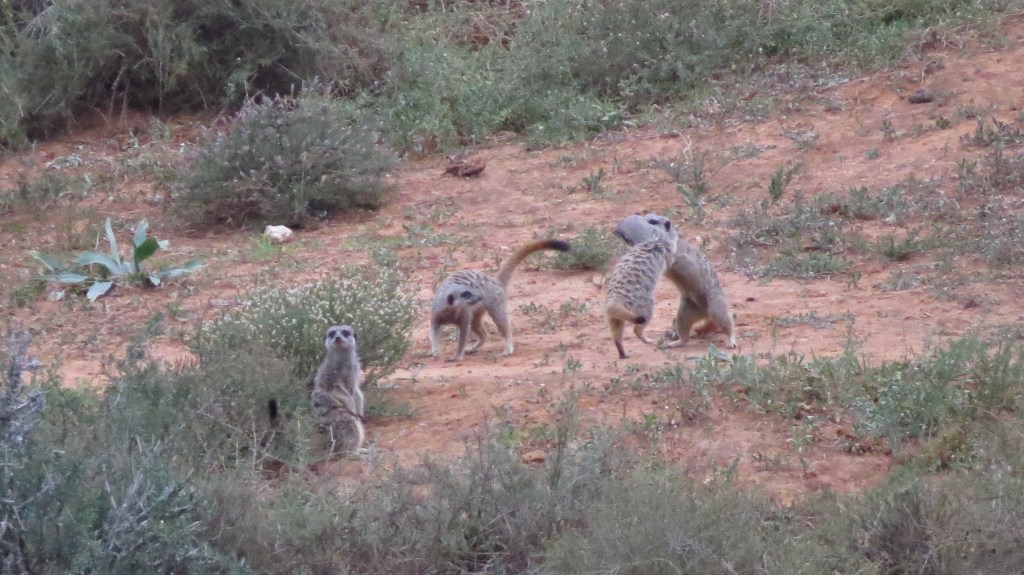
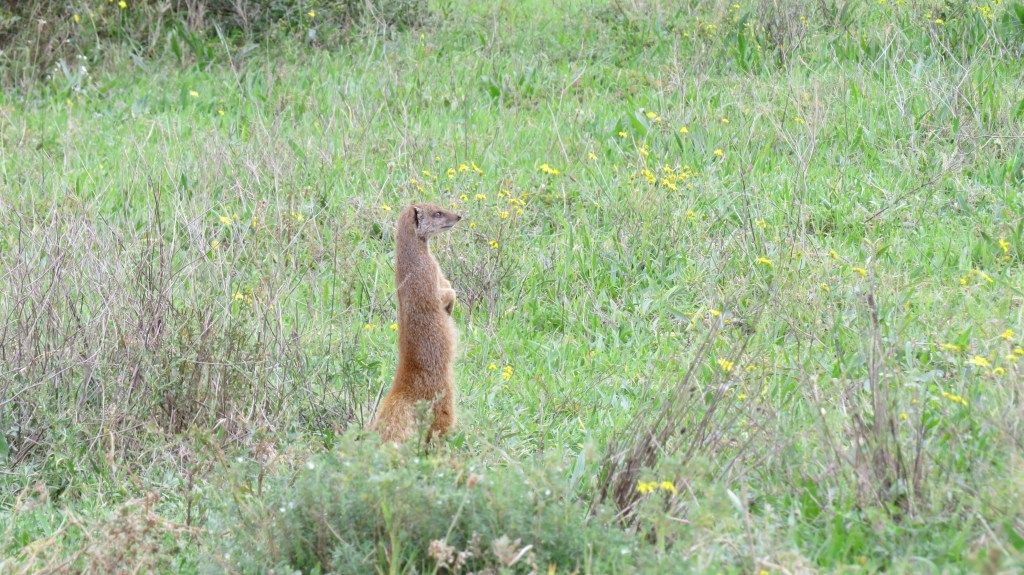
First Day – By the time we entered the park and registered at the main office at the Addo Rest Camp, we only had about an hour till our Sunset Safari. This was enough time to unpack into our chalet and relax on the patio for a bit. As we looked out across the scrub we were amazed that there was a family of meerkats playing in what was left of the afternoon light. This is the point when I emphasise that a good pair of binoculars and / or a camera with a really good zoom will definitely enhance your experience. The photo below is taken at 50x zoom (without a tripod hence the slight blur):
We had read that around sunset and sunrise were the best times to see the wildlife as the animals are more active at these times. However, in our experience at Addo and also Kruger, we found that this wasn’t really the best time to wildlife watch. Regardless of how active the animals might be, given that most of the tours are spent in poor or no light conditions, you tended to only get good views of the wildlife if they were right next to the road. On the other hand, what these tours (and the night tour) are good for is seeing different types of animal that you’d be highly unlikely to see during the day.
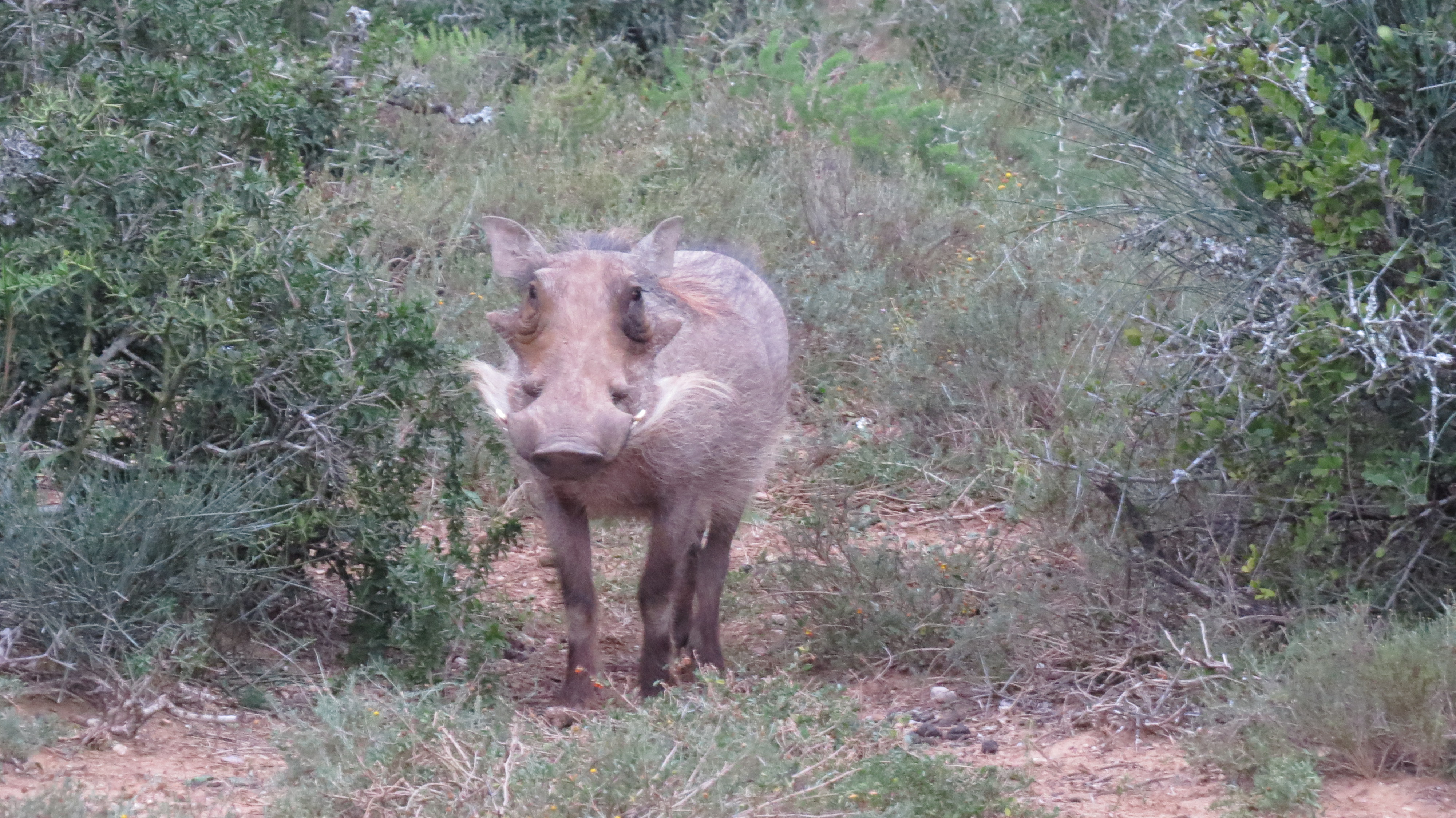
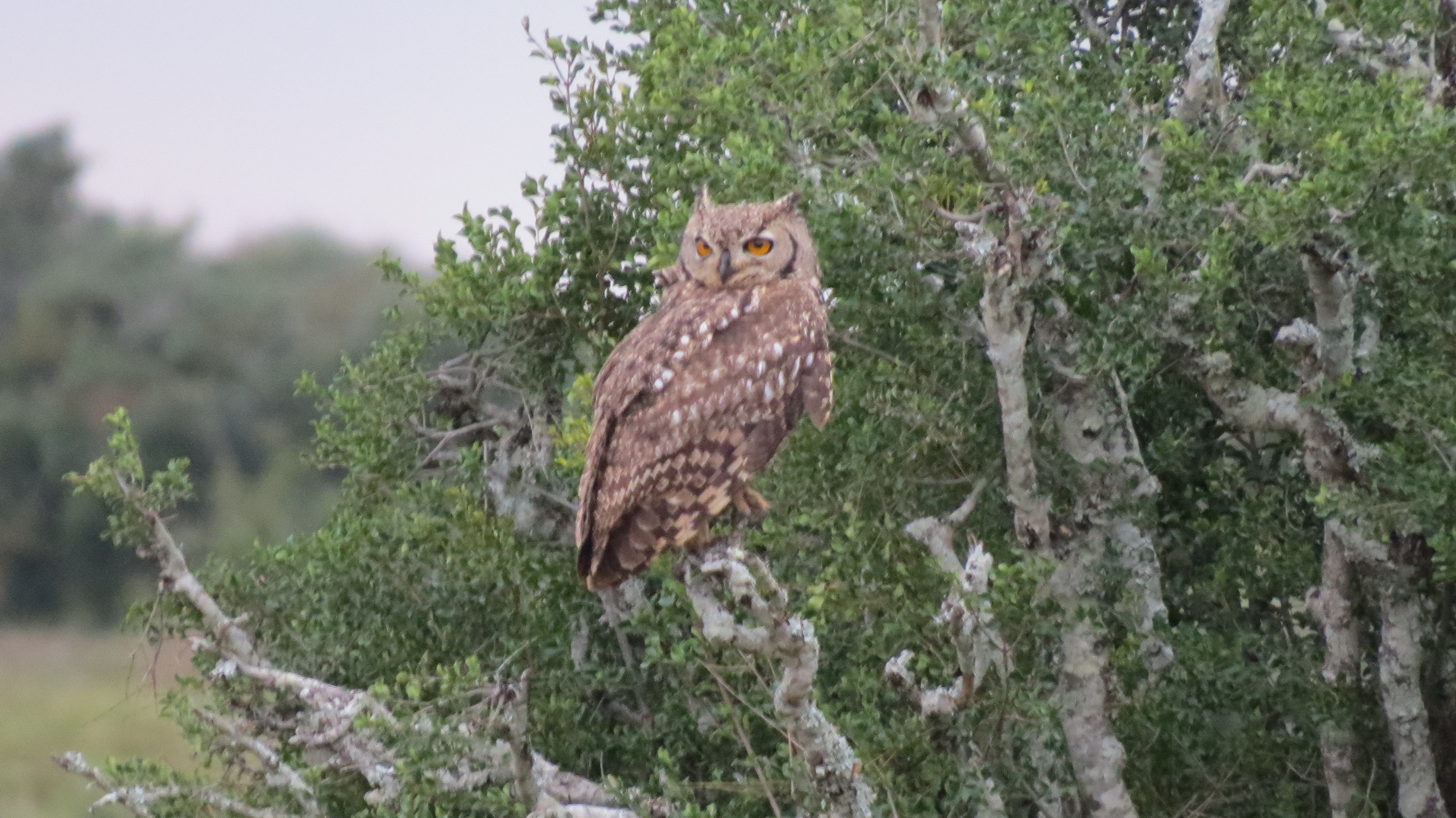
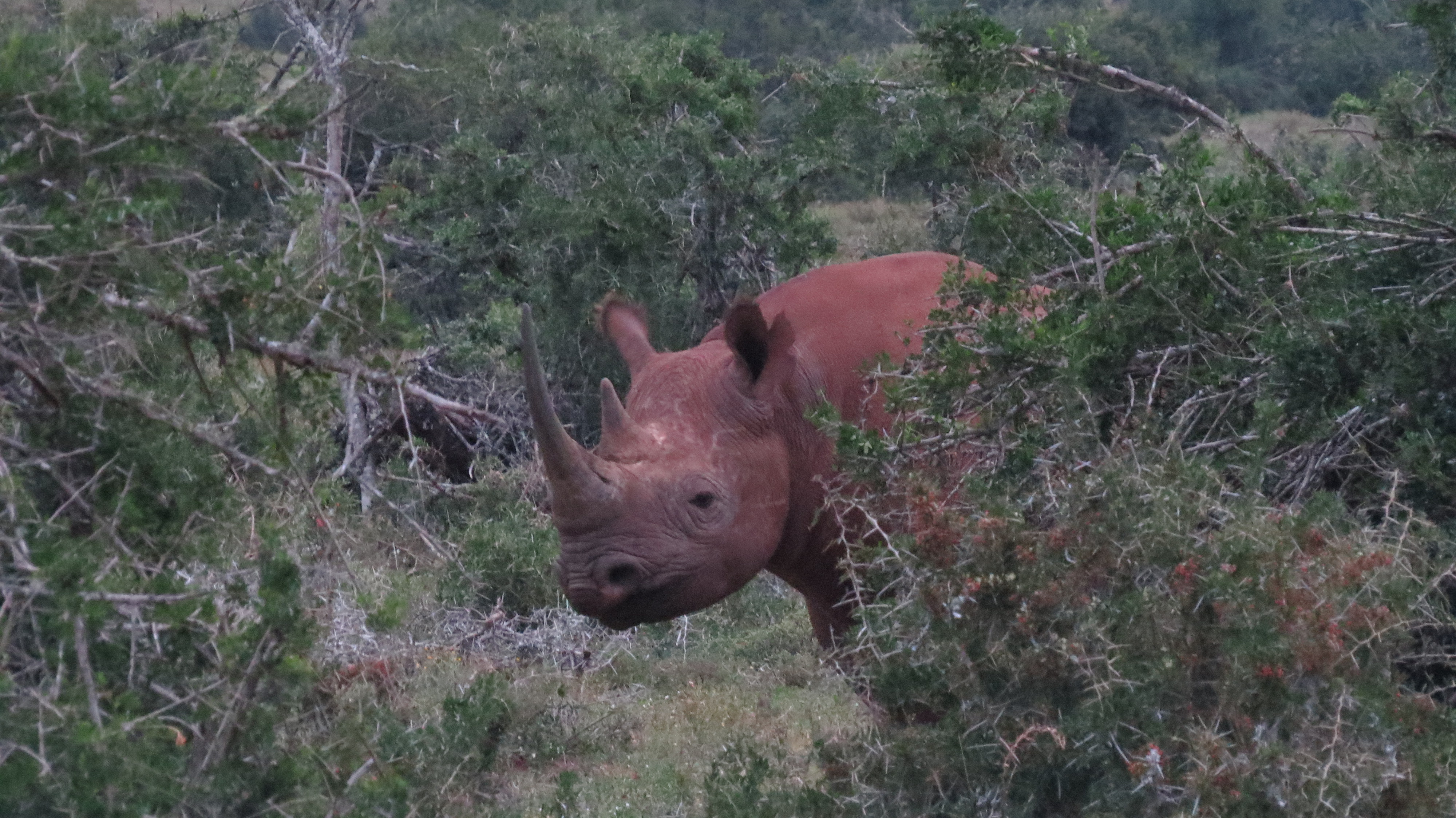
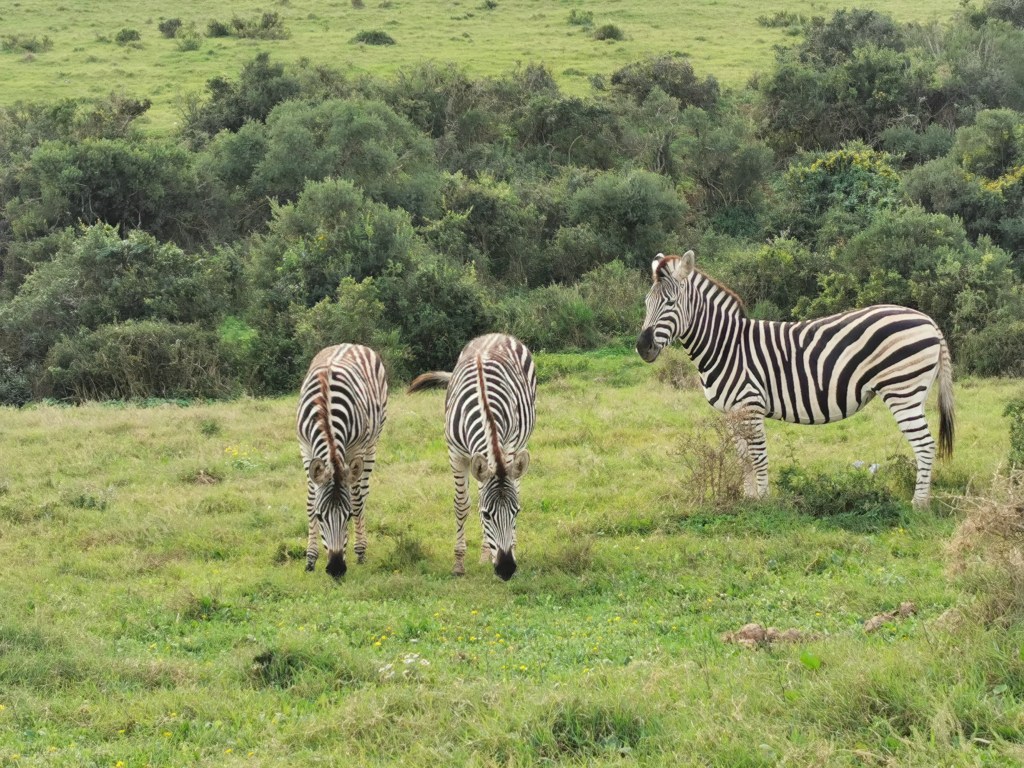
Despite our overall views of sunset and sunrise tours being a bit negative, this first tour was our most successful one of this type. There was only four of us on the tour with the driver, so we could use one of the smaller vehicles, and whilst the light was still good (not great due to the heavy cloud cover) we were lucky enough to spot warthogs, a yellow mongoose, a couple of Spotted Eagle Owls and multiple types of antelope. Then, as the light was leaving us, we came across a couple of black rhinos. This was an amazing experience and, despite the black rhino’s tendency to charge, we were close enough to one of them to see it smelling the air and judging our threat. Luckily we must have passed the test as it left us alone. What we weren’t to know is that this would be the only rhinos we would see on our trip. The poaching situation in Kruger has become so bad in the last ten years that you will be lucky if you come across one.
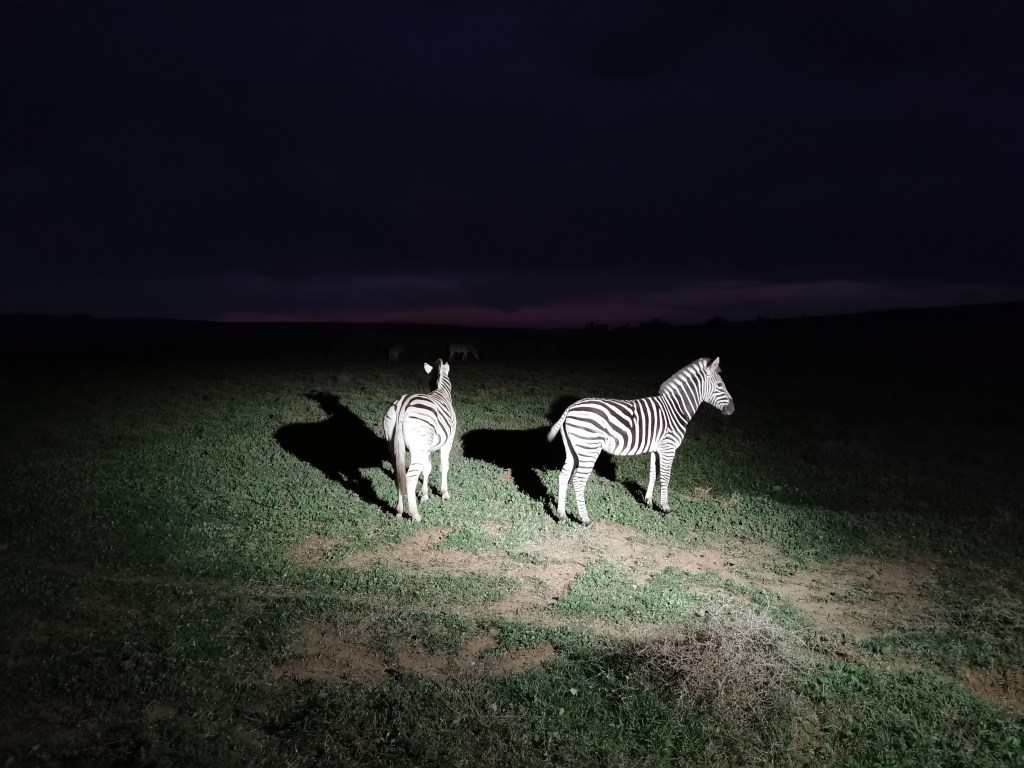
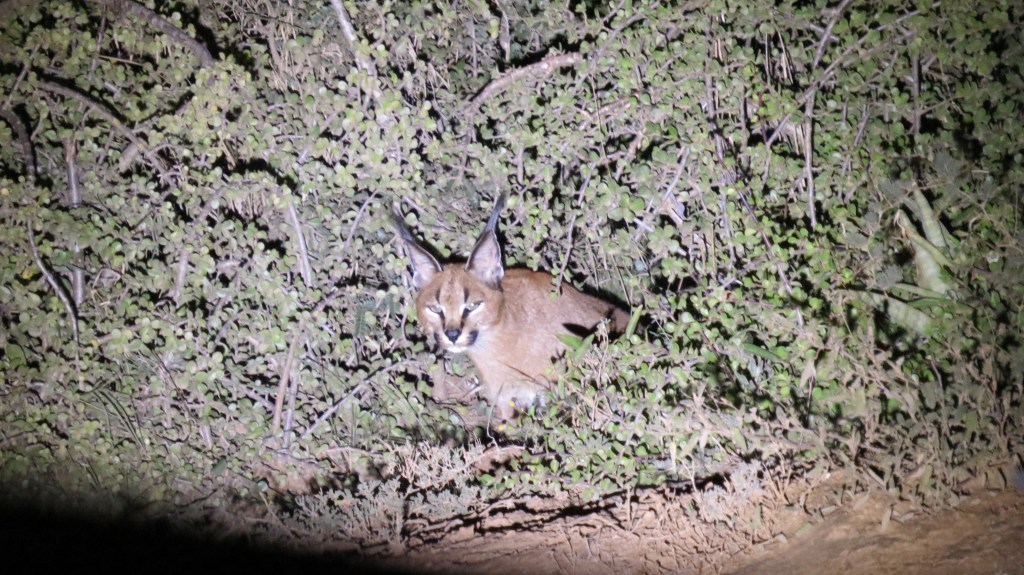
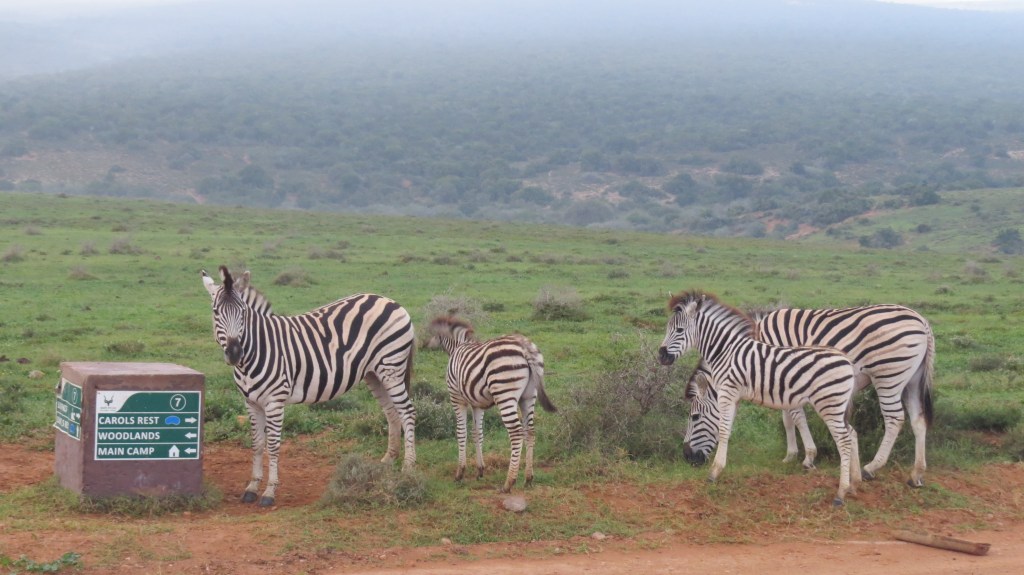
As it became dark, it became much harder to spot anything, even after turning on the spotlights at the sides of the vehicle. We did however startle some zebras that were by the side of the road and we got our first glimpse of an elephant. We were very excited at this given that it was our first one, but in hindsight, it was much better and easier seeing them during the day. Our one big success in the darkness was spotting a Caracal. This is the biggest of the ‘small cats’ and is very elusive, so we counted ourselves very fortunate. Not long afterwards we headed back to the camp, tucked into some of the snacks that had been provided with the tour, and got an early night in preparation for our sunrise tour…
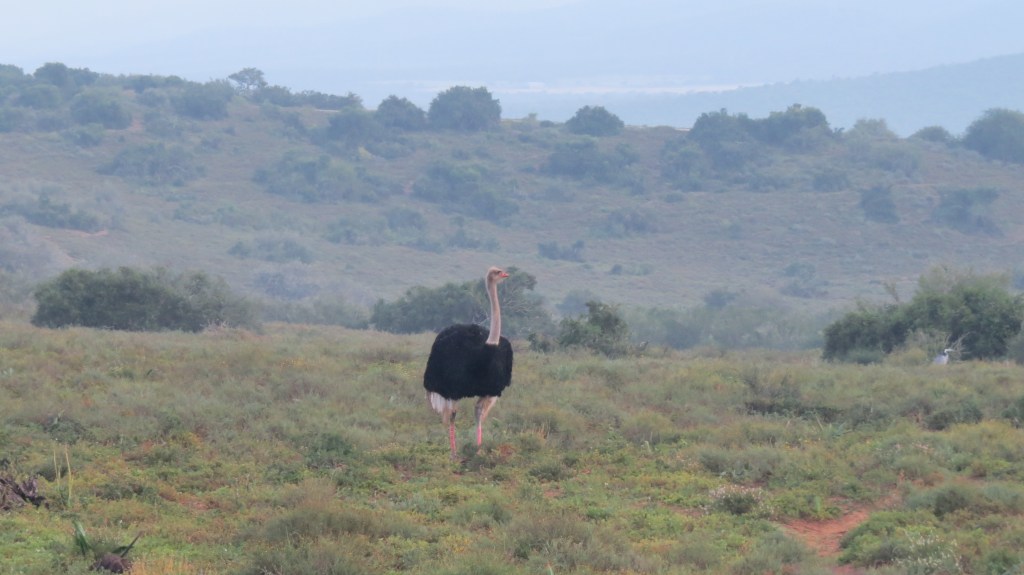
Second Day – Despite sleeping well it was still hard to get up for the sunrise tour! We strapped on our head torches and made of way to the meeting point at reception. As we were heading up the track, a female bushbuck suddenly ran in front of us, maybe ten metres away. Even though the camps are safe to walk around, it doesn’t mean that you won’t come across some wildlife, especially different types of antelope. The first part of the tour was quite anticlimactic and wasn’t helped by the heavy cloud cover which meant we didn’t even have the moon or stars to help light the surroundings. We were both very keen and were intently searching behind each bush and tree as the spotlights passed over them, but during the first hour or so we didn’t see anything apart from a few scrub hares and a couple of zebra that we woke up with our spotlights. Our concentration was waning at this point when a spotted hyena materialised out of the darkness, ran round the back of our truck and then melted back into the shadows. It just went to show that you can drive around for hours not seeing much, but you never know what’s coming. When the light came it was better, and we saw our first buffalo and ostrich, so we were able to put a tick next to a few new animals. We also got a much better look at some black-backed jackals, which we’d seen the night before but only at a distance in the gloom.
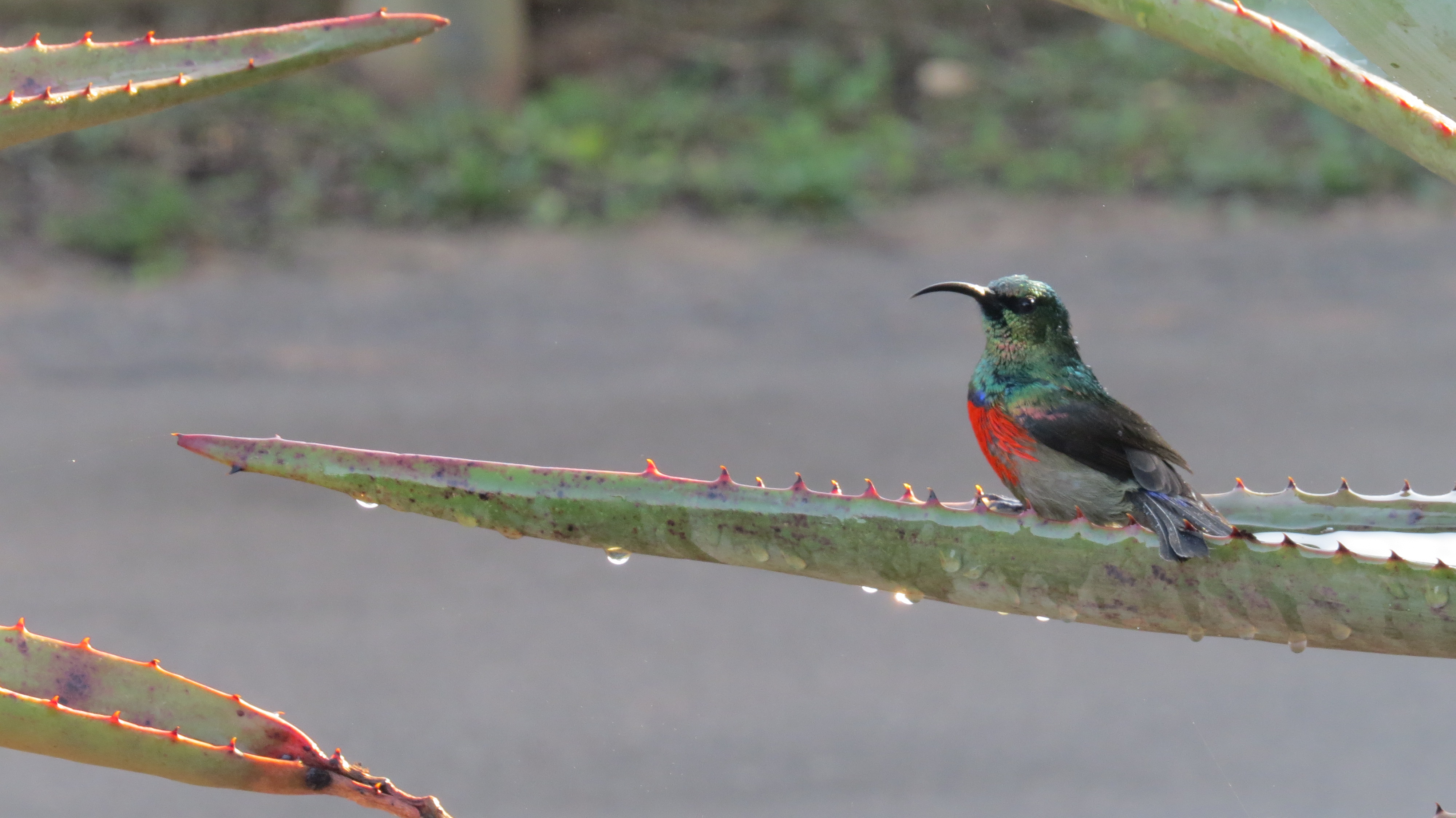
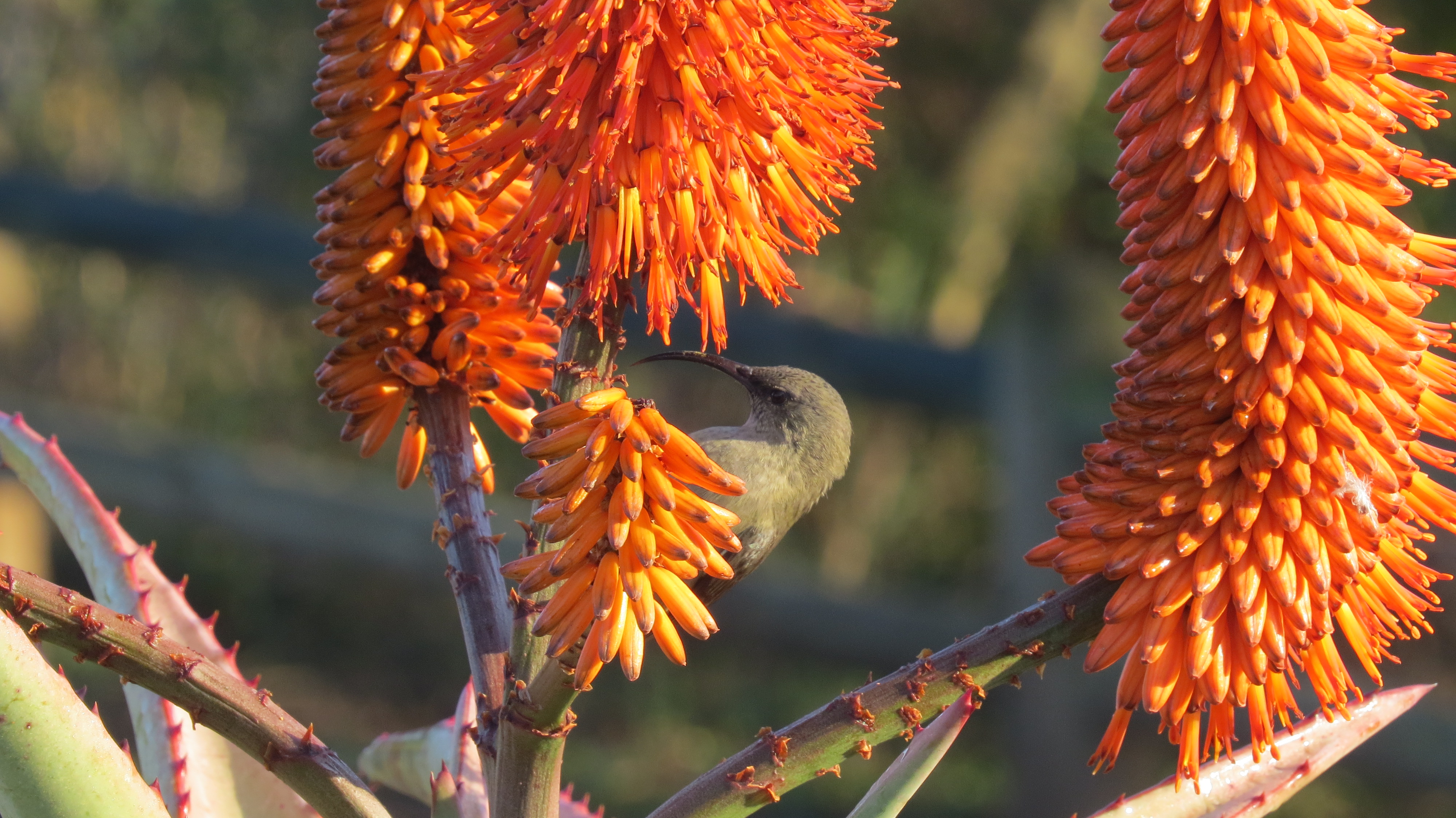
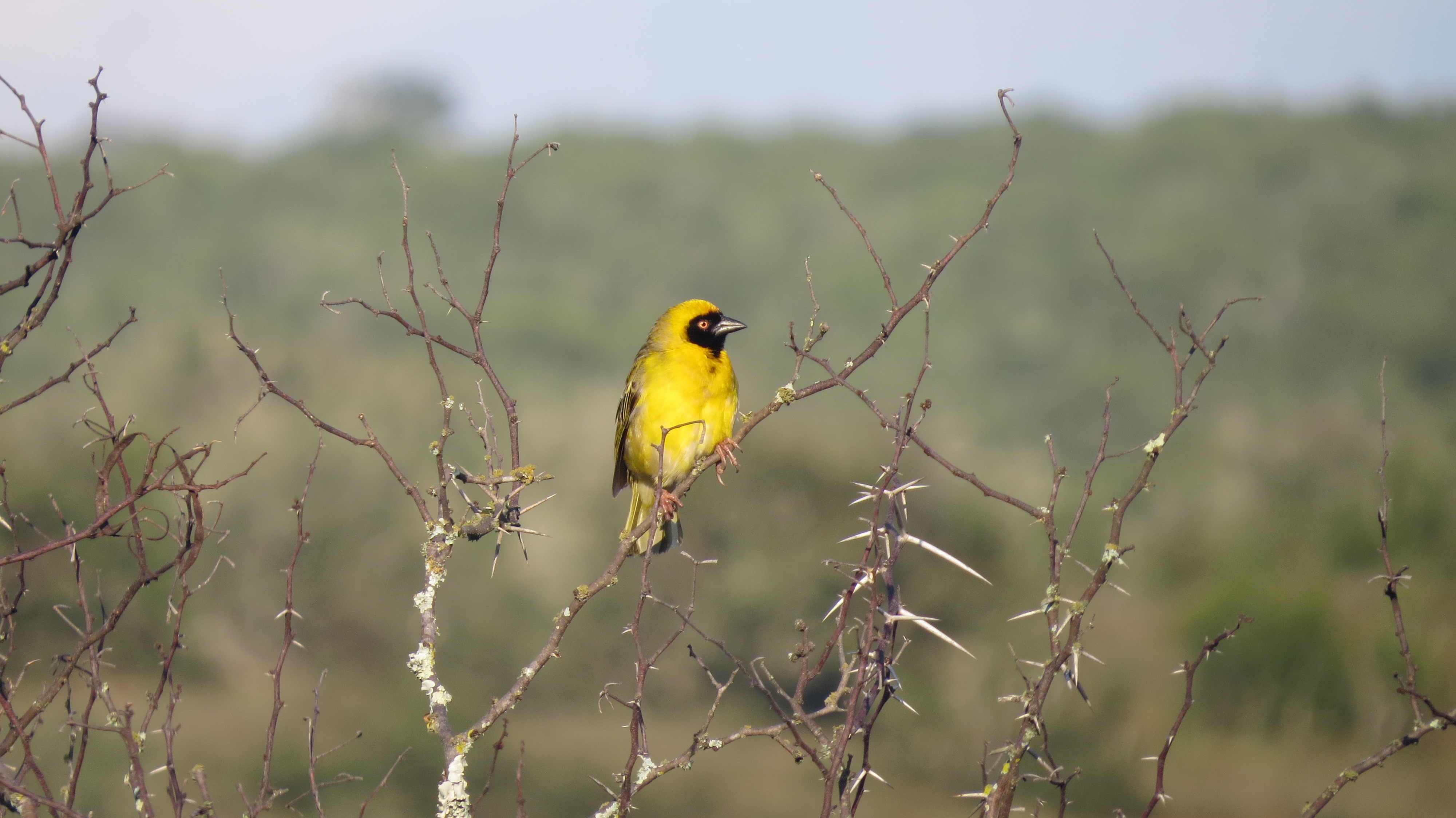
After returning to the camp we spent a bit of time at the bird hide there, where pretty yellow birds flitted about the reeds (they were some types of weaver) before Radka headed back to our chalet. I stayed a bit longer and then on my way back a male bushbuck ran across the path, and then in the decorative plants by the side of the track a beautiful greater double collared sunbird was having a bath in one of the upturned leaves. When I got back Radka was sitting on the patio watching the meerkats who had all been stood up in a row scouting the area. It was a shame to have missed it but the sunbird was a pretty good alternative!
After having breakfast, getting packed and checking out of our accommodation, it was time for our first self-drive safari. We had only planned on spending two to three hours on this, as we made our way through the park to the southern entrance, but because of how much we were enjoying it and the additional loops we did, it ended up taking double that time.
We started by driving round the Nzipondo Loop before carrying on a bit to the Gwarrie Pan and Rooidam waterholes, where there were lots of antelope having a drink. We then backtracked slightly and took the road to Zuurkop Lookout Point. Once you have left the main camp you are not allowed to exit your vehicle apart from at designated points. These places are normally walled enclosures of some kind, sometimes housing toilets or places to sit and have a snack, but there are also lookout points, which are totally open – but are deemed safer, presumably because of the specific locations or because you have a good view around yourself. It was still slightly unnerving, however, to get out and stretch your legs next to this sign…
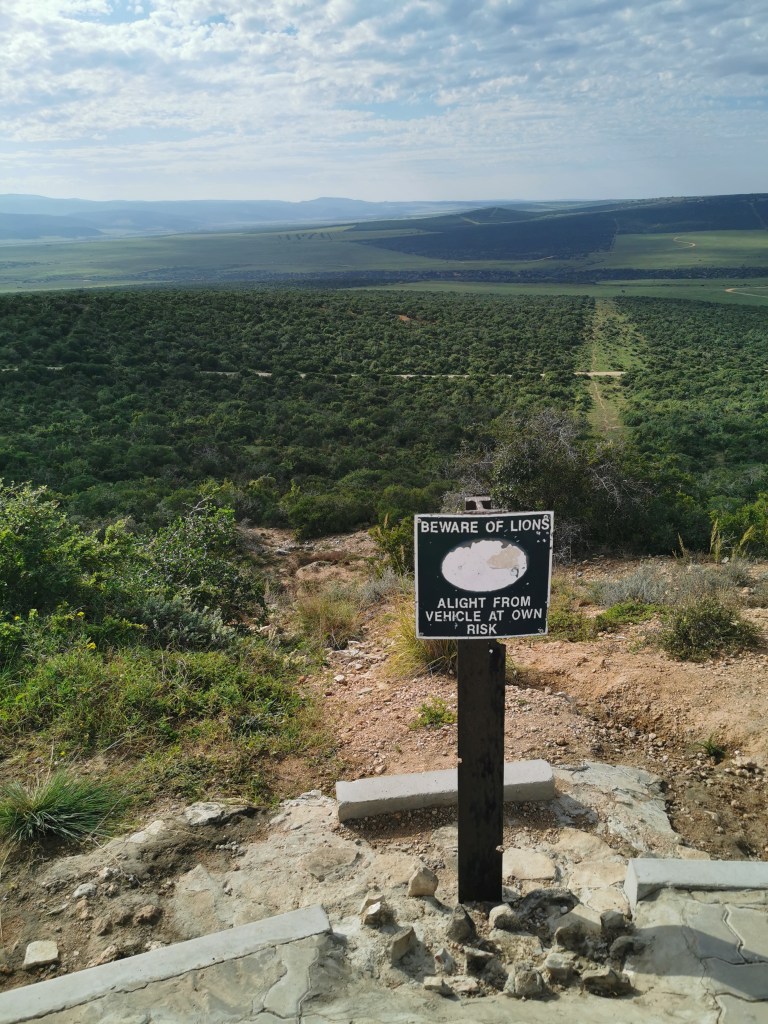
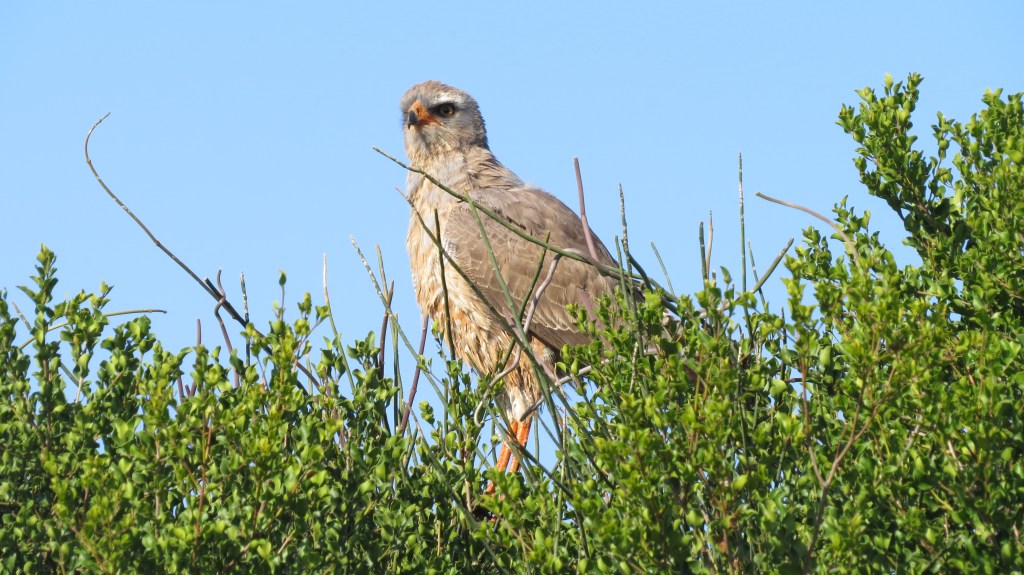
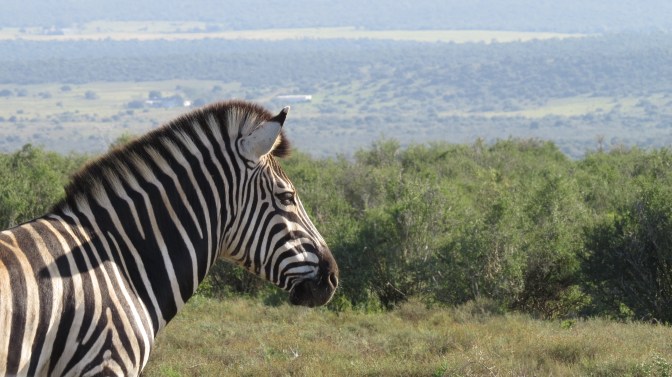
We didn’t see any lions (or anywhere in Addo Elephant Park actually) so were able to carry on to Jack’s Picnic Site, where we stopped for a break. The first part of the drive had been very pleasant and we’d spotted different types of antelope, zebras, warthogs, and some birds of prey perched in the trees scouring the surroundings.
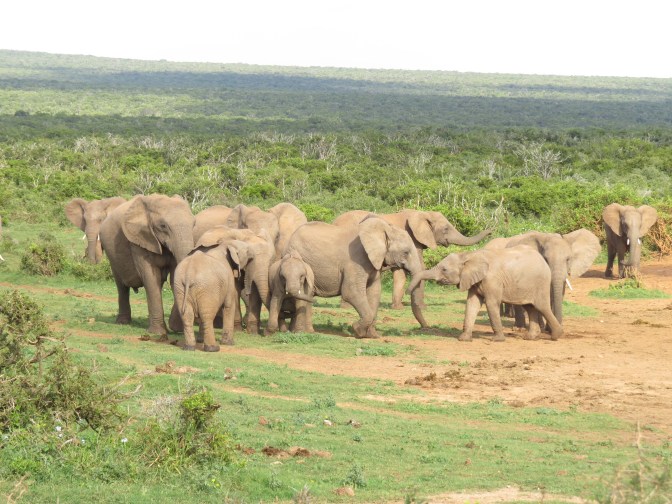
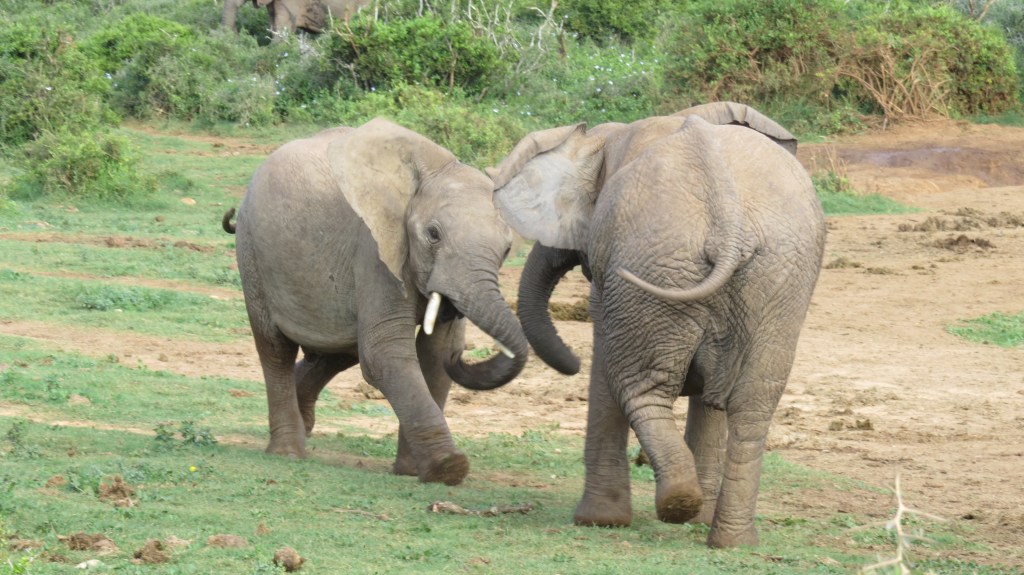
The highlight of our time in Addo was next, as we made our way to Marion Baree Waterhole. We’d been told that midday was the worst time to spot wildlife, and yet as we approached the waterhole there were already a few cars parked up. And no wonder, as there was a small herd of elephants hanging around. And we hadn’t waited more than ten minutes when another herd made its way through the trees. There were now dozens of elephants interacting and making use of the waterhole to drink or to cool down. We were so engrossed that we got a fright when a couple of large females came from another direction and walked right behind our car. It was so surreal to glance at the back mirror and have an elephant there! We stayed there for at least half an hour watching these majestic giants. It was as if we’d stumbled upon a pre-arranged meeting between friends. The young elephants were the funniest, the medium sized ones were play-fighting with each other whilst the smaller ones made do with chasing the couple of poor warthogs who were trying to access the waterhole. At one point a large male with a broken tusk came out from the trees and simply pushed his way into the water, hung around for a while, before heading off again on his own. It was almost a shame to leave but when one of the herds decided to start heading off we followed their lead and headed on south.

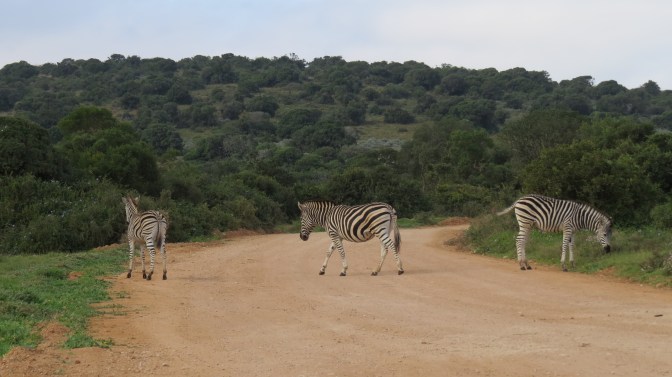
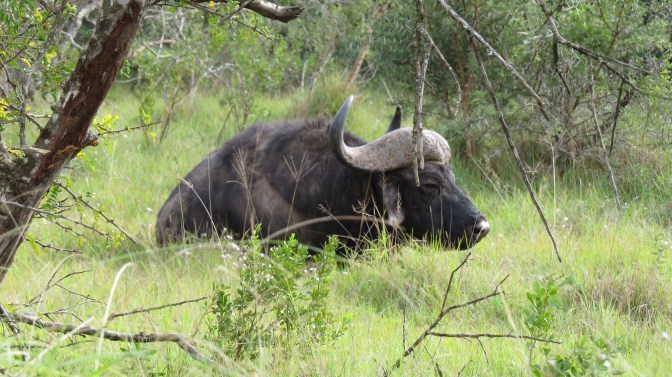
Next was the Lismore Waterhole before completing the Ngulube Loop and backtracking slightly to the Peasland Waterhole. Each of these had something to enjoy, with antelope, warthogs, zebras and elephants to be spotted amongst the bushes. It also showed that, despite how attentive you are, you’re going to miss so much. Despite them being huge, we almost missed two buffalo lying down behind a bush right next to the road. And it shouldn’t just be the larger animals you’re keeping an eye out for, it was very cool to have a dung beetle scuttling along by the side of the road. It was just a shame it wasn’t rolling one of its balls of dung.

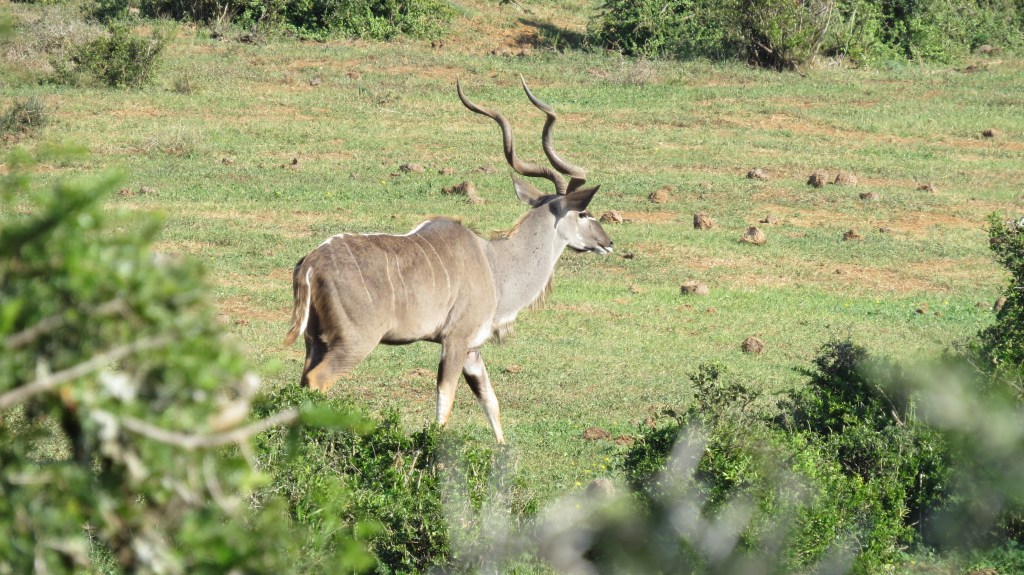
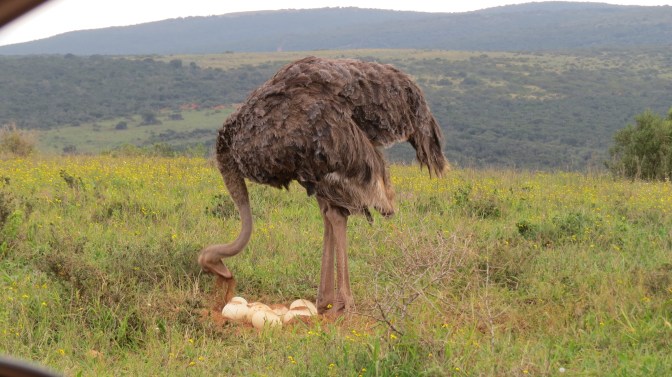
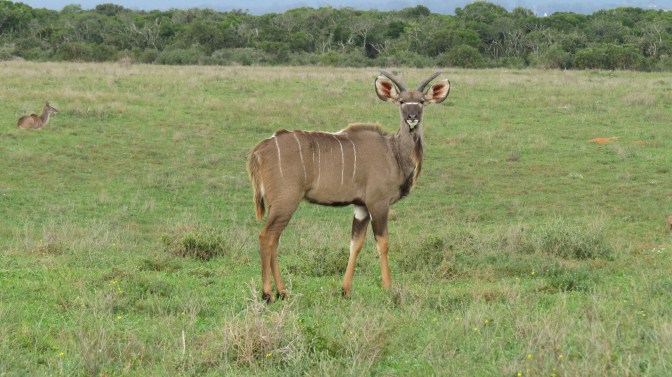
We decided to do one more loop before heading for the exit, and we’re glad we did as there was a lot to see on the Vukani Loop. First was a yellow mongoose standing on its hind legs looking around, and later on we saw two ostriches. As we got closer to the female one, it turned out she was guarding a load of eggs, with the nest being right next to the road. After a while, the male ostrich came along and took over the protective duty whilst the female went off to feed. It was very cool to watch this interaction, and yes, the eggs are massive! Further along the loop there were a load of kudus and that was our last major interaction before heading for the exit.

Addo Elephant National Park was as amazing introduction to South Africa. We thoroughly enjoyed our time here and we got some great wildlife spotting experiences. The landscape was varied, the camp and accommodation were both very nice, and the roads were good enough for self-driving safaris, despite the fact that we only had a Toyota Corolla (a normal, non-4-by-4, sedan). On the other hand, despite there being some big cats in Addo, you’ll be very lucky if you see them, so in this regards Addo can’t really compete against one of the major parks, such as Kruger. So whilst I’d definitely recommend the park, especially at the beginning of the trip, if you’ve already been to somewhere like Kruger, you might find Addo slightly lacking.
After leaving the park we still had a long drive, as we were heading to the Tsitsikamma Section of the Garden Route National Park. Given that we arrived quite late to the Storms River Mouth Restcamp, the main office was closed, but we were still able to get our keys from the guys at the entrance check-point.
Storms River Mouth
There are quite a lot of options regarding accommodation in Tsitsikamma, and certainly cheaper ones in the village, but we decided to stay at the National Park accommodation. This was mainly because of its proximity to the ocean and it being the starting point for a couple of walks that we wanted to do in the area. Despite the extra cost, we were very happy with our Oceanette accommodation. The studio had a small kitchen, along with a seating area and a patio that looked straight out onto the ocean. Whilst sitting there in the mornings and evenings we were lucky enough to see some whales out to sea, so you can’t really ask for more than that can you!
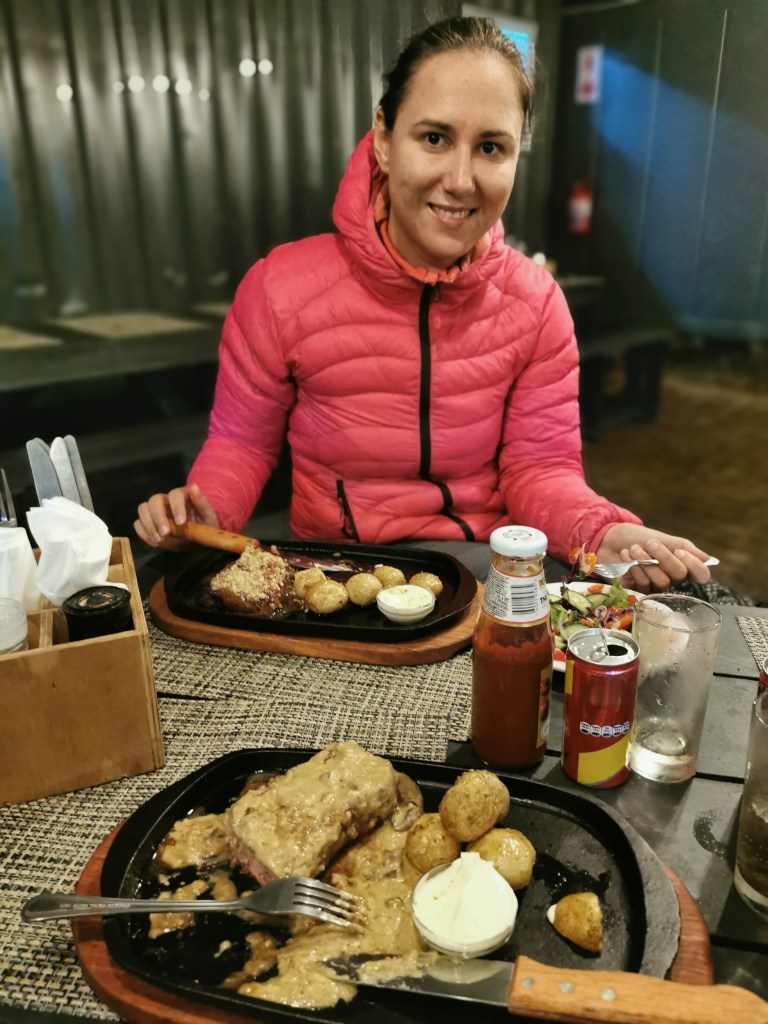
Due to arriving quite late on our first evening we didn’t really want to cook, so we decided to try out the restaurant. The whole site was quite spread out along the coast and given that we were at one end and the restaurant was at the other, it meant that it would have been a couple of kilometres walk. Given the time and how hungry we were, we decided to be very lazy and drive within the site to the restaurant. I paid for my laziness, however, as the restaurant was under reconstruction and the replacement was an outdoor space between some large metals shipping containers. Due to driving I hadn’t thought to bring a coat, so I sat there freezing waiting for the food. Luckily the meal was worth it. The restaurant specialises in steaks, so we each got one with different sauces and they were both delicious! So we’d definitely recommend having a meal there if you’re staying at the site. Afterwards we headed back and fell asleep to the sound of the waves crashing against the shore.
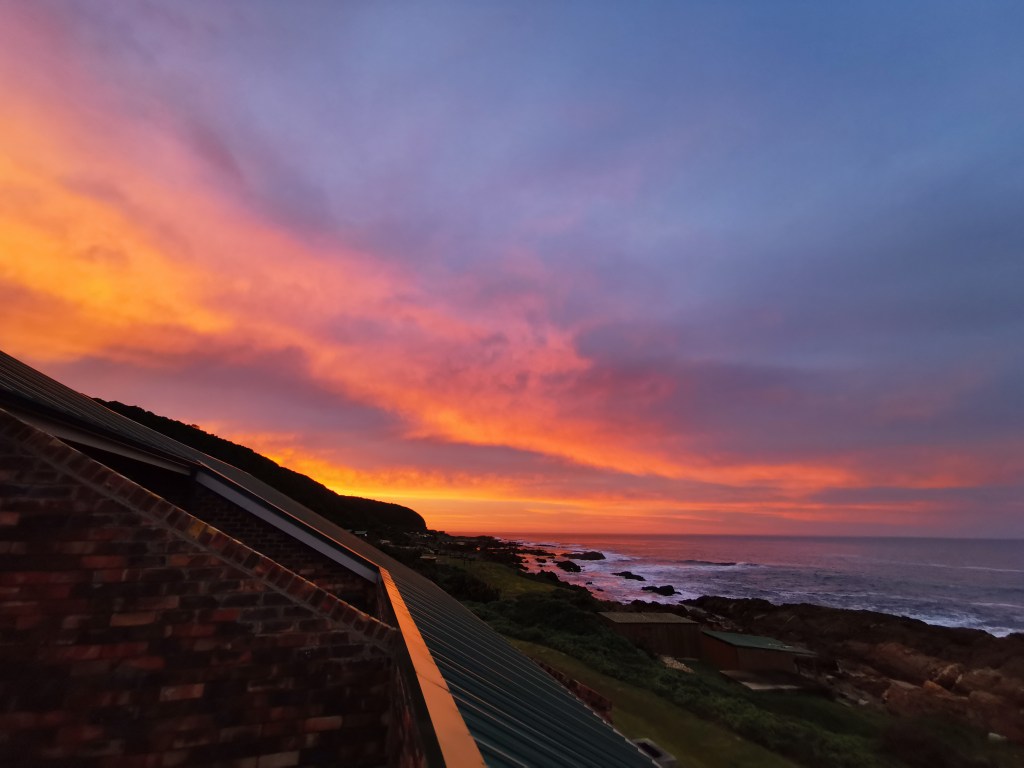
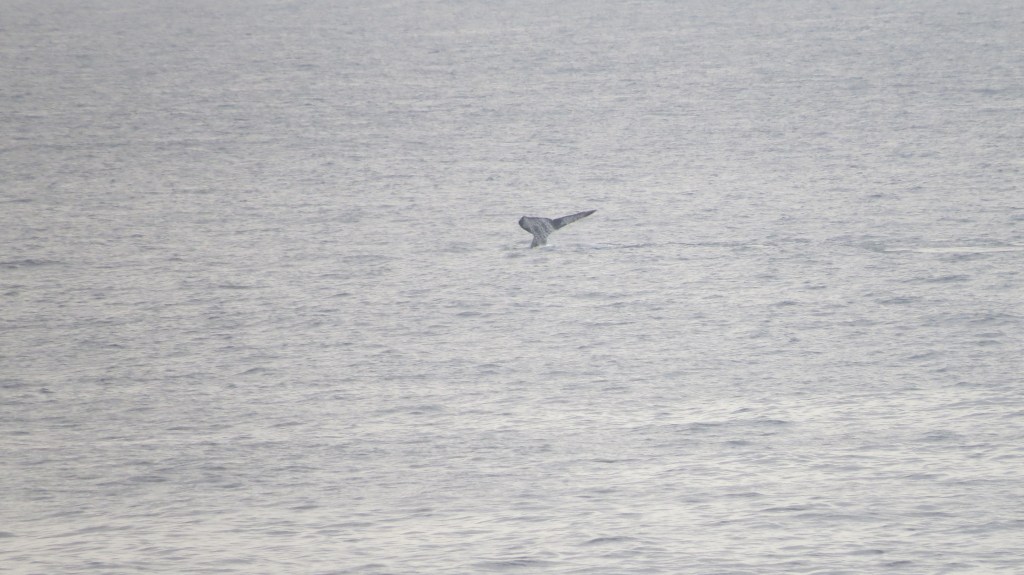
We woke in time for a beautiful sunrise. Despite the orientation of the shore meaning you don’t see the actual Sun rising from the ocean, it doesn’t mean you still can’t get beautiful colours. We then had breakfast on the patio and got our first sightings of the funny rock hyraxes (or ‘dassies‘, as they’re known locally) scampering on the rocks, before also spotting some whales out to sea. It was too far to say for sure which type they were, but we think the were humpbacks.
It was then time for our first hike of the trip. There were three walks starting in Storms River Mouth that we fancied trying – the Blue Druiker Trail, the Waterfall Trail and the Mouth Trail. There are other walks in the area, and a nice summary can be found on this website. Due to only staying for two nights, we decided to combine the first two trails. This meant joining halfway along the walk to the waterfall, but given that the Waterfall Trail is a ‘there and back again’ hike, we didn’t feel that we’d be missing out as we’d see the scenery on the return journey.
The Blue Druiker and Waterfall Trails
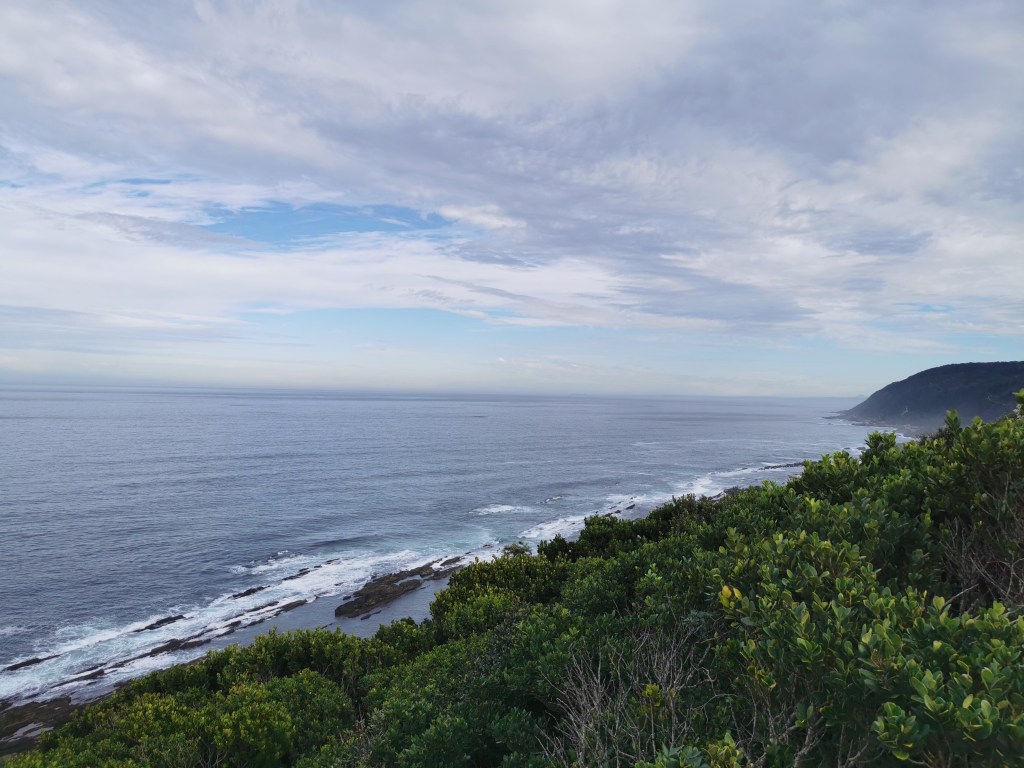
The Blue Druiker Trail starts by the road near the shop and restaurant, and follows steps up onto the cliff. At this stage there is a nice viewpoint looking up and down the coast. We stayed there for a couple of minutes before heading into the trees.
The trail then winds its way through the forest. It is named after the elusive, small antelope that lives in the area, but we were not fortunate enough to spot one. What we did see were plenty of flashes of different birds, and after a while we went past a pretty little waterfall.
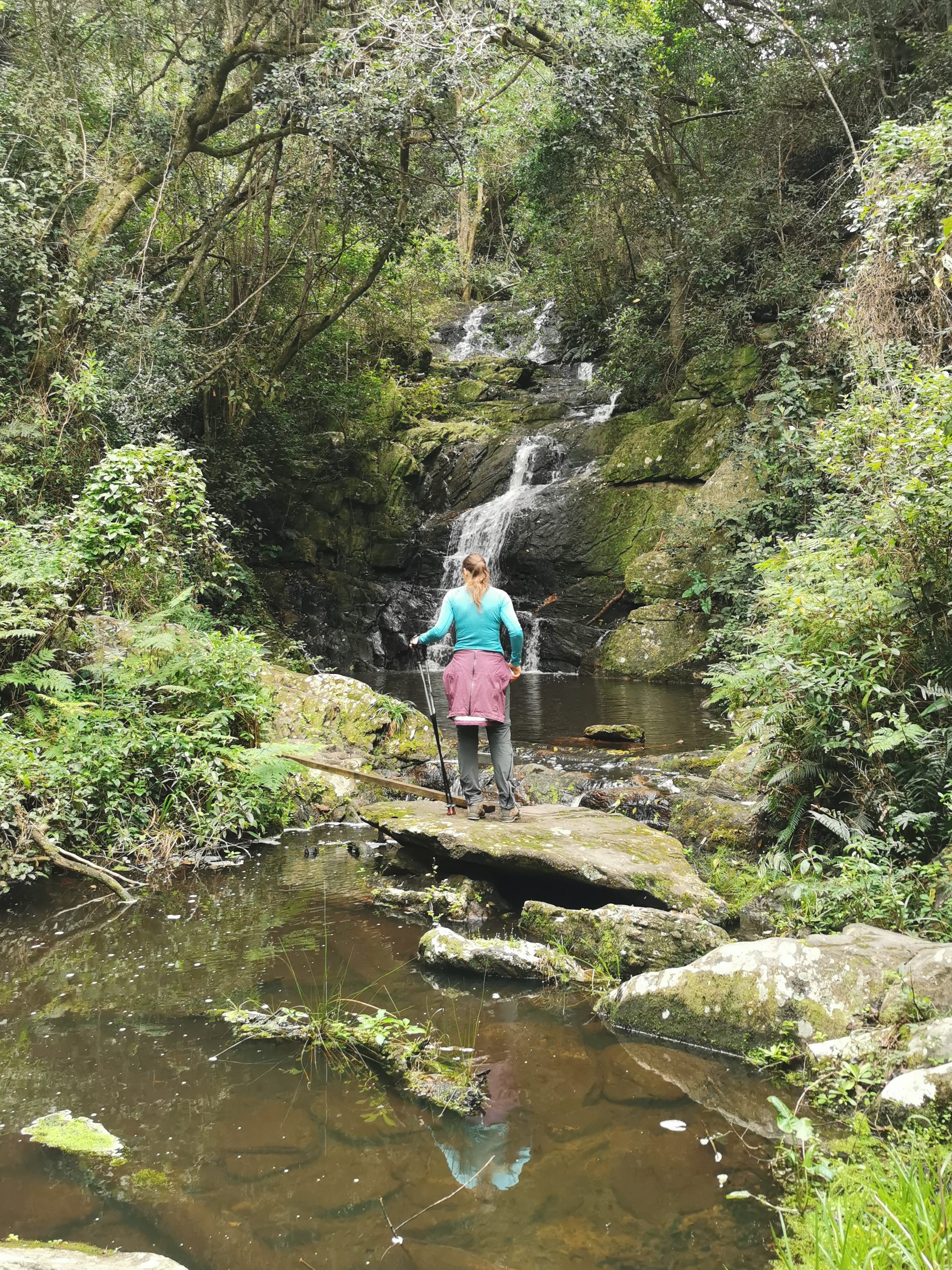
Whilst some of the older trees are impressive and the greenery can make the walk quite atmospheric at times, it is also quite monotonous given the lack of any views around. So, by the time we reached the path to take us to the Waterfall Trail, we were quite happy to be leaving the forest behind.
The Waterfall Trail is the first few kilometres of the famous Otter Trail, and it leads from the Storms River Mouth Rest Camp and straight along the shore until you reach the famous Tsitsikamma Waterfall. This marks the furthest you can go along the path without having a permit to hike the Otter Trail. We joined about half-way along the Waterfall Trail and we were immediately required to start clambering over boulders and make our way around little bays in the shore. It was harder than we had expected, both physically and in terms of finding the path, but it was also very picturesque and we enjoyed the scrambling after the drudgery of the forest.
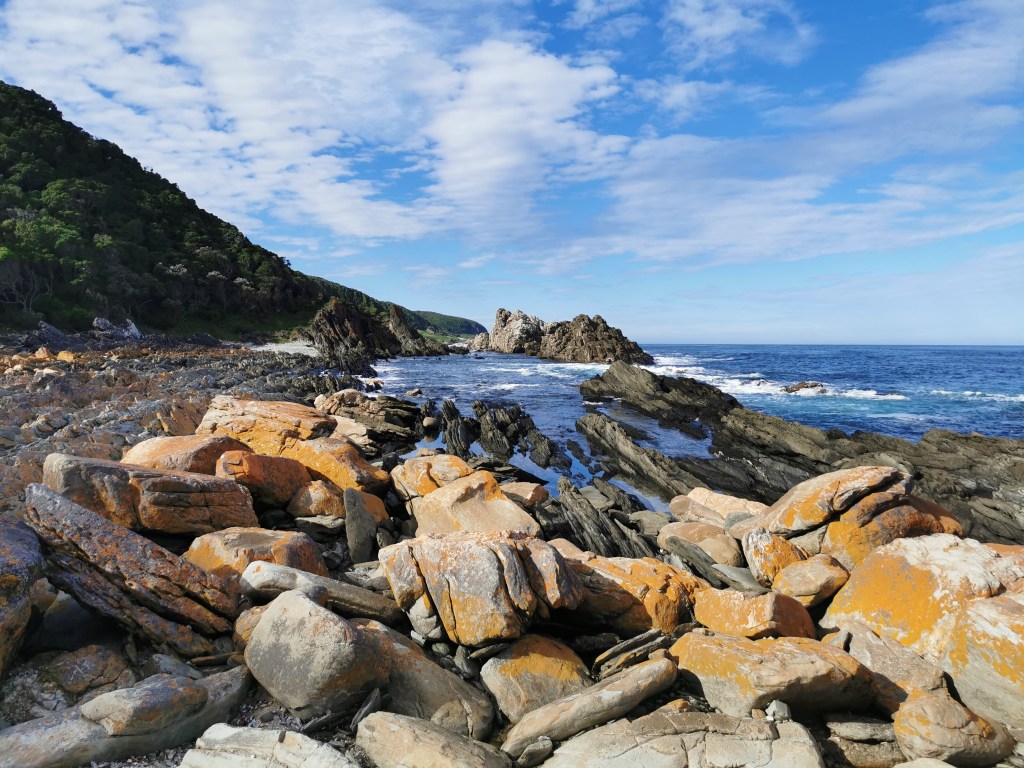
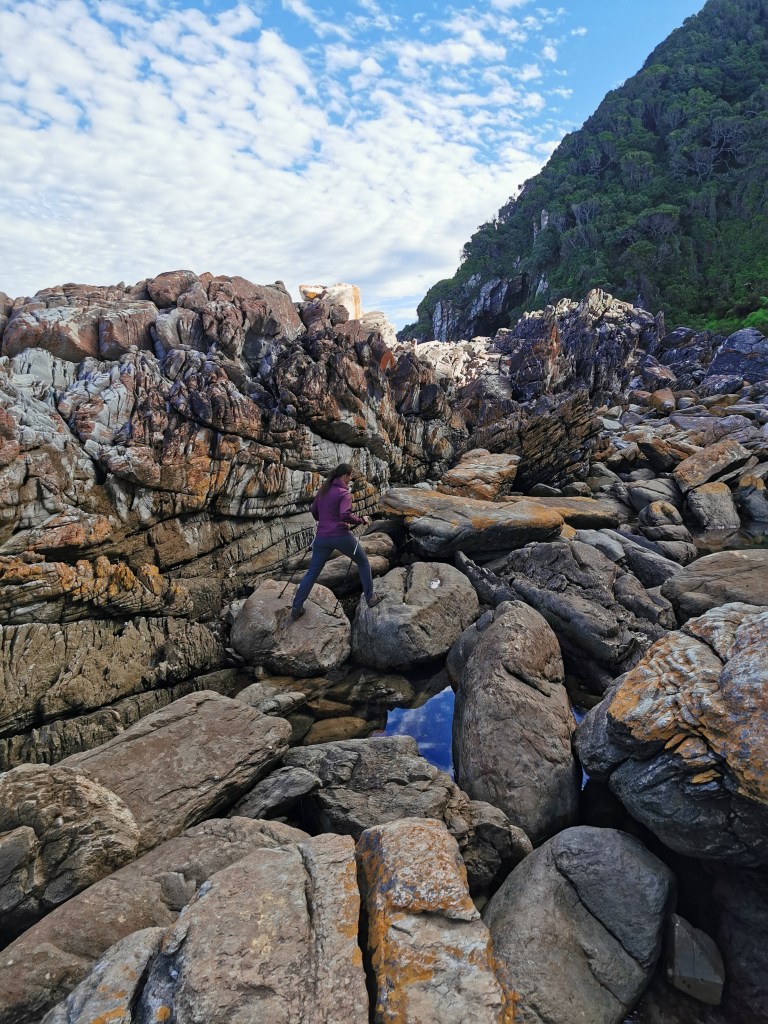
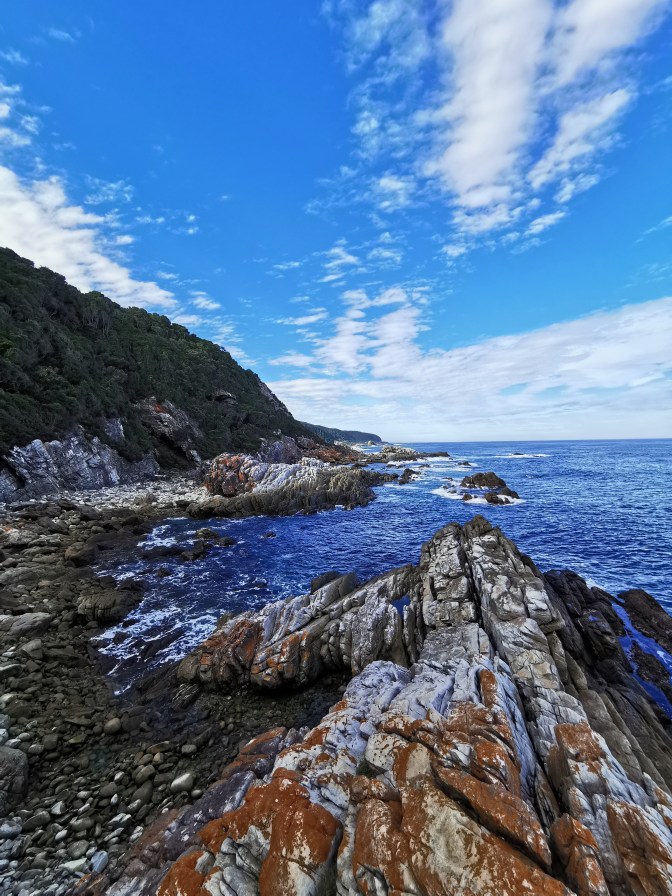
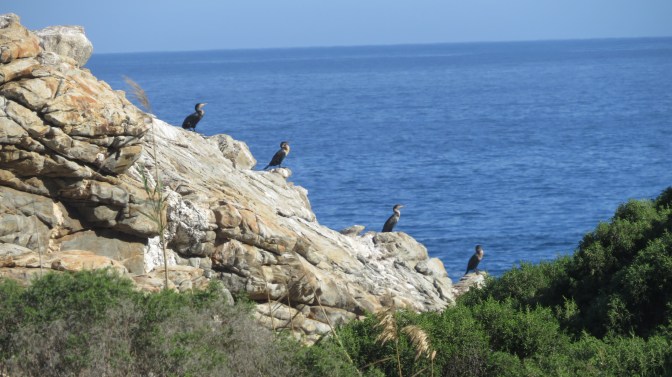
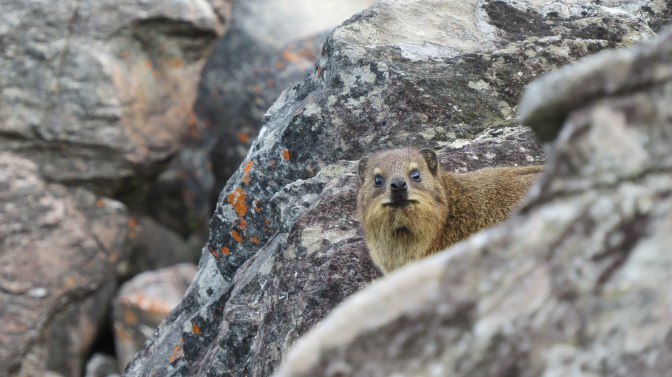
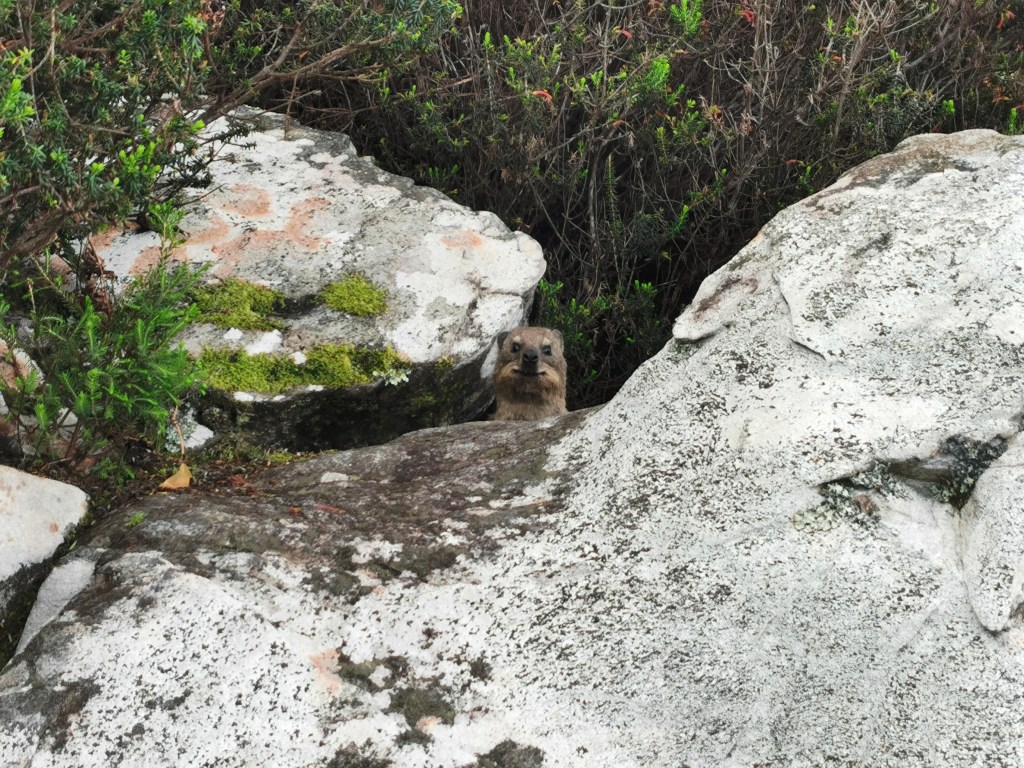
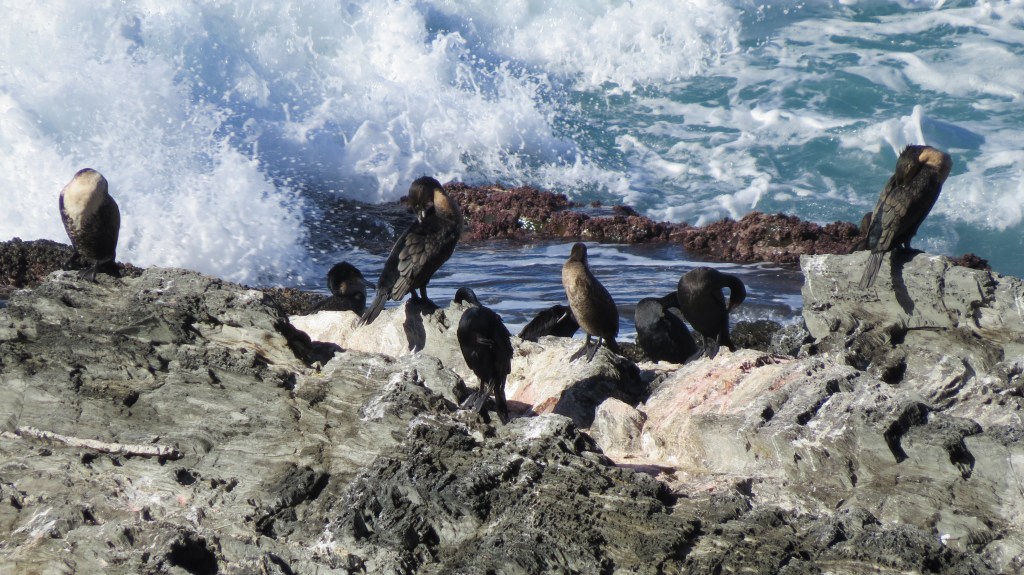
We also got to enjoy the wildlife along the shore, with cormorants lining the rocks and the funny rock hyraxes seemingly popping up from no-where at one stage of the walk. At one point I got the feeling I was being watched and turned around to see a funny face poking out over a rock just a couple of metres away. Apparently they’re actually quite grumpy and can bite, but I just found them hilarious!
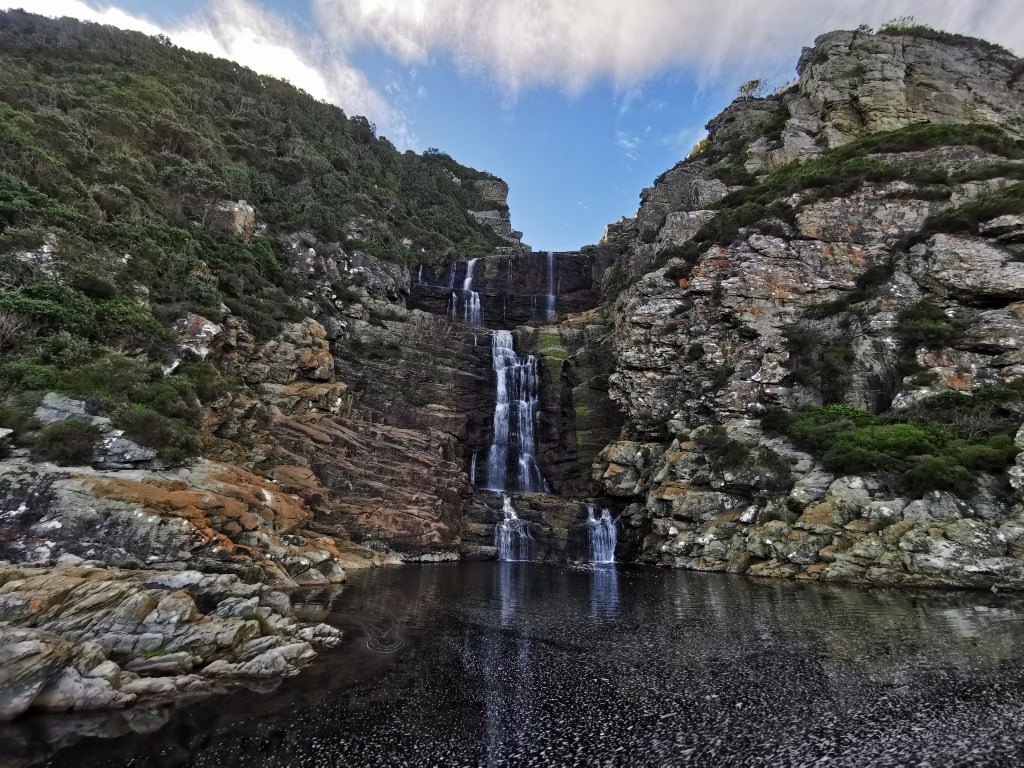
It actually took us quite a while to get to the waterfall, despite the distance not being that great but it was certainly worth the effort once we got there. The water plummeted from the top of the cliff into a pool, which then led directly into the sea. It was a very beautiful spot. Given that we’d come during winter and the time of the day, there was no light falling directly onto the waterfall, but that barely detracted from the views.
We stayed for as long as we could before having to leave to make sure we were back before dark. Although we could probably have stayed longer, a combination of being more comfortable climbing over the rocks and knowing where the trail went meant that we made much better time on the way back. So we had plenty of time to cook and then relax on our patio. It had been a lovely day. If you fancy seeing a Relive video of our route, please click here.
The Mouth Trail
The following morning, we enjoyed our patio until we had to pack up and check out of our accommodation. After returning our key to the main office we came back to the area with the restaurant, as this is where the Mouth Trail begins. Although, due to the reconstruction we struggled to find the actual start point. In the end, it is actually quite easy to get to – you just skirt the buildings until you get to a little sandy beach. This is also the point where they rent out kayaks and organise trips on the ocean.
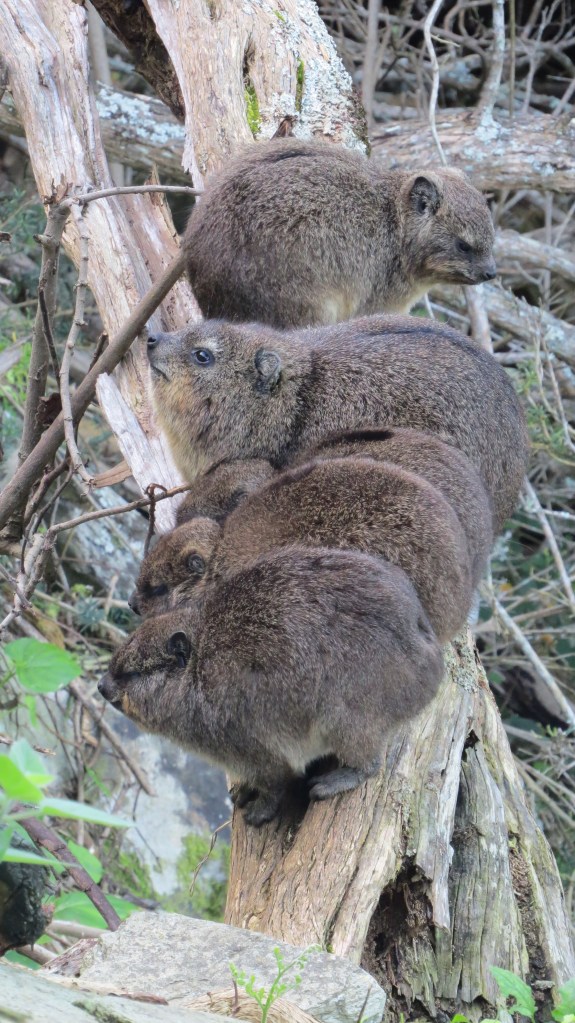
From here, you follow a well made pathway up into the trees until you get to a pleasant little waterfall. You then keep on following the wooden boardwalk. It wasn’t long before we came across another group of rock hyraxes congregated right next to the path.
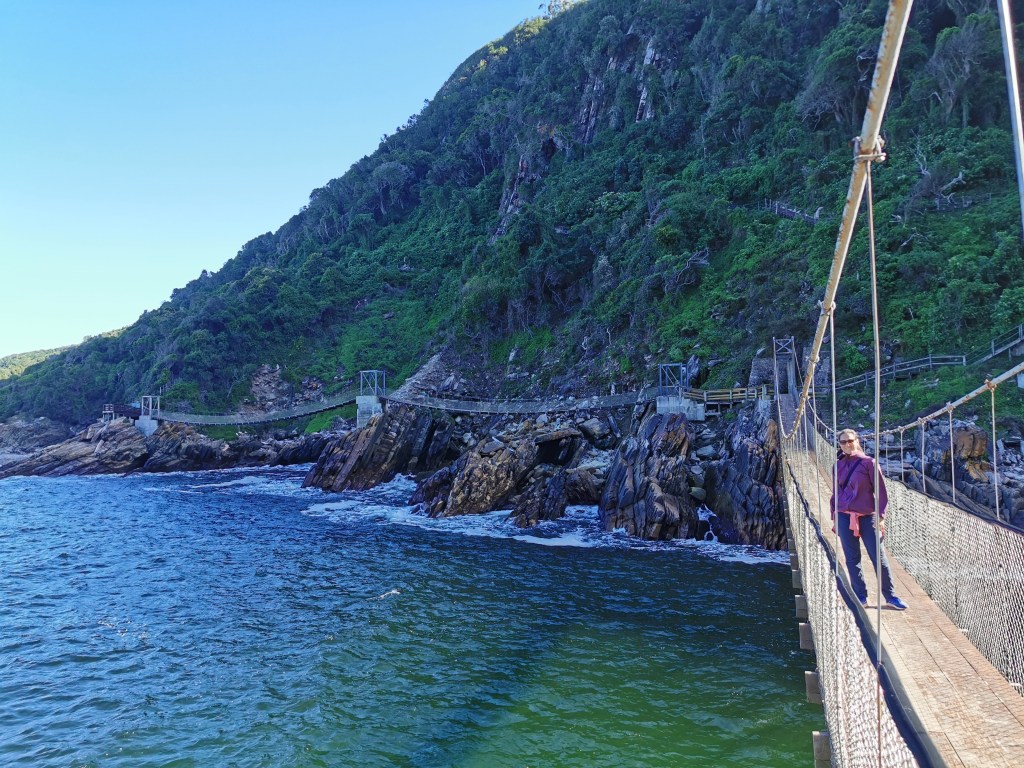
It wasn’t far past this point when we got our first real view of the bridges spanning the Storms River mouth. It was very picturesque, and we hadn’t realised that there would be three separate bridges.

We passed over the bridges, enjoying the view of the canyon that the river comes through. At this point we saw a group of kayakers just starting their journey up the river and into the canyon. Due to the large swells in the ocean we hadn’t really considered kayaking at all, but with hindsight it could have been a really nice activity, as the surroundings were stunning. But we didn’t have time to change our plans at that point, so we carried on over the three bridges. Once you’re over the other side, you can make your way up to the top of hill overlooking the canyon, but we didn’t have the time to do the whole walk. So, we just walked to the first viewpoint before heading back the way we’d come. There was a point after the first bridge where you can go a slightly different way back and make a bit of a loop of the central part of the trail, and we’re glad we did as you get nice views over the bridges that we hadn’t seen on the way there.

To see our route using the Relive app, please click here.
After getting back to our car it was time to head off and leave the Tsitsikamma section of the Garden Route National Park. We had a really nice time there and would recommend anyone to visit!
Knysna
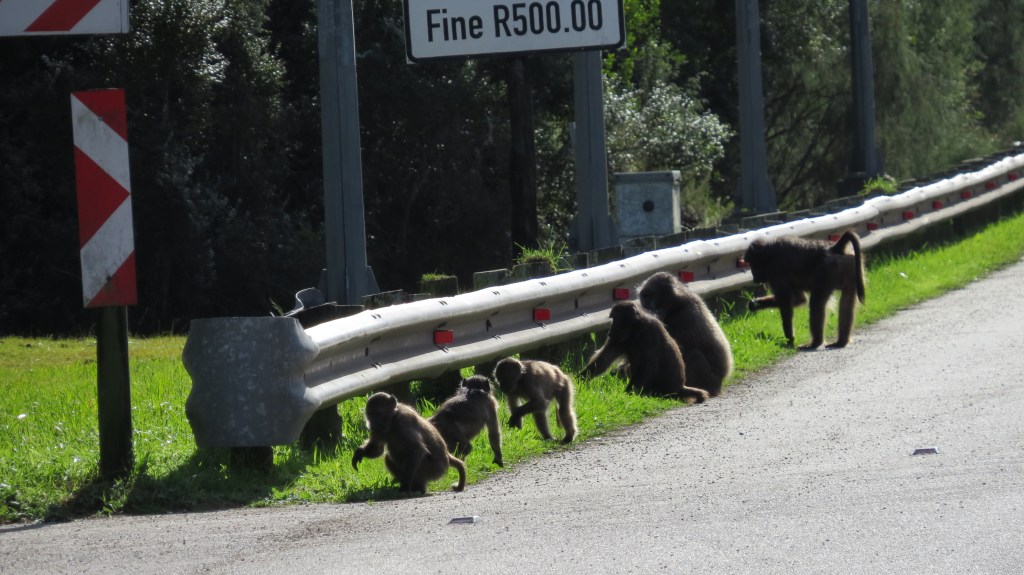
Our next stop was a few hours drive down Route 2 in Knysna. The drive included getting stuck behind a tarmac-laying machine and then having to stop for a troop of baboons crossing the road. But we eventually arrived to our accommodation just off the waterfront in Knysna, only to find that we couldn’t access our apartment. Luckily, a kind security guard helped us contact the owners and we were able to sort the situation.
Sunset Cruise on Knysna Lagoon
The main reason that we were a bit panicky about accessing our accommodation was that the traffic jams and road works had made us pushed for time regarding attending the ‘Sunset Cruise’ we’d booked for the evening. The boat set off from the neighbouring Thesen Island but luckily we were able to get a taxi and made it in time. However, in the rush I managed to forget my sunglasses, so I ended up having to buy the cheapest pair I could find (still pricey) from one of the expensive, fancy shops that are dotted around the main square of the island.
Shockingly, we were the only passengers on the cruise! This meant that we got to have a good chat with the captain about everything from him crashing the boat on his first day on the job to racial inequality in South Africa. He was a very interesting individual, but the constant dialogue did mean the trip wasn’t quite as relaxing as it could have been. We still thoroughly enjoyed it though. We slowly moved around Thesen Island and skirted the western tip of Leisure Island as we made our way towards ‘The Heads’. On our western side was a nature reserve on one of the arms of the lagoon (I say lagoon but apparently it is actually an estuary – something to do with water flow that I didn’t quite catch…). This nature reserve had been established to protect the area from development so the only houses on the area belonged to people who were already living there when the nature reserve was established. That is apart from one house. One communications CEO had persuaded the powers that be to let him build a house there if he provided high-speed internet to the surrounding area. However, there were multiple regulations attached towards the building of the house – and he ended up breaking every one of them. He plonked his overly-large house right on top of the hill, so that it could be seen by everyone. Apparently there is still a lot of anger and law-suits related to this.
The area with The Heads was very picturesque, and it was here that we stopped the boat so that we could both try oysters for the first time. Knysna is famous for oysters. and even has an annual festival in their honour, and yet it now no longer has any active oyster farms in its waters! The multiple farms that had been there had been found to be too environmentally unfriendly, so had closed down over the years. So the oysters we tried had been grown a little bit down the coast but kept fresh in Knysna’s waters. The captain showed us how to open them up and then drowned them in lemon juice before handing them to us to try. We both stood next to the rail in case we had to throw them straight back up but luckily nothing so extreme happened. Radka was not at all keen, whilst I couldn’t really taste anything beyond the lemon juice. Whilst the price of the cruise included three oysters per person, we were happy to stop after the first. But we weren’t so coy about drinking the wine on offer…

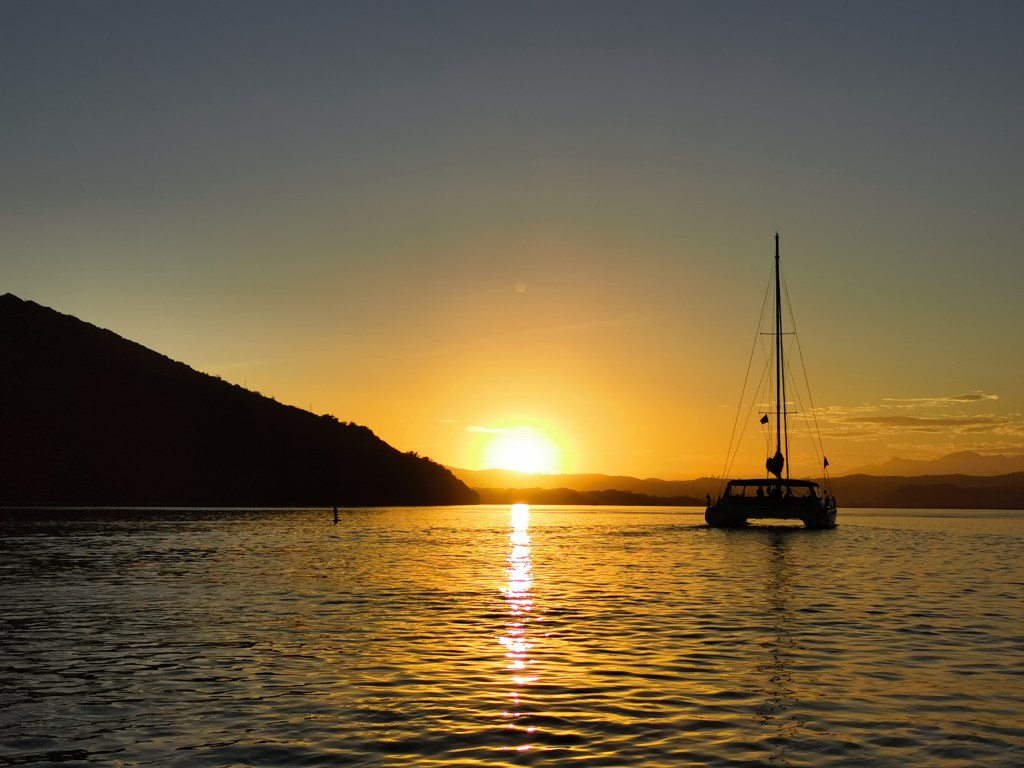
As we turned around and headed back the sun was starting to set and with a glass of wine in hand, it really was an idyllic setting. We hadn’t been sure what to expect from a ‘sunset cruise with wine and oysters’ as it sounded pretty pretentious, but we ended up having a really nice time and would definitely recommend it if you’re ever in Knysna.
Dinner at Freshline Fisheries
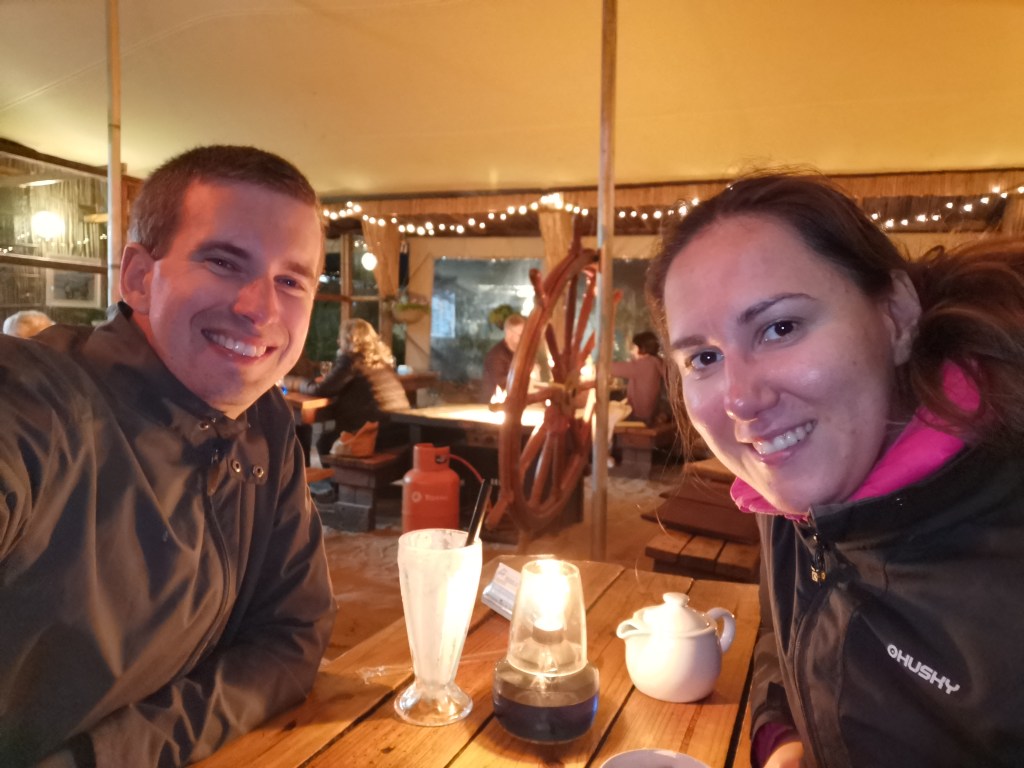
Given that our accommodation was only basically two main, touristy streets away from where the boat docked, and after being assured of the routes relative safety by the captain, we decided to walk back rather than take a taxi. Part of the reason was that we would pass another of the captain’s recommendations – Freshline Fisheries. As we approached where it was supposed to be we were initially a bit flummoxed until we realised that it was around the back of a building in a large industrial carpark. We weren’t convinced as we looked upon the large marquee-like structure but as we ventured in our fears were allayed by the pleasant decor and the warm feeling provided by the lights and lanterns. The staff were very friendly and the fish and chips (there were other options available) were delicious. We also liked how they didn’t have a liquor license but seemed to turn a blind eye to customers who sneaked their own in. There was one old couple who brazenly took out a couple of wine glasses from their bag followed by a large bottle of red and happily sat chatting and drinking (and eating) until at least when we left, but probably much later into the night. So, if you’re looking for somewhere to eat in Knysna, we’d definitely recommend this place and please don’t be put off by the view from outside!
Wilderness
We didn’t leave as early as we should have done, but after a reasonably short drive, we eventually arrived to Wilderness. Whilst there are multiple options for walking in the area (see here for more details) we had decided to walk the Half-Collared Kingfisher Trail.
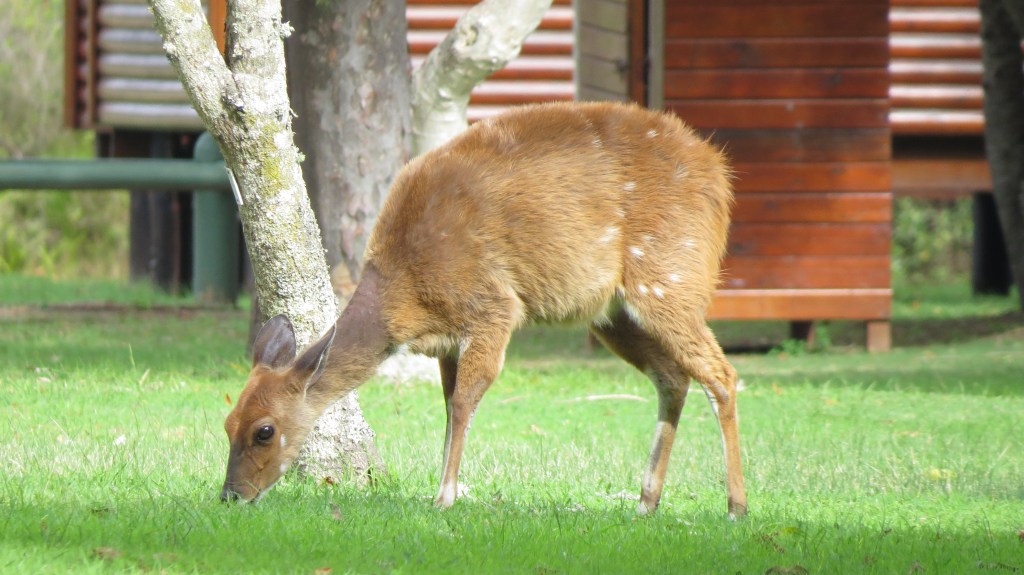
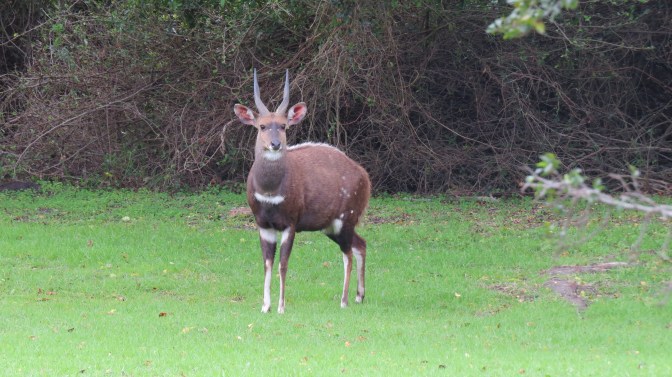
Wilderness comes under the Garden Route National Park, so we needed to sign in at the office and show our Wild Cards. The lady at the office told us that there was no wildlife on the trek to watch out for. And yet we hadn’t even started the trail and there were bush bucks walking around the campsite. South Africans obviously have a different meaning for the term…
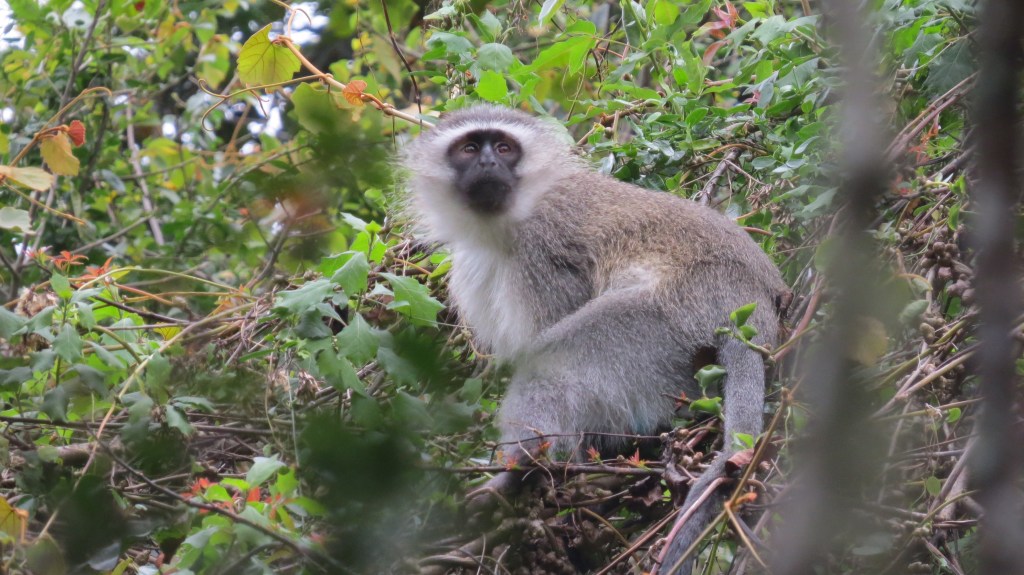
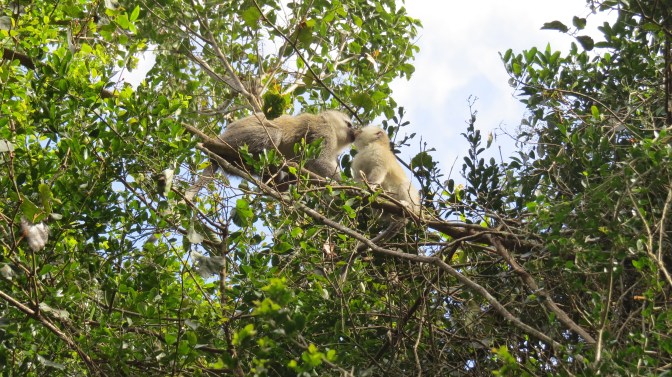
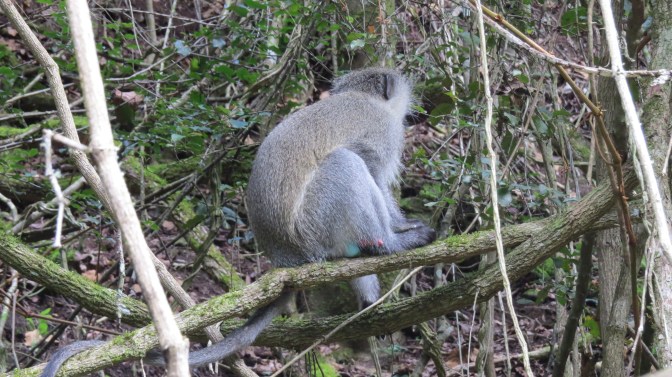
The start of the walk was pleasant enough as we meandered along the river but it soon livened up when we were suddenly right next to a small troop of vervet monkeys. I literally just looked to my left and there was a monkey climbing a tree not three metres from me. There was one youngster amongst the group and it was pretty funny to watch it clambering amongst the branches and trying to play with the adults. We watched them for a while as they passed through the trees around us and crossed the path on the branches overhead. This encounter really improved our opinion of the trail!
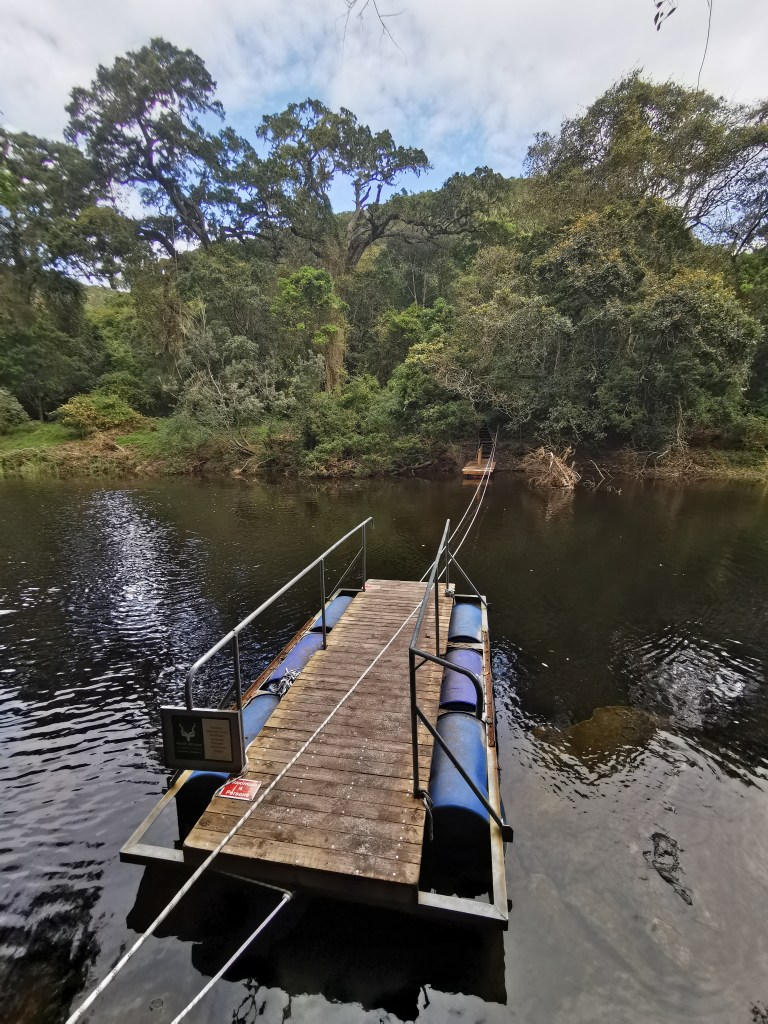
Not far after this we had the choice to either carry along the path to get to a crossing point or to cross the river using a pontoon to pull ourselves across. The pontoon looked much more interesting and turned put to be quite fun – especially as you had to do a little jump to get onto the shore on the far side.
The path on the other side of the river was pleasant but was again improved by wildlife sightings. We saw Double Collared and Amethyst Sunbirds and Turaco Lorries (which we’d spotted glimpses of on the Blue Druiker Trail but without getting a good look), a rather scary looking Reed Cormorant, and then Radka made a fantastic sighting of a Giant Kingfisher.
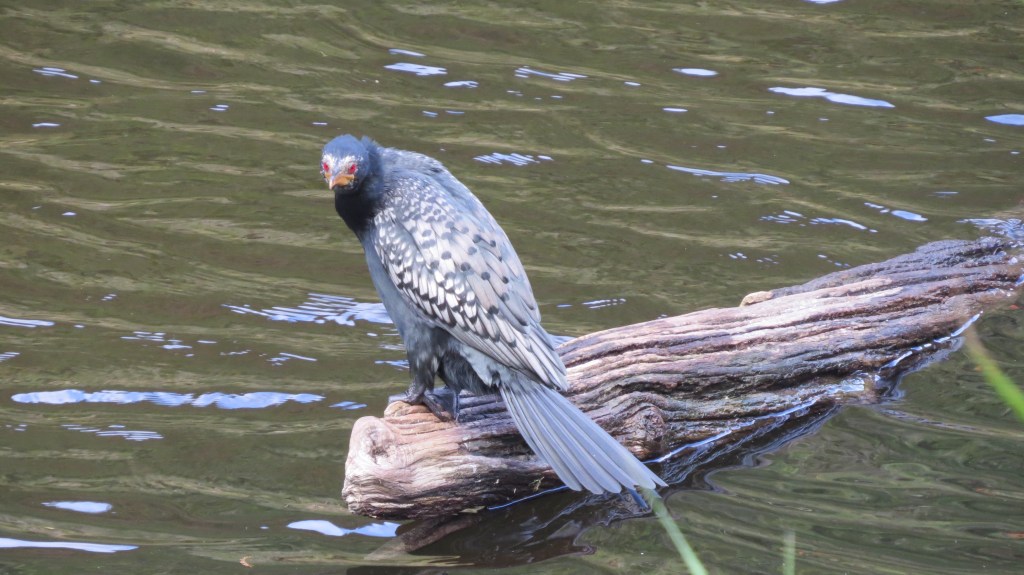
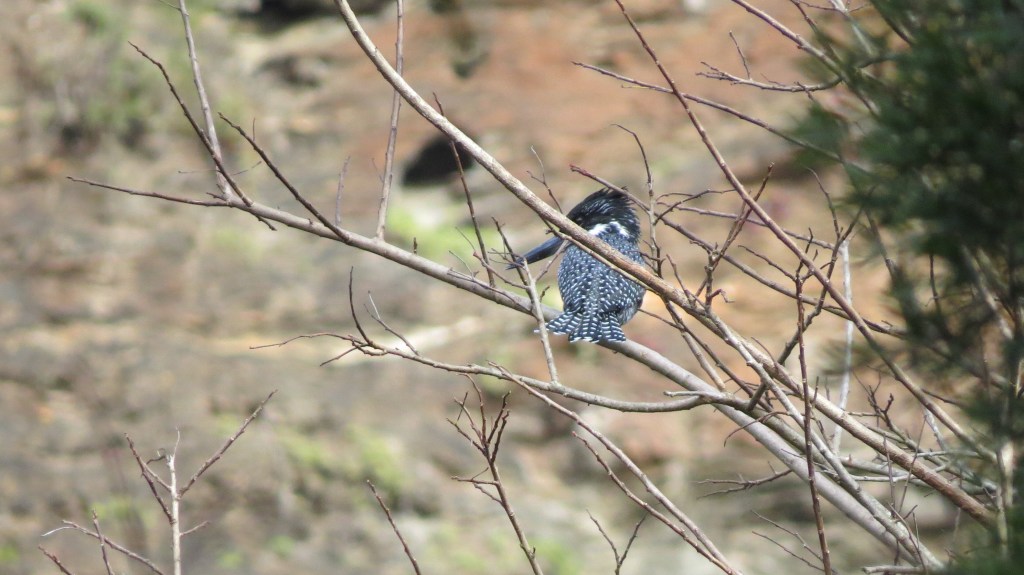
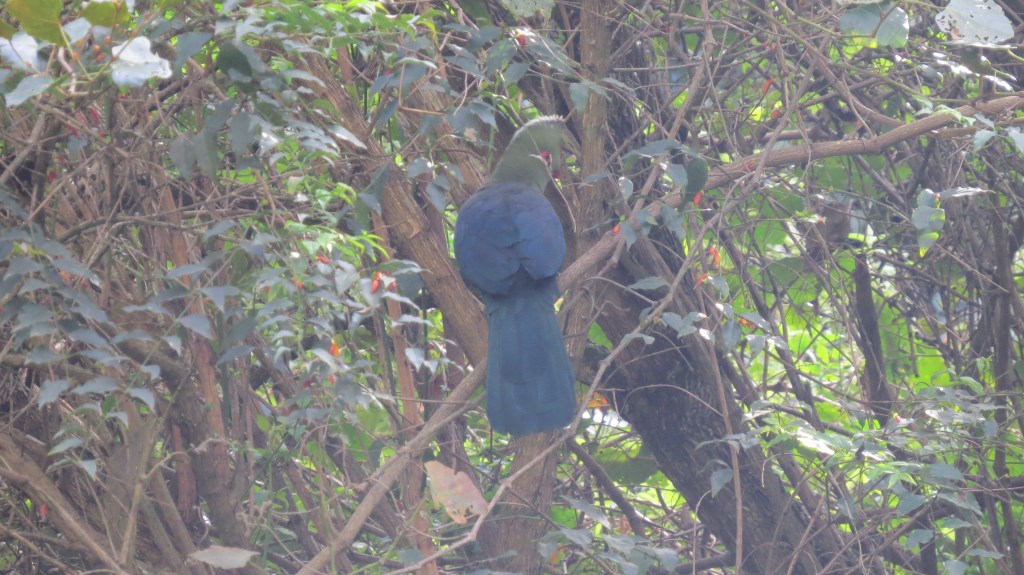
After a while the trail started making its way up higher and from across the valley we heard deep calls and were fortunate to spot a large baboon climbing in the trees on the opposite side of the valley. At the culmination of the walk, out of nowhere you walk into this area of huge boulders around the river, with the centrepiece being a very picturesque waterfall. This was a perfect place to have our late lunch and sit and relax whilst enjoying the view.
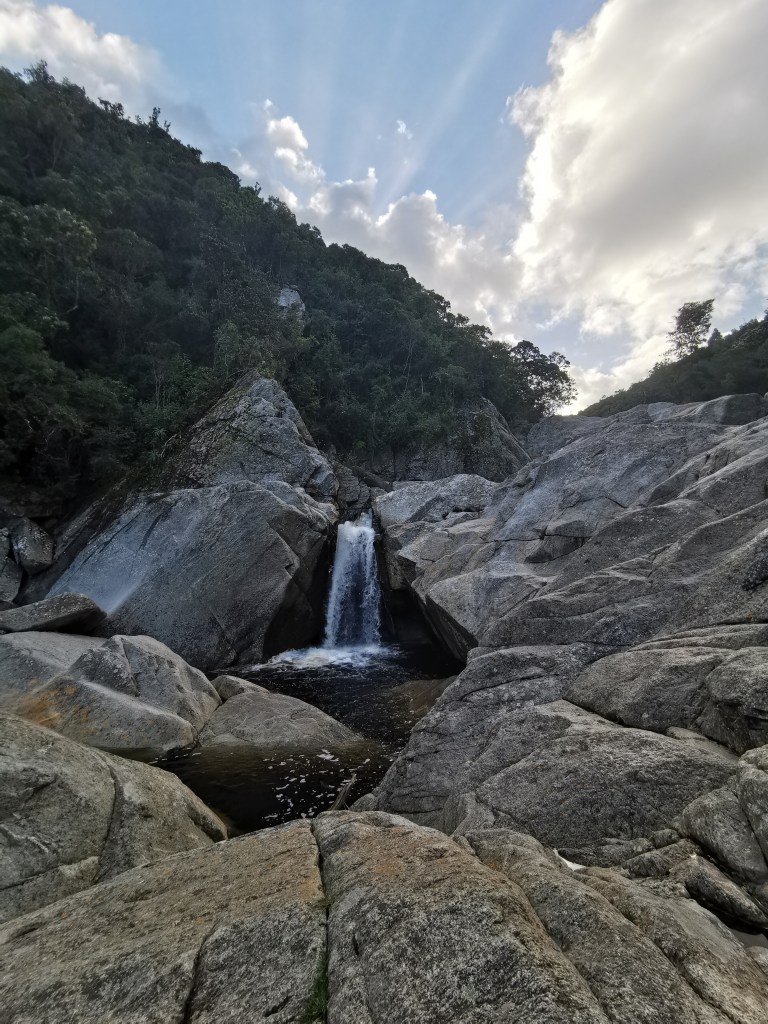
Our way back to the campsite was much quicker and the only point of note was that we took the earlier crossing using the stepping stones instead of the pontoon, and this was a massive mistake as the pathway on the other side was awful! It was difficult at times to walk on and it didn’t offer any advantages in terms of views, so we’d definitely recommend just taking the pontoon both ways. Time was getting on so we also didn’t complete the extra route up to the viewpoint. But the views of the river and the campsite in the late afternoon light were nice enough anyway.
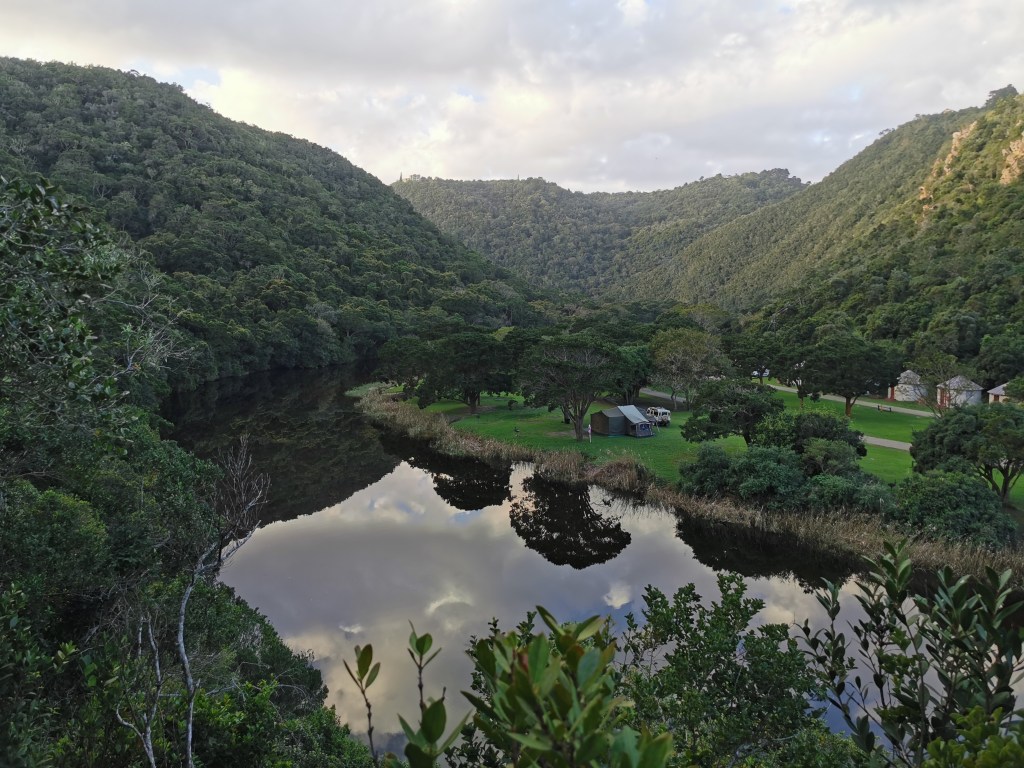
Overall, we’d probably class the walk itself as ‘pleasant’ rather than anything extreme or amazing. The waterfall in the valley at the end was really nice but what made the walk so enjoyable for us was the numerous wildlife encounters we were fortunate enough to experience.
We made our way back to our accommodation in Knysna and decided to eat in. Although I’d managed to make a mistake with the food shop. What I thought was just a can of sweetcorn, turned out to be sweetcorn-paste. Is this load of mush a common thing? As I don’t think I’ve ever seen it before. It was a bit weird but we made do.
To see our route using the Relive app, please click here.
Plettenberg Bay
The following day we got up early in preparation for heading to Plettenberg for a day of whale-watching and swimming with seals. Those of you familiar with the local geography might be wondering why we seemed to be heading back on ourselves. This order of activities had not been our original plan on how to structure our journey but when we checked out the weather forecasts, it looked to be our best way of avoiding as much rain as possible! This is also why we ended up staying in Knysna rather than Plettenberg. On the whole, I think we did well to maximise the nice weather whilst we were on the Garden Route.
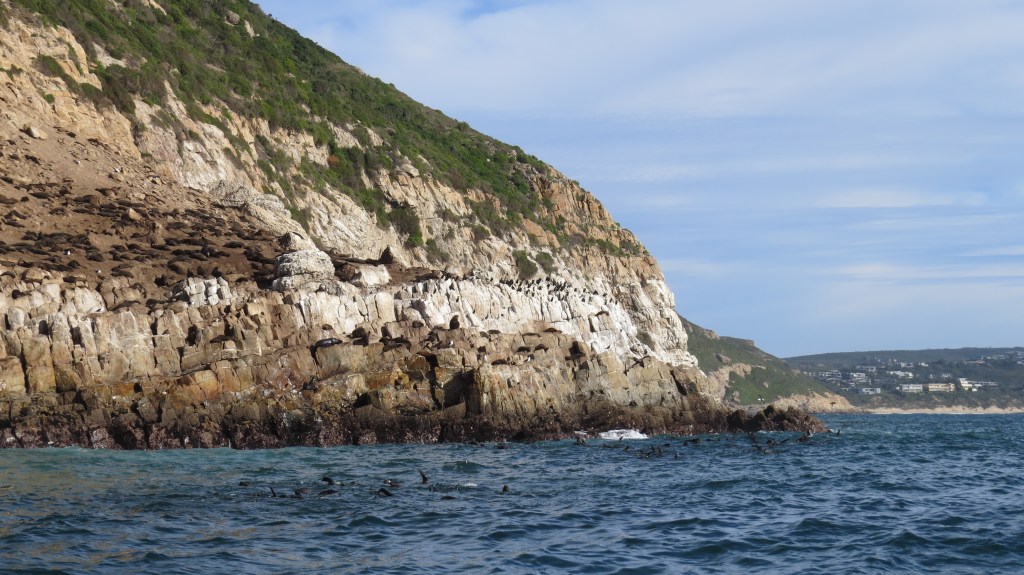
We didn’t get our confirmation for our activities until just before eight AM but fortunately everything was going ahead. We drove there, passing some pretty misty scenery on the mountains and got there in plenty of time. First was the whale watching trip. Plettenberg Bay isn’t as well known for whale-watching as Algoa Bay or Hermanus, but we’d already had to move on from the former and given that the forecast for when we would be in the latter looked dodgy at best, we thought we’d better give it a go in Plettenberg whilst we had the chance. We had a high level of anticipation for this activity given how many whales we’d seen from shore at Storms River Mouth but the trip turned out to be largely anti-climatic. The most exciting part of the first 95% of the trip was getting the boat into the water, which required a tractor to drive quickly and then stop, causing the boat to be launched across the sand and into the water. We then had about two hours of nothing. We did see the spray from a whale fairly close by, but because it was ‘only’ a smaller Brydes Whale, we didn’t investigate, as they searched for humpback whales. They failed. This was a shame, as we’ve never seen a Brydes Whale, so we would have been very keen to get a closer look. I think as compensation for the lack of sightings, they returned via the cliffs to see the seals, but given that we were coming back in our second activity anyway, I couldn’t shift the feeling of disappointment.
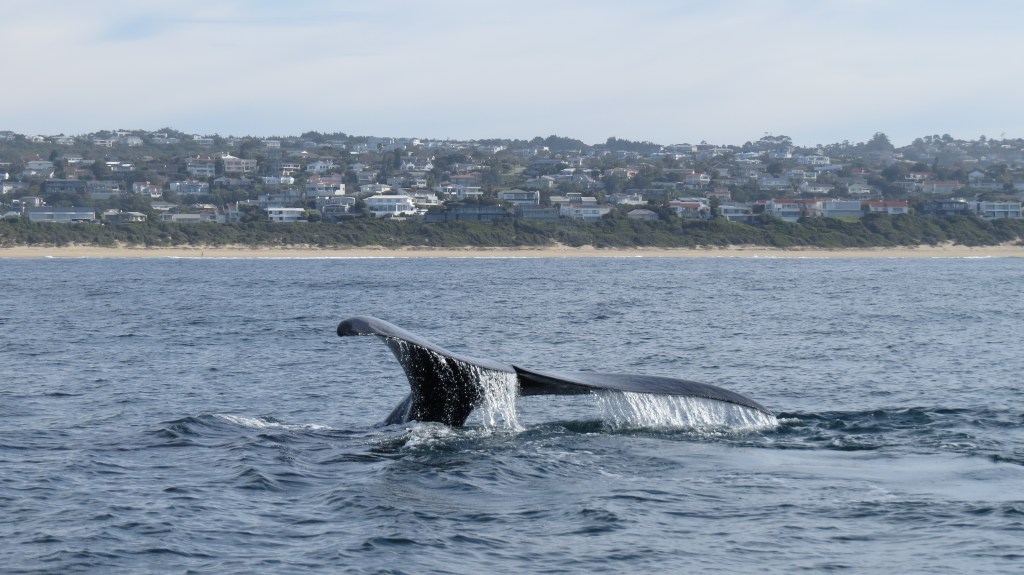
However, as we were going back from the cliffs to the beach a Southern Right Whale popped up not that far from us and then again not long afterwards. We were pretty close and it was a really majestic experience, as we got the full tale up in the air before it disappeared again into the depths. This one encounter managed to save the whole excursion! They really are beautiful creatures.
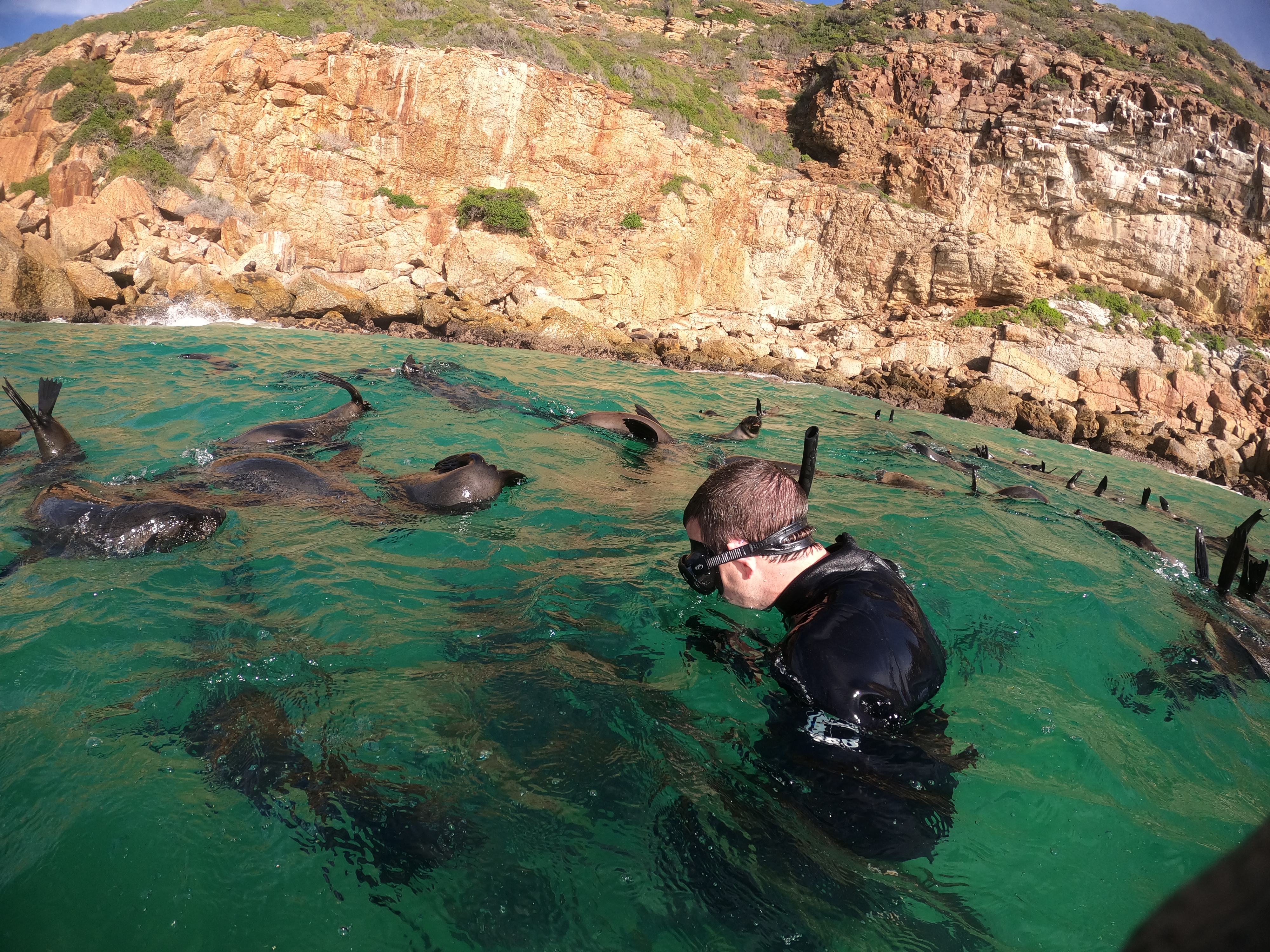
When we got back it was time to get changed for the second activity – swimming with seals. After donning wetsuits we went out in a smaller boat and headed straight for the cliffs. There are thousands of seals that live on those cliffs and there were dozens that we swam with. It was really good fun. They were constantly swimming around you and repeatedly trying to bite and steal your flippers. I got a couple of nips on my ankle by mistake, but nothing that broke the skin, mainly due to the extra protective coverings that are added to the wetsuits around your hands and ankles. Although when you looked down at the seals they morphed from these cute, playful animals into looking a bit scary when they bared their teeth whilst biting the flipper. It reminded me of those BBC documentaries with the vicious leopard seals hunting the penguins.
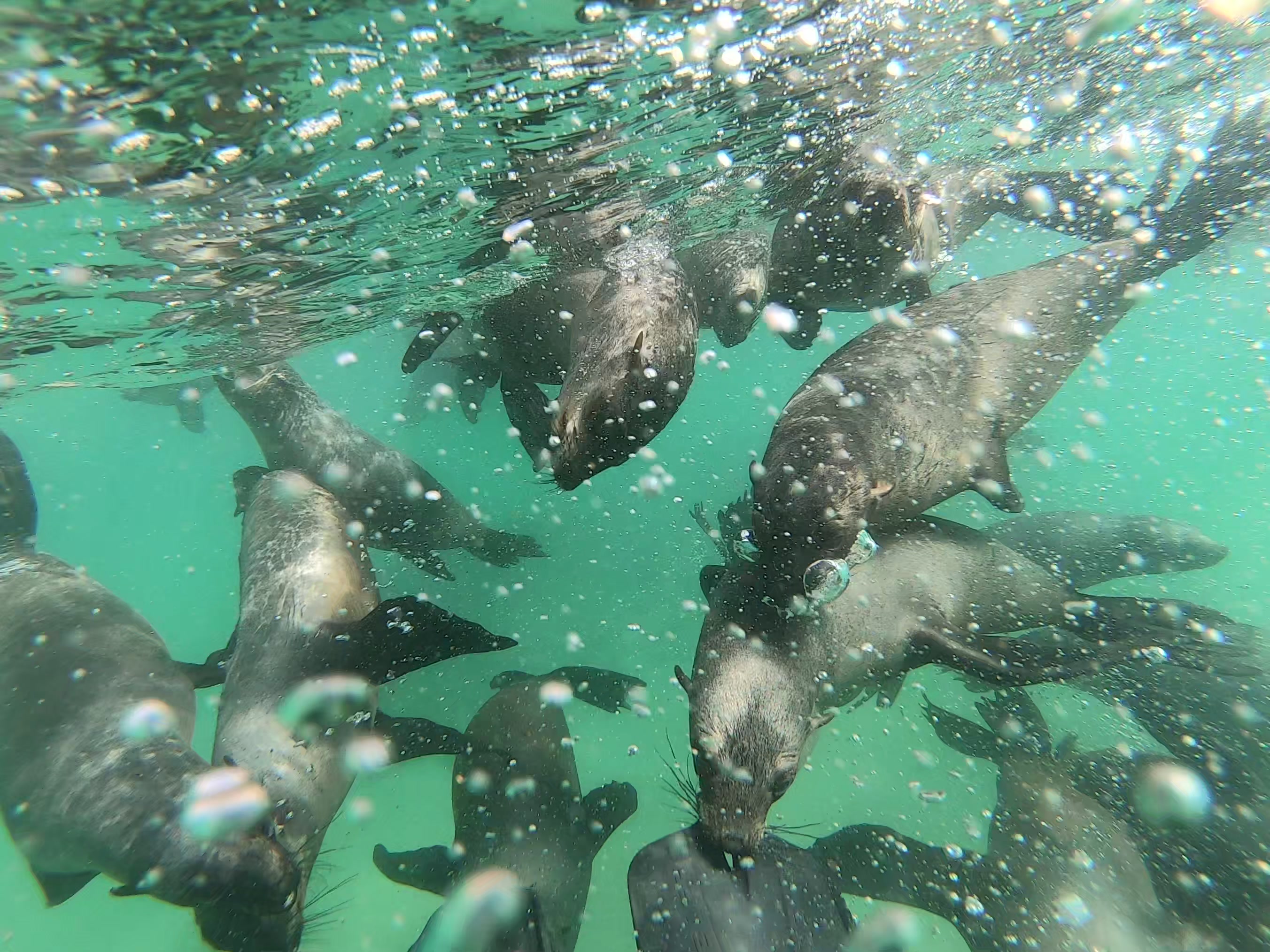
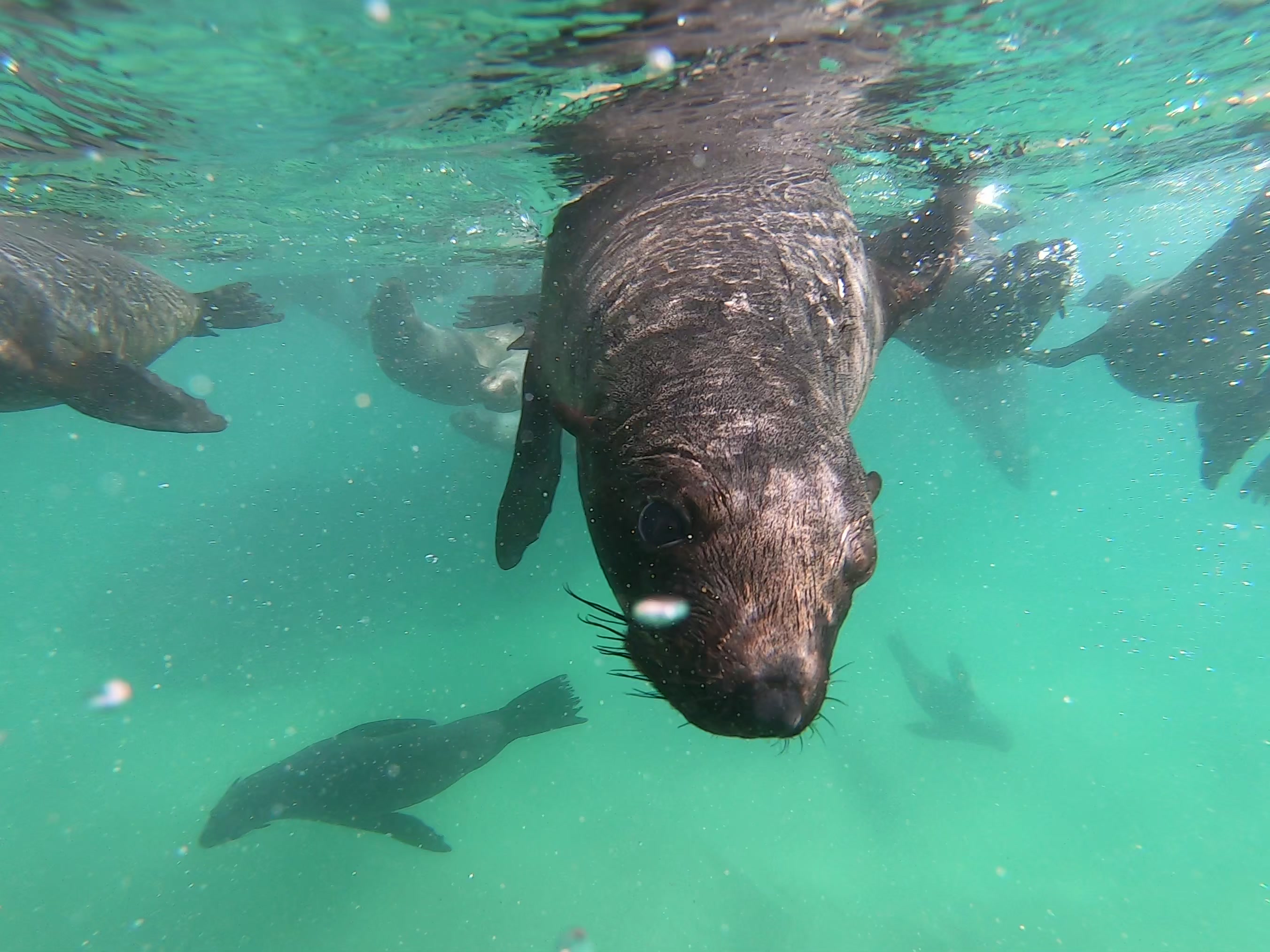
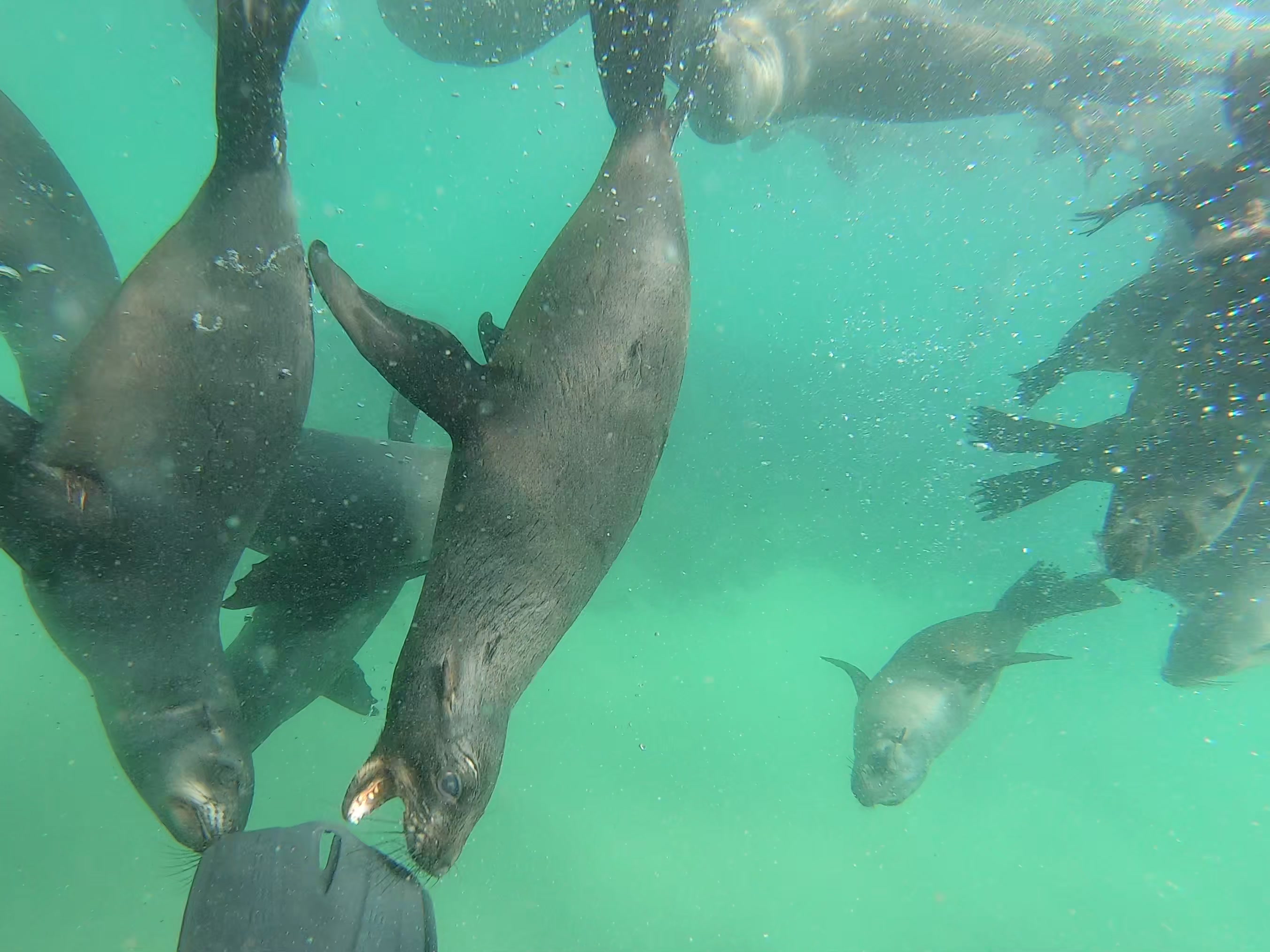
The time went really quickly and it was a shame when it was over and we were heading back to the beach. To get onto the beach, the boat has to go at quite a fast speed and just launch itself up the sand. Something similar happened with the previous activity but it was more extreme with the smaller boat. After having a warm shower and getting changed, it was time to leave and to get something to eat. It had been a fantastic experience and we’d definitely recommend this activity to anyone staying in Plettenberg.
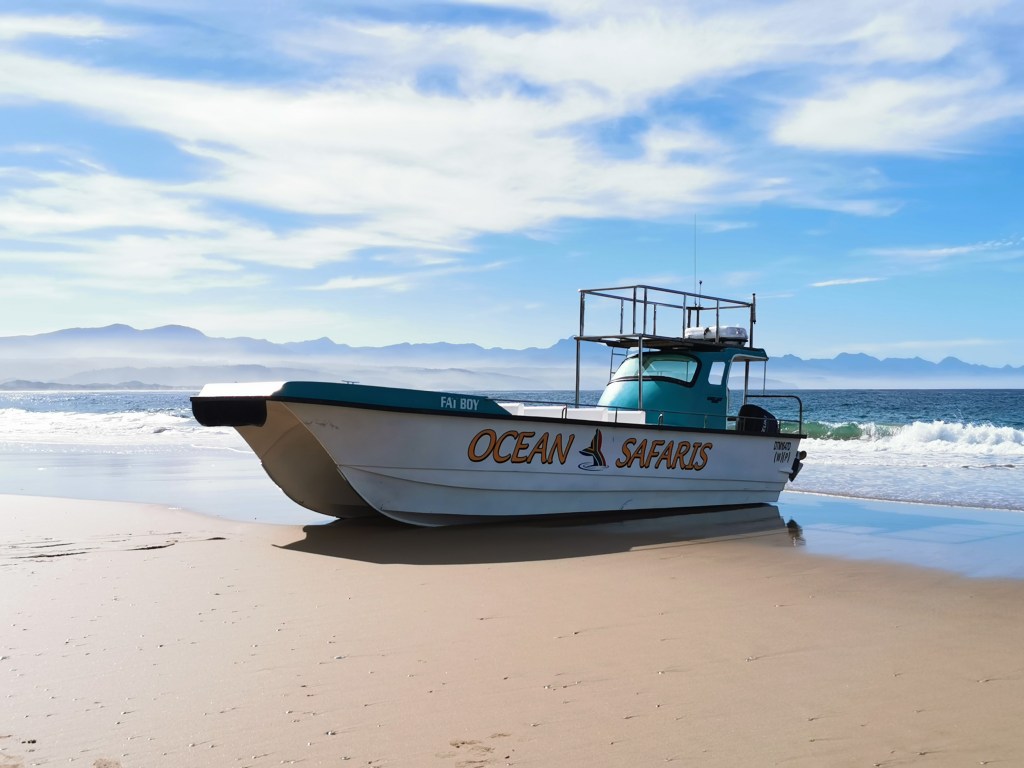
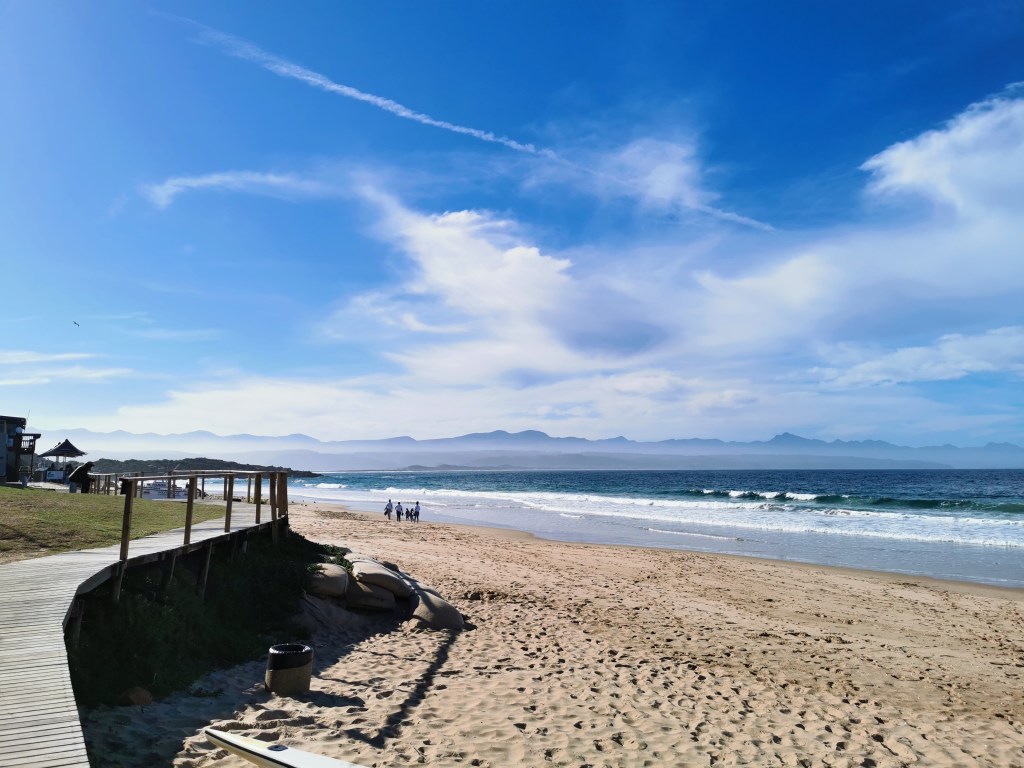
We walked along the promenade until we reached the Plett Ski-Boat Club, where we got something to eat and drink. It was a nice place and had an amazing view. Afterwards we had a walk along the beach. It had turned out to be a beautiful day and yet the beach was fairly quiet at this time of the year. After picking up an ice cream from the kiosk for desert, it was time to drive back. Whilst we didn’t get to really see Plettenberg itself or walk along to the Robberg Nature Reserve, we had had an amazing time. A relaxing evening followed until I had to watch England in the penalty shootout against Switzerland…
Agulhas National Park
The following day involved a lot of driving as we left our accommodation in Knysna and ventured south in steadily worsening weather to our next destination, Hermanus. Despite the poor conditions, we decided to stick with our planned detour and visit Agulhas National Park, which contains the most southernly point of the African continent.
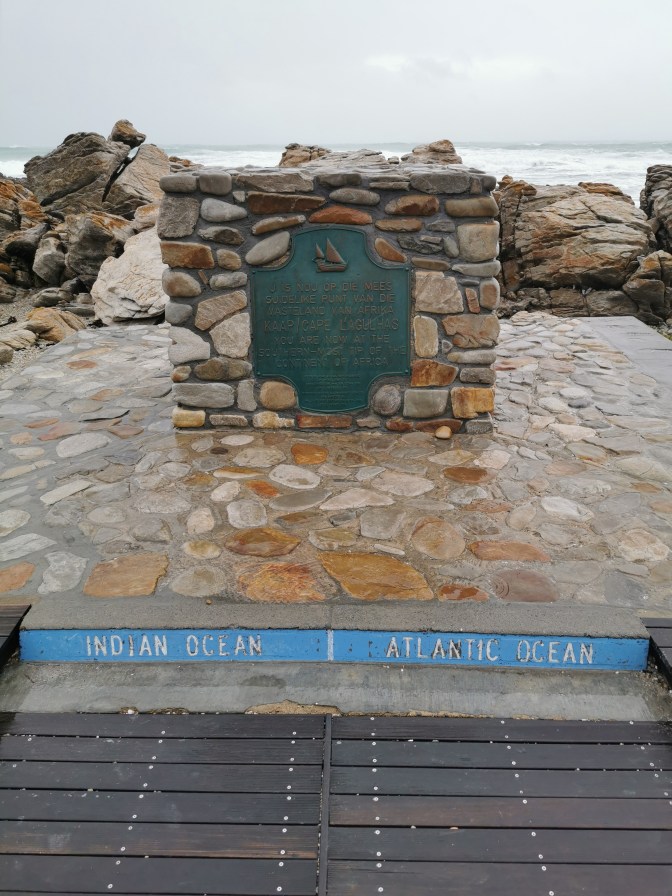
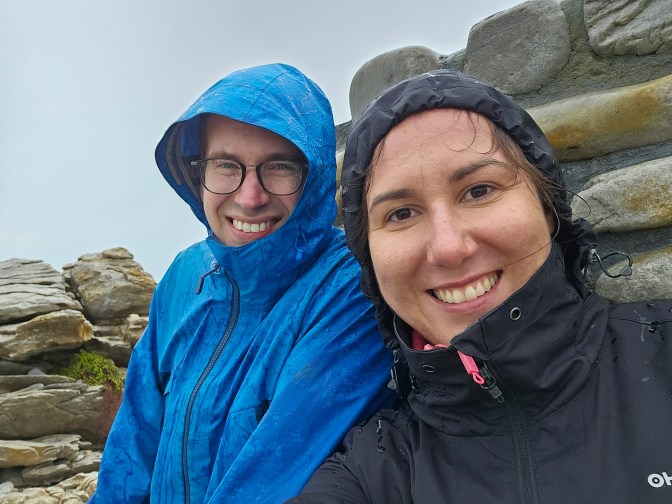
We’re still not sure if we made the correct decision, as the weather was appalling and it is a big detour from the motorway, but I guess it’s quite a cool, niche place to visit. The place itself would have been pleasant enough. There was a rugged coastline and quite a picturesque lighthouse nearby, but those thoughts exited our minds as soon as we got out of the car. We actually though we’d hit a lull in the rain when we parked by the side of the road, but as soon as we’d walked 20 metres it came back with a vengeance and was now mixed with hailstones. So, what could have been a nice visit turned into ‘get there as quick as possible, grab a couple of photos, and get the hell out of there’! As well as being the most southernly point of Africa, this is the point where the Atlantic and Indian Ocean meet, and there is a statue commemorating that fact. We actually ended up hiding behind it until the worst of the hail was over!
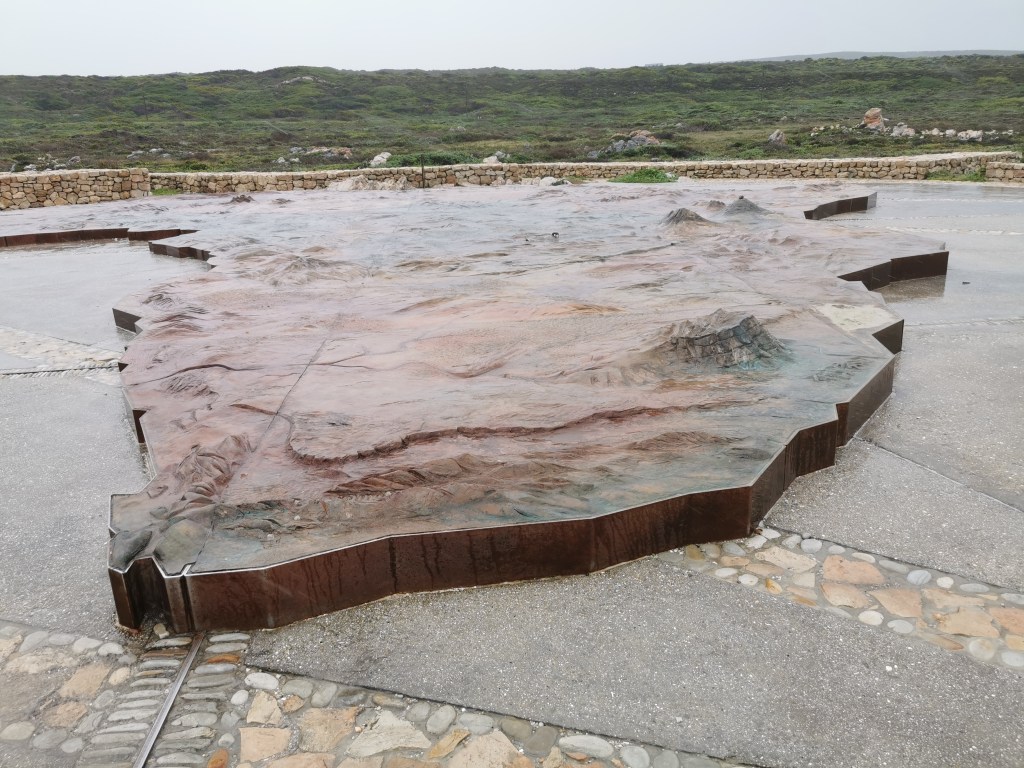
Next to this statue is also a further piece of artwork depicting a relief map of the African continent, which was quite impressive.
One last thing to point out, is that there are two pathways leading from the road. It turns out that the first one you reach is the shortest one and the path you are supposed to take (despite what it said on my online map). The other path is longer and very uneven underfoot. Guess which one we took…
Hermanus
When we were planning our Garden Rote trip, Hermanus is probably the place that we were most looking forward to visiting. It is famous for its whale watching, both on boating excursions and simply from the coast. They even have an old tradition of someone ringing a bell when you can see a whale out to sea. However, when we were arrived in South Africa and were solidifying our plans, the predicted rain and wind, combined with the effect this would have on the ocean swells, plus the fact that our first trip in Algoa Bay was cancelled, suggested to us that there was little point in spending too much time in Hermanus. Hence, we only spent one night there, and the patchy weather and raging seas vindicated our decision. Nonetheless, what we saw in our short time there left us in little doubt that this could be a fantastic place to visit in different circumstances.
Burgundy Restaurant
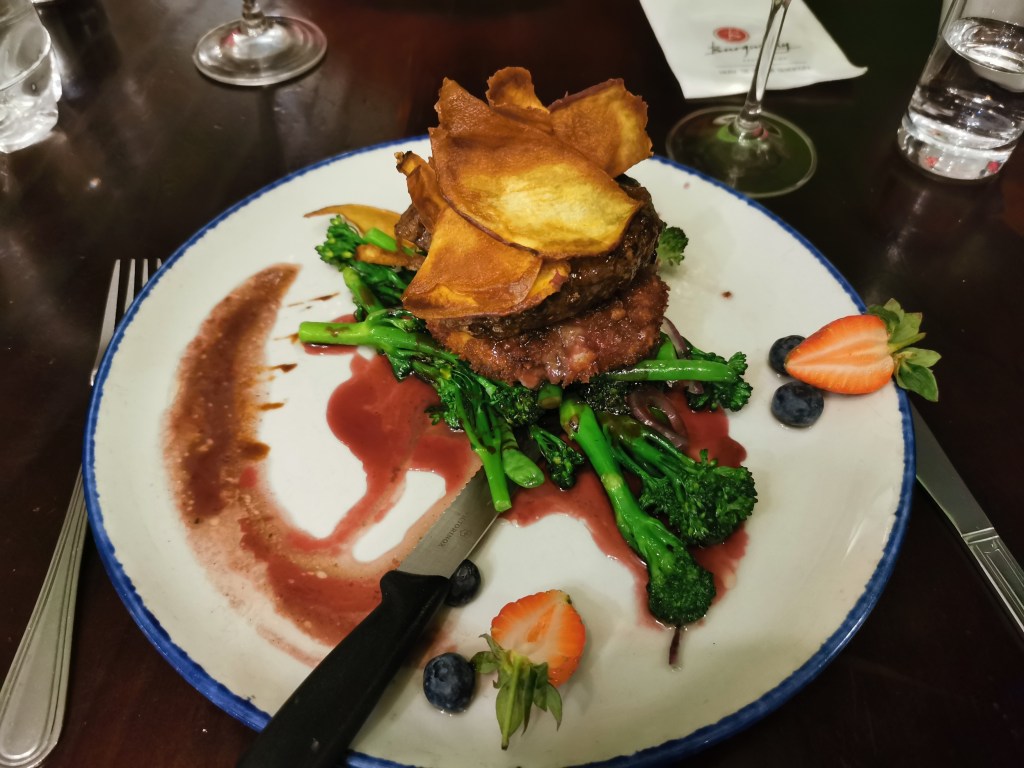
After finally making it to our accommodation in Hermanus, we ventured out into the rain once more to try out the Burgundy restaurant, and it did not disappoint. This was the best meal we had during our trip in South Africa. Despite being unsure whether to try them or not, we both had the Ostrich fillets and they were delicious. We were also impressed with the nice South African wine they served and the tasty Cape Date Pudding for dessert. We’d definitely recommend this place and would happily come back.
Walk along the coast
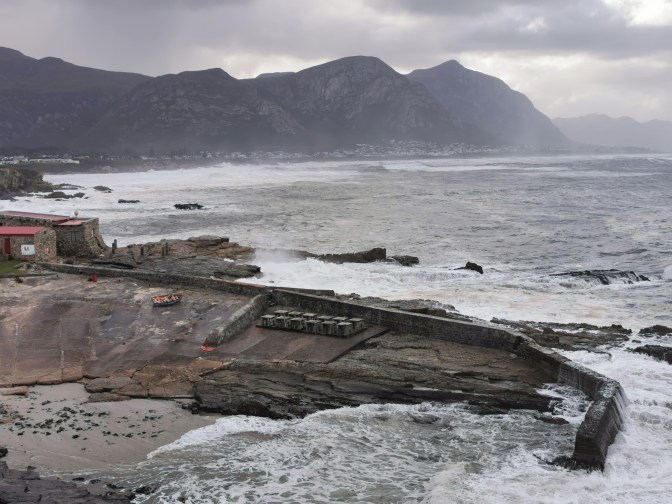
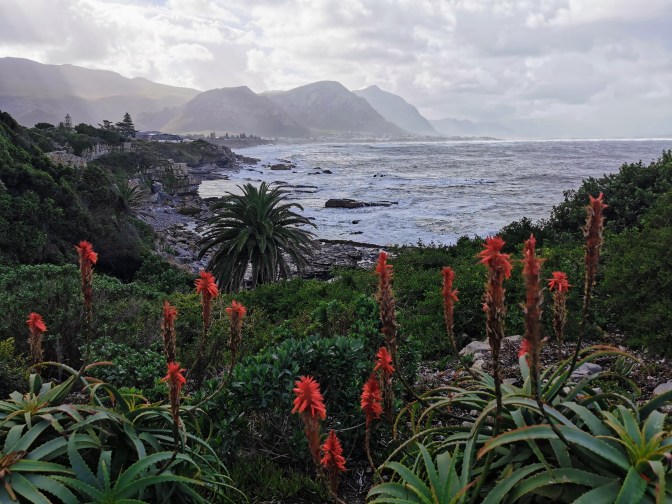
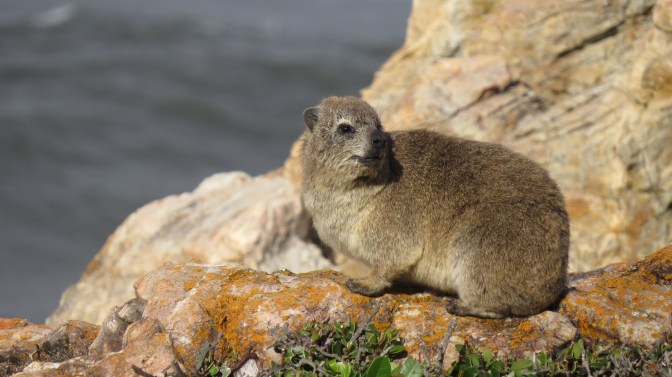
Despite having to dodge rain showers we still managed to have a very nice walk along the coastal path. The dark clouds and the waves crashing against the old harbour actually made for quite an atmospheric setting. And then on the way back, the Sun actually came out for a bit, which was very pleasant. This also allowed us to more easily spot some wildlife up on the cliffs, with numerous birds and more Dassies making an appearance. Whilst we only had a reasonably short walk, it could easily be made into an all day activity if you have the right weather.
To see our route coming back using the Relive app, please click here.
Whale Museum
There are a couple of small museums in the main part of the town and we spent maybe half an hour looking around them. The Whale Museum was the bigger of the two (not saying much) and had some interesting boards, Although I’d say it’s probably more for children. But even with kids doing the activities, you wouldn’t be there for long. But it was still pleasant enough.
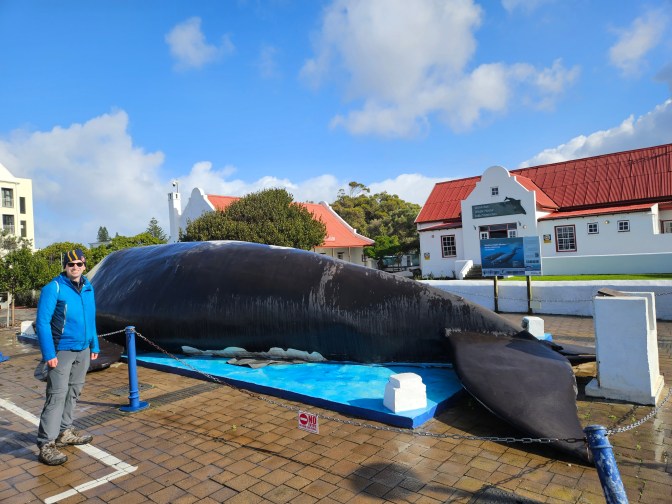
Buying Souvenirs
The market stalls near the museums were a nice place to get some different souvenirs. There were various types of crafts and artwork and they generally seemed to be made locally rather than mass produced (at least I think so – but don’t quote me on that!). We got a couple small stone figures depicting a Whale and a Zebra and could have easily bought more items but we managed to rein ourselves in.
Betty’s Bay
After leaving Hermanus, we drove on and visited Betty’s Bay. The reason for going there was to visit the African Penguin colony that lives there. And it certainly did not disappoint! There is a little boardwalk along the coast where you can view the dozens of penguins dotted about.
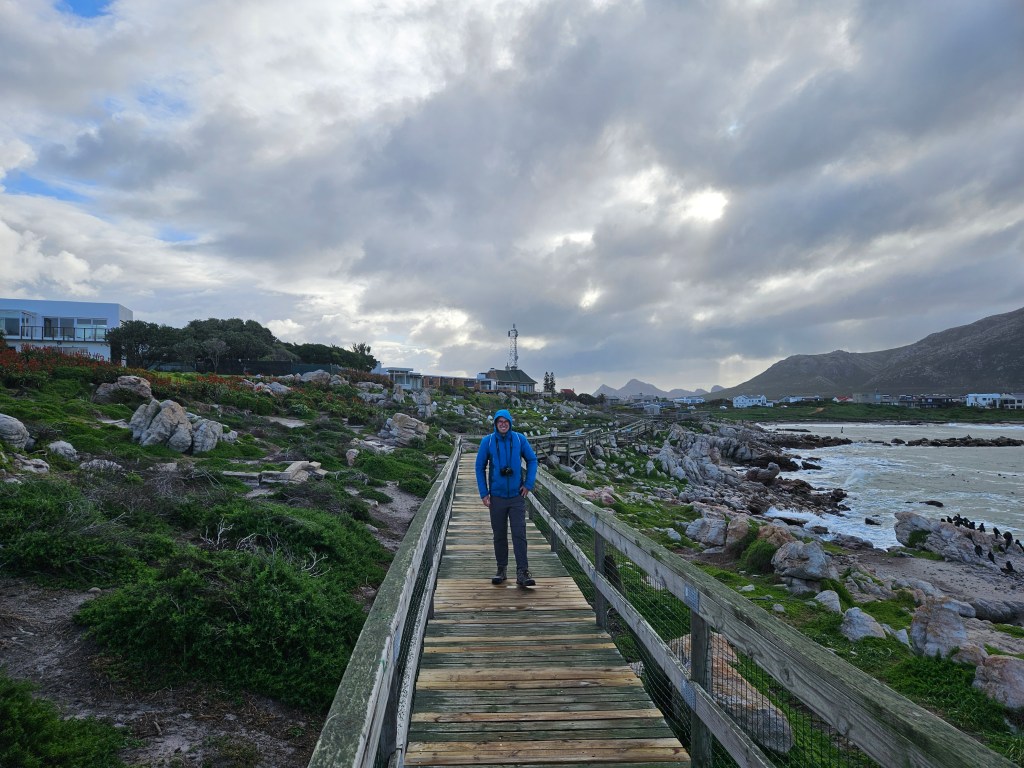
Some of the penguins are in little houses that have been put up for them, whilst others are in their more traditional burrows.
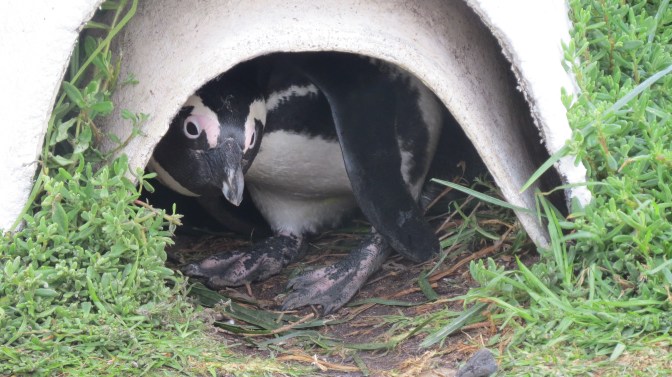
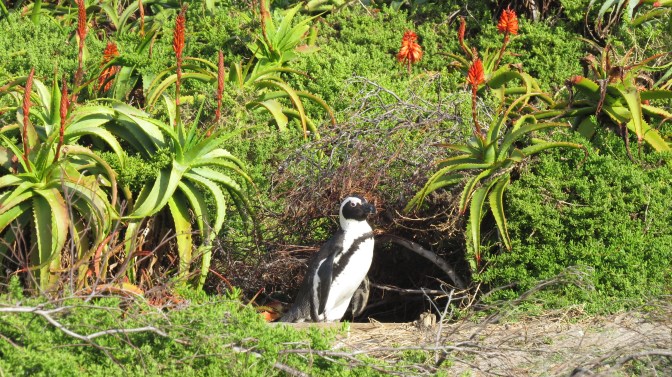
There were also hundreds of Cormorants and other seabirds on the rocks along with the Rock Hyraxes, which seem to be ubiquitous across this first part of our trip.
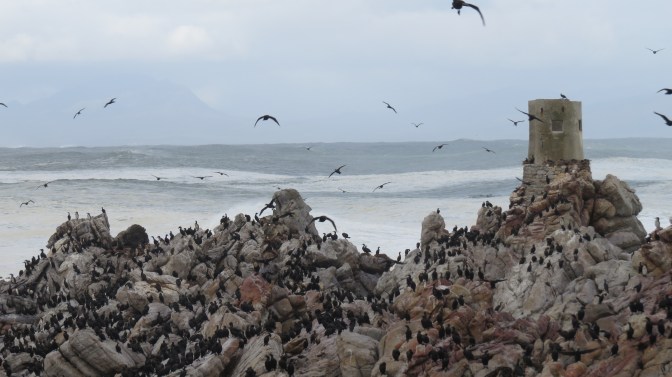
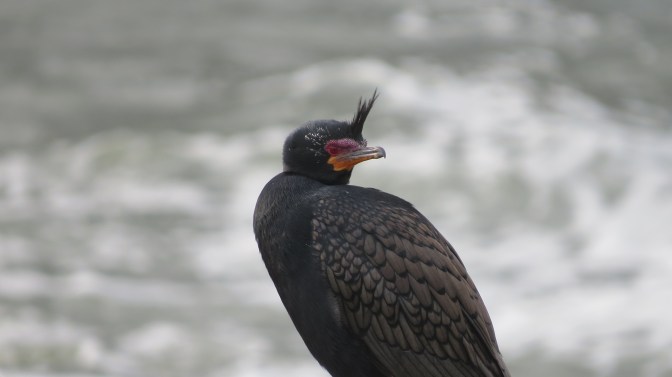
The mountain backdrop and crashing waves made for a very atmospheric setting, which seemed to fit with the distinctive cries of the penguins to further improve the experience. These cries are the reason for the other name for this species – the ‘Jackass Penguins’, as their cry is likened to that of a donkey.

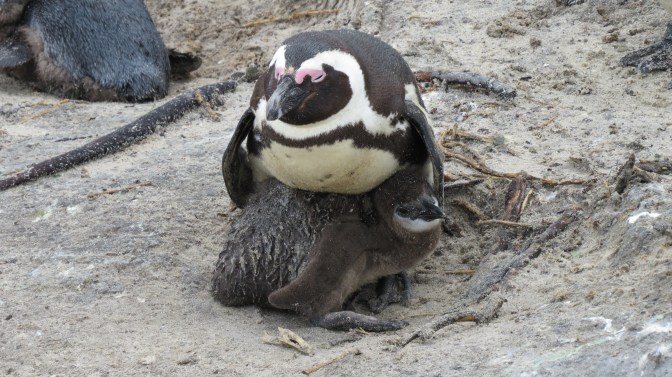
The penguins were very cute and there were still some younger ones of varying sizes and stages of development. This meant that some were going between different stages of plumage, so they had tufts of feathers sticking out, making them even more amusing.
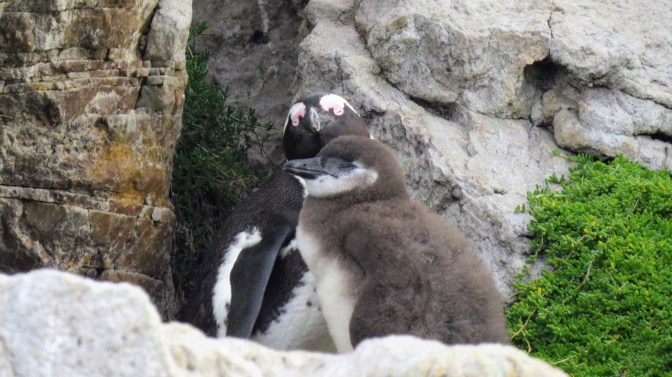
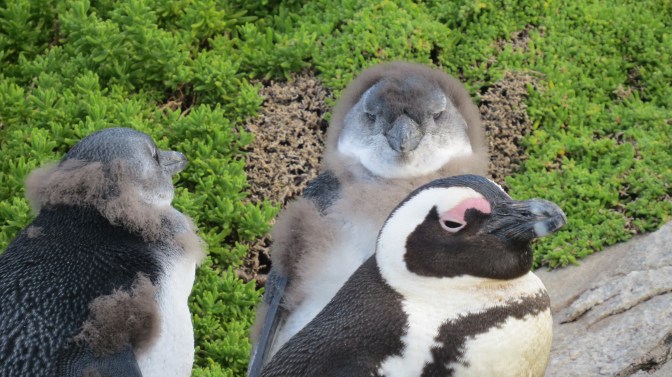
As we made our way back to the car we even saw a tiny antelope sitting in the grass. So it had been a very successful visit!

Franschhoek
The road onwards towards the famous wine-making town of Franschhoek was interesting, as it got more and more hilly, the rain came and went and then suddenly there were snow-capped peaks ahead of us! The dreary conditions and the nature around actually reminded me of Scotland. It certainly didn’t seem like one of the world’s premiere vineyard areas. But after one more windy pass, we were suddenly looking down into a valley with a small town that was surrounded by vineyards. The contrast was incredible. The Sun happened to be setting at this point so it was a beautiful view.
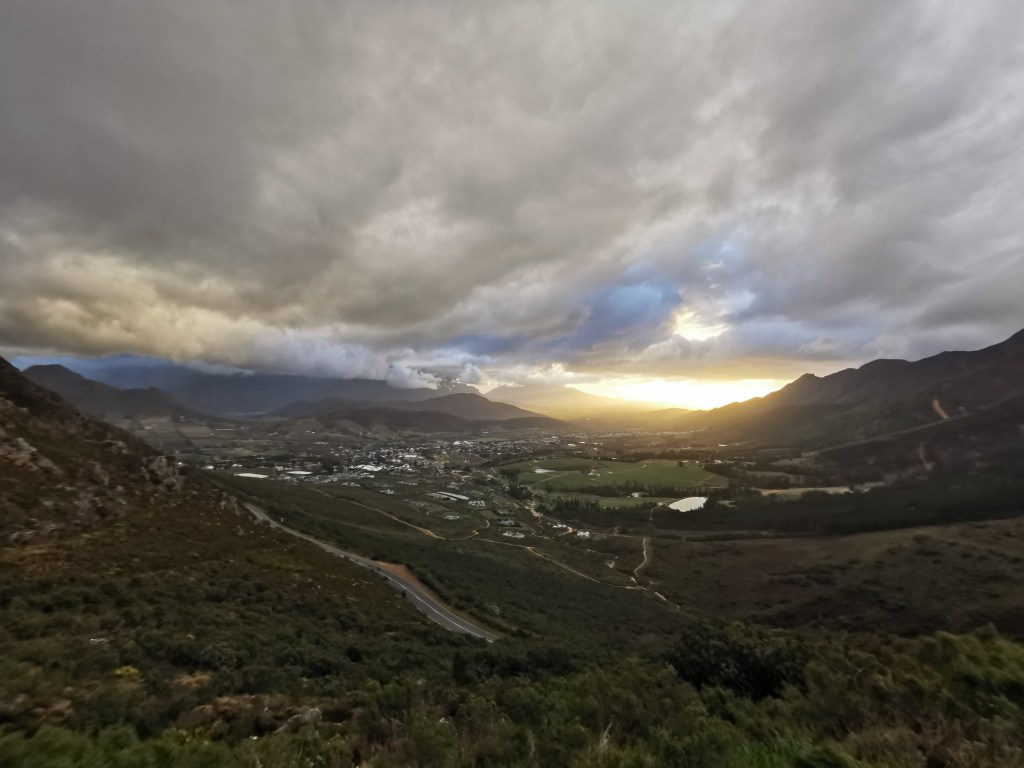
Now, neither Radka nor myself are particularly wine drinkers and don’t really know much about them. But we felt that visiting the wine region near to Cape Town was a must-do activity for this type of holiday. There are loads of places to choose from, and we could even have done day trips from Cape Town, but we decided to just visit one of the towns properly for a couple of nights, and were given a recommendation of Franschhoek. However, nearer the time we checked the weather and it was meant to be atrocious when we were going to be in Franschhoek, so we booked to do a curated wine tasting. This meant that we didn’t have to worry about getting from place to place or working out which estates to visit. We booked it through the official Wine Tram website, where you can also get different types of ticket depending what type of itinerary you want. And given that we hadn’t had a firm idea of where we wanted to go in Franschhoek anyway, we ended up being very happy with our choice to do it in this way.
Curated Wine Experience
Our tour started with a run through the rain from our strategically placed accommodation just over the road to the main office, where we were greeted with a small introduction and a hot drink. There were only four of us doing the tour that day, which made for a nice personalised experience.
We set off on their old fashioned bus to our first destination, Mont Rochelle, the winery owned by Richard Branson. We had a brief cellar tour, where our guide Simon started taking us on the journey of wine production. We discussed the positioning of the vines, then the use of destemmers to isolate the grapes to produce the must. Then the fermentation and maturation phases. And how different barrels can add different tastes based on the age and density of the wood. We then proceeded to a wine tasting session. We were taught how to taste the wines properly and how different scents can ‘prime’ your brain into recognising the different nuances of the wine (apparently…). This is what links to wine pairing with different foods. They are either supposed to compliment each others tastes or provide a contrast, but not have one overpower the other. After going through the starter pairings, we had a tasty lunch with another glass of wine. I really couldn’t tell you in which way the pairings worked but it was all very nice…
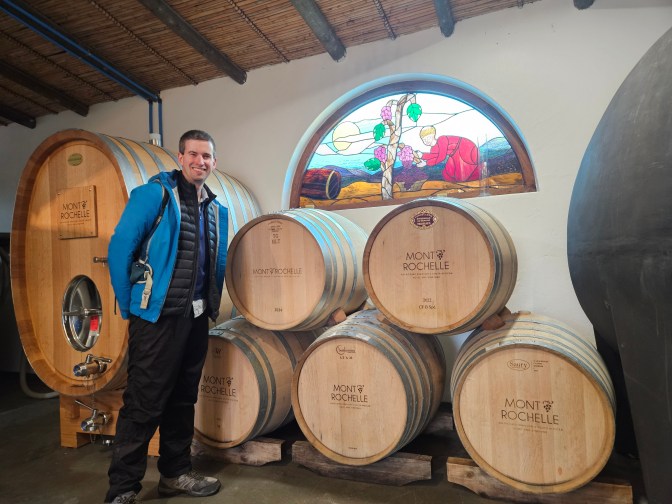
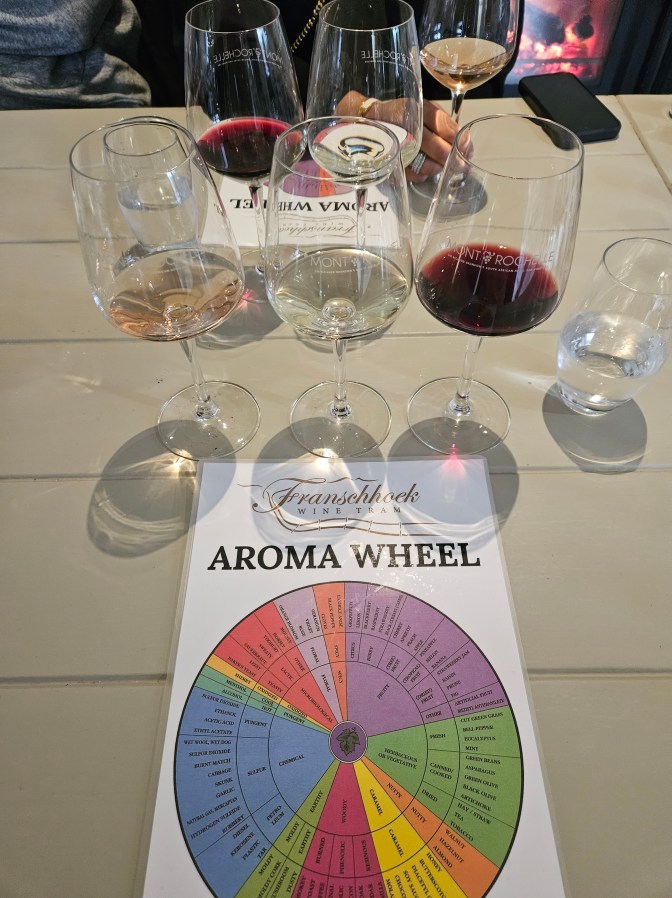
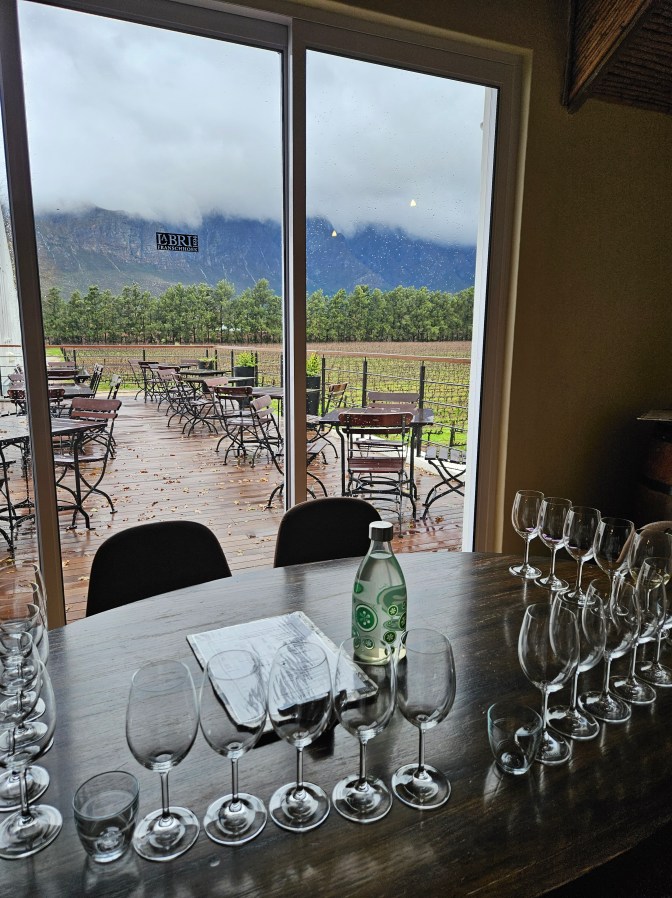
We then moved on to the La Bri estate. This is one of the founding wineries and specialises in ‘soft production’, where more of the production is done by hand. The second cellar tour was followed by another tasting session with another set of wines.
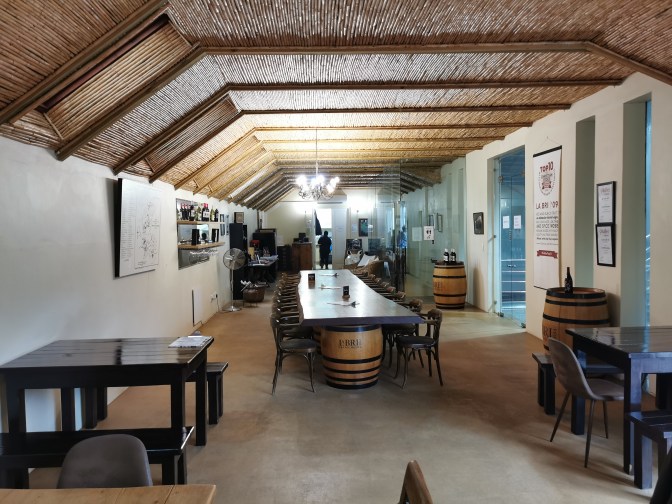
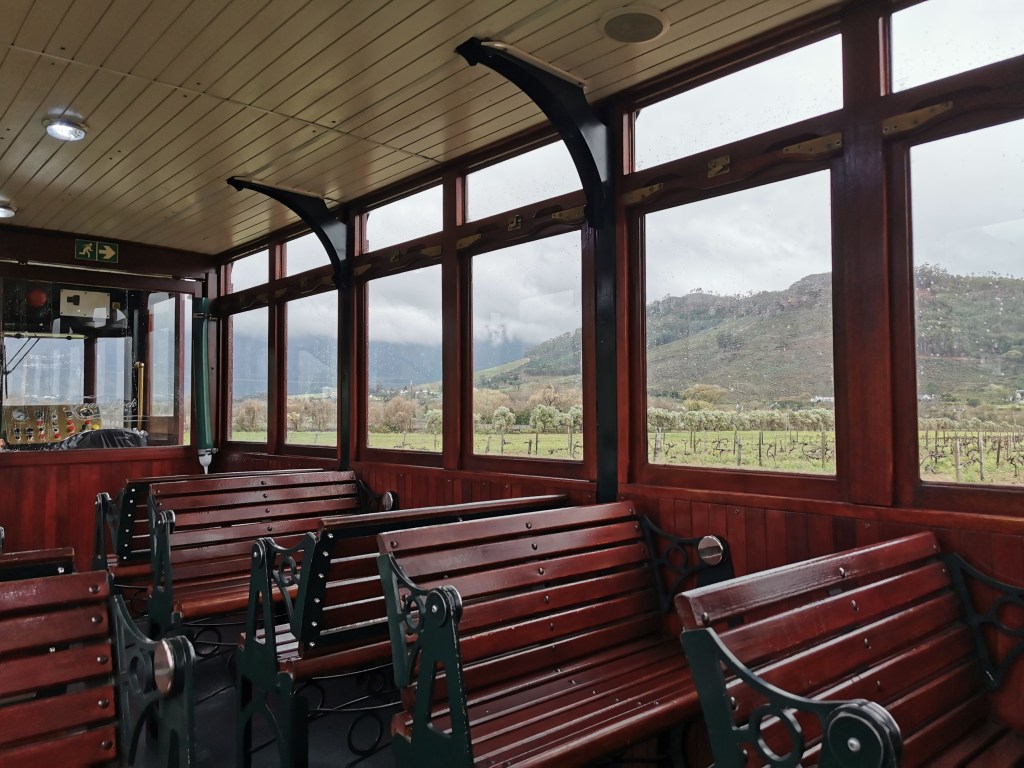
We then made our way back to the main office, as we were now going to take the famous tram to our final destination. The tram was old fashioned and rickety, but it was a nice experience. We were then served with another glass of wine on the way and got to see some of the vineyards as we passed. We actually went to the end of the permitted line before heading back to our final destination, Grande Provence.
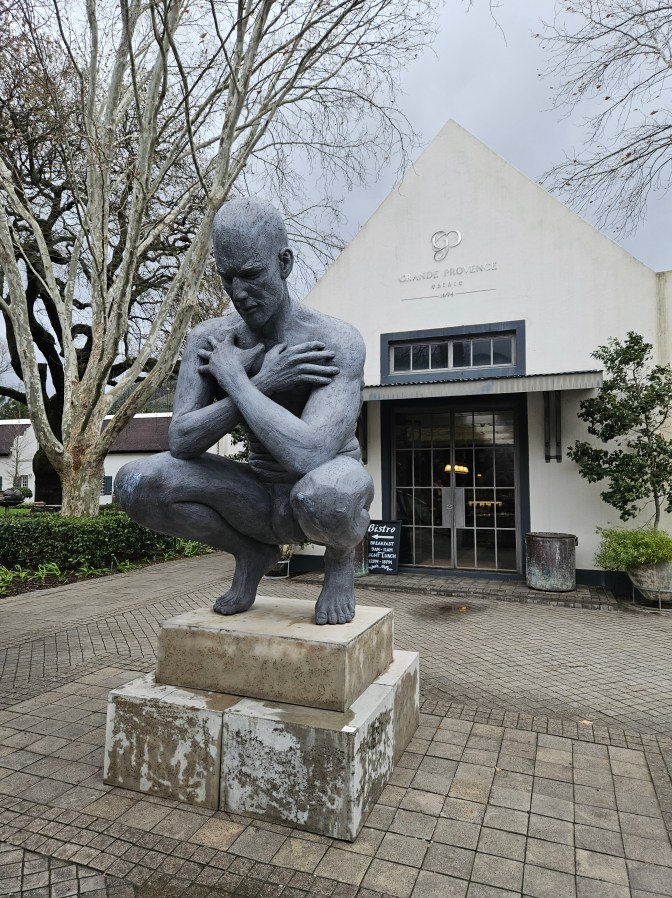
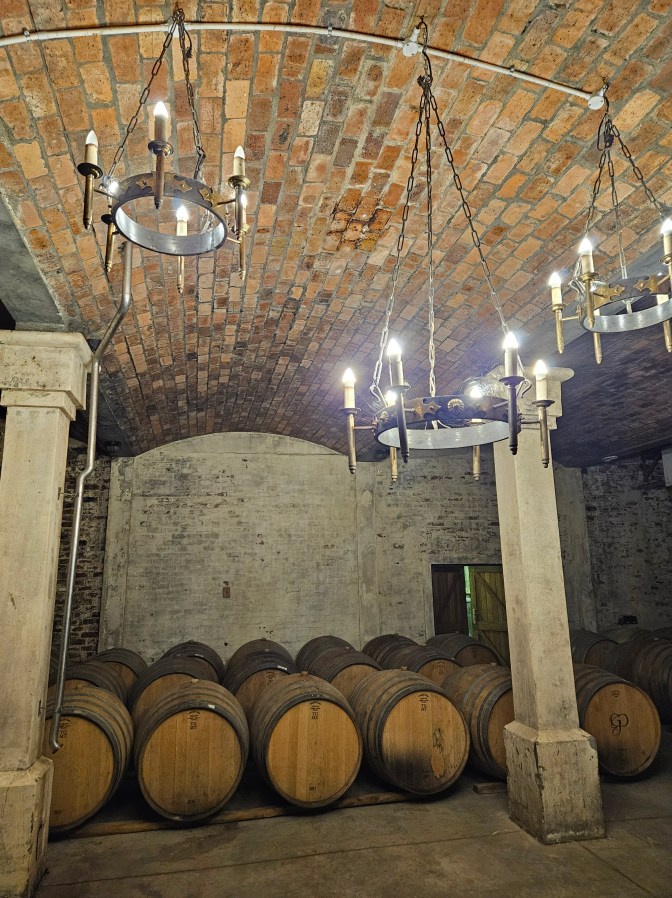
The Grande Provence estate is larger in scale than the others we visited. In their cellar we discussed the pressing of the skins in the production of different types of wine and how different conditions, such as temperature, air flow and humidity affect the wine. We then had another pairing session, this time linked to nougat deserts, which was a nice way to round off the sessions. Before heading back, we had time to look around the sculpture garden on the estate and you can purchase or order wines if desired.

Despite being very uneducated when it comes to wines, we still thoroughly enjoyed the day. And I’m sure that the copious amounts of wine that were drank had absolutely nothing to do with that…
Cape Town
The final stop on our South African road trip was arguably to the nation’s most famous city, Cape Town. Now I’m sure you don’t need me to describe the numerous sights and activities that can be done from this multi-cultural hub, but even if you’d like me to, I can’t. Now this is partly our fault. We knew that July was part of the rainy season for this part of South Africa, but we took a risk and came anyway. But we couldn’t have predicted just how bad it would be. Hiking up Table Mountain was one of the things we were most looking forward to about coming to South Africa. Not only did the weather make that impossible, in the three days we were in Cape Town we did not even see Table Mountain. That’s right, the cloud constantly covered the mountain. Another activity that we’d booked months in advance was to visit Robben Island, but the ocean swells put paid to that hope. So, the activities I’m going to describe here are very limited.
Cape Point National Park
Despite the weather, because we had the Wildcard we still made a couple of journeys out to the national park at the end of the Cape Peninsula. We had originally wanted to do a few of the different walks that were dotted around the park, but the weather made that tricky.
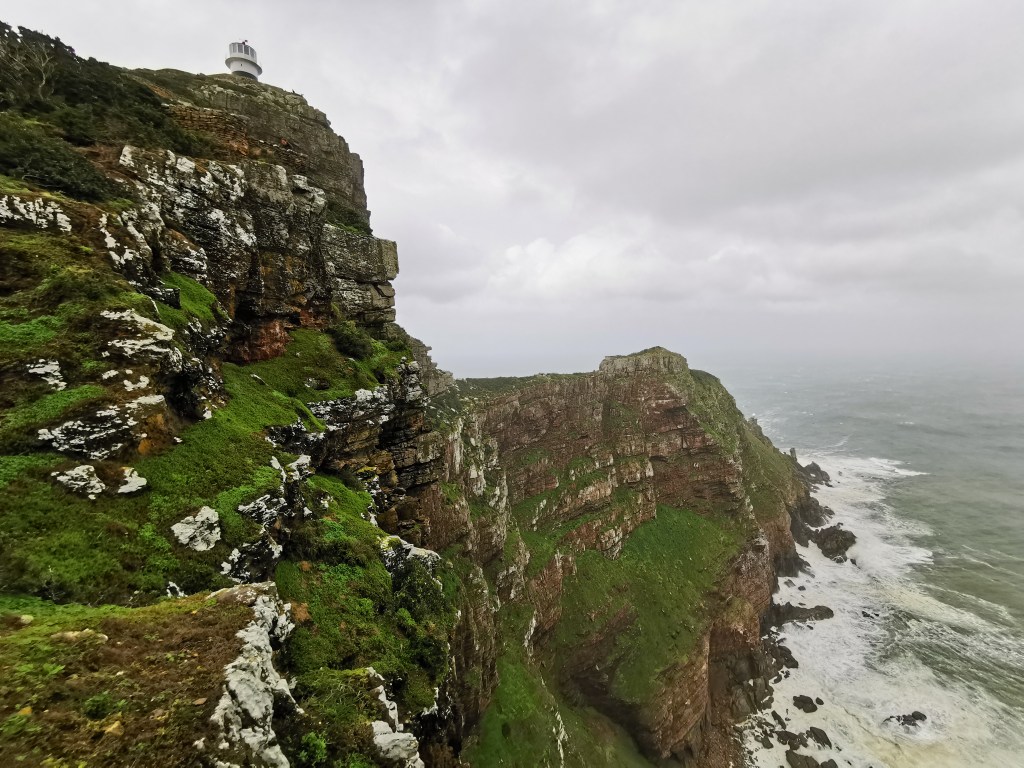
Walk to the lighthouse – During the first visit, we drove to the tip of the peninsula and took advantage of a break in the clouds to walk up to the ‘Old Cape Point Lighthouse’. We actually got a little bit of sunshine on the way up and this led to some attractive views across the cliffs towards the ‘New Cape Point Lighthouse’, with the Cape of Good Hope stretching out behind it. Of course, we’d only been at the top for two minutes before Radka spotted some dark, fast-moving clouds heading in our direction and within five minutes the heavens had opened and we got drenched with a mixture of rain and hail. But at least we had gotten up there, and it certainly would be a nice place to go in better weather.
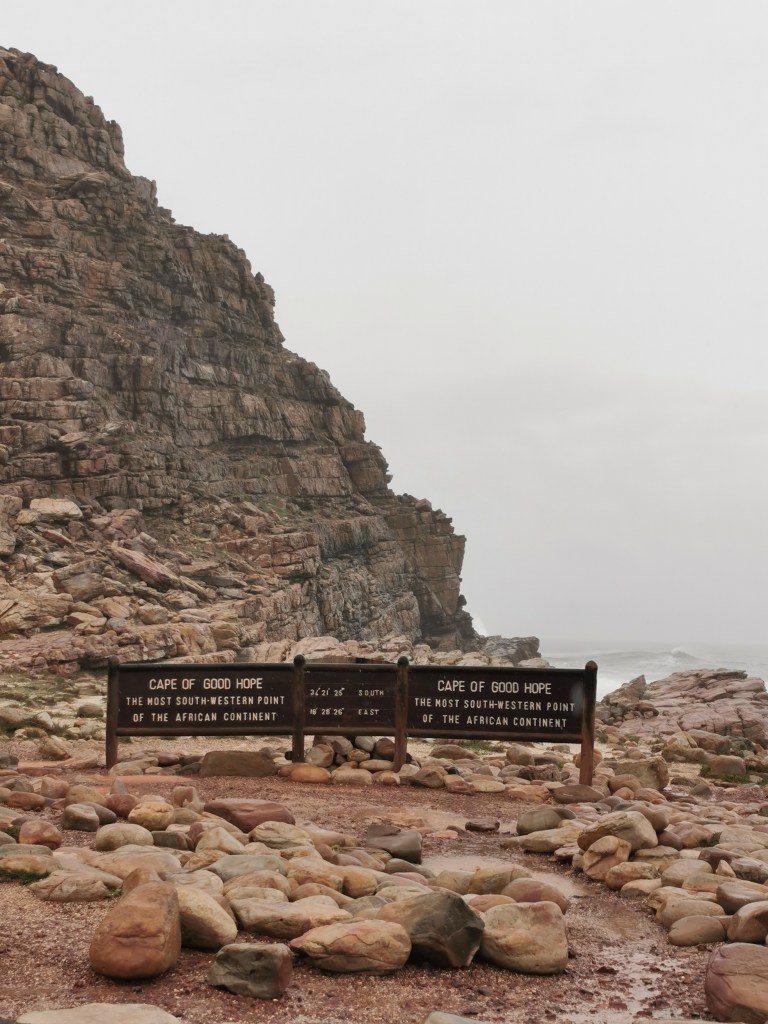
Cape of Good Hope Viewpoints – Unfortunately, we didn’t get to go along the walkway that provides the best views along the cliffs overlooking the Cape of Good Hope. But we did drive to the end of the path to get a quick snap of the sign.
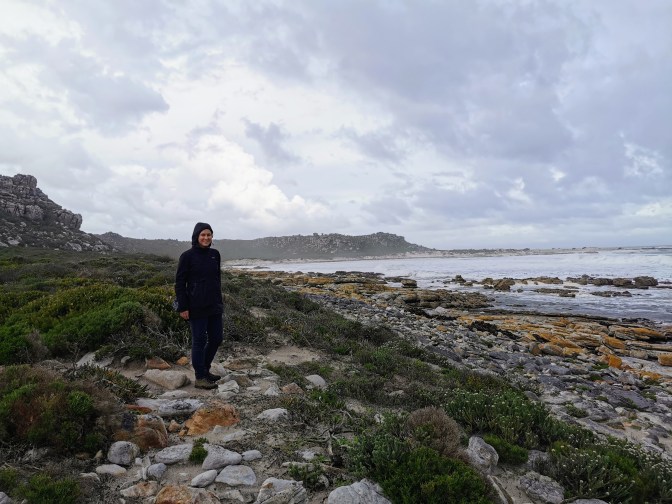
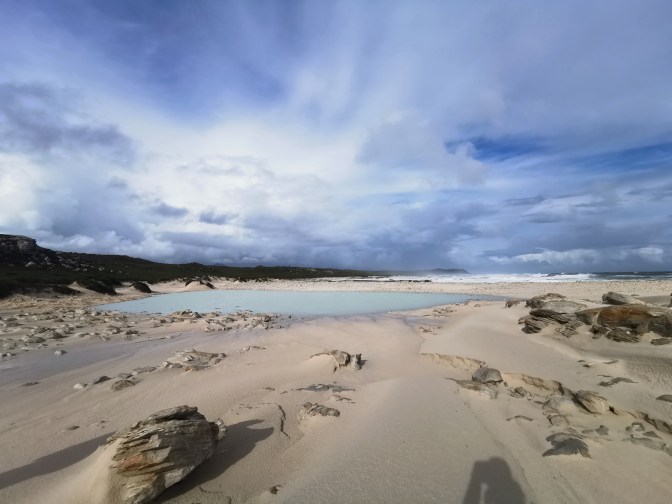
Olifantsbos Beach to do the Shipwrecks Trail – The following day we headed back to the national park with the hope of actually doing one of the trails. The weather was still dodgy, so we started out a bit sceptically. It didn’t help that the path was flooded, so we had to make our way around and over the rocks and flora. It drizzled a bit but then got out quite nice as we alternated between the shrubbery and the beach itself, steadily heading towards the ruin. We actually managed to miss the main ruin and kept on going until we came to the Nolloth wreck. This was quite cool, as the small part that remained stuck up out of the sand. We took a few photos before starting our journey back (we didn’t have time to do the inland route and the paths seemed to pretty non-existent when we looked). Before long I noticed the main wreck along the water line, so went to have a look. This was the Thomas T Tucker, which sank during the second World War. It was spread into multiple pieces and was interesting to see. We got about half way back when the weather turned and the wind drove the rain and hail into us, soaking us through in seconds! We decided to take a road back to be faster. Luckily the extreme weather didn’t last long, and the wind started to dry us out a bit by the time we made it back to the car. If the weather had been more positive, then this would have been a nice walk in its own right. But having the interesting wrecks at the end made it even better. Just make sure you have some sort of offline maps downloaded, as there are next to no markings and the path can be very hard to follow.
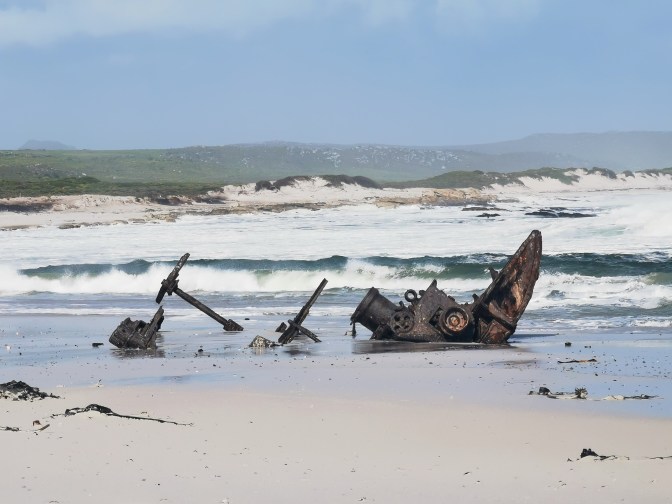
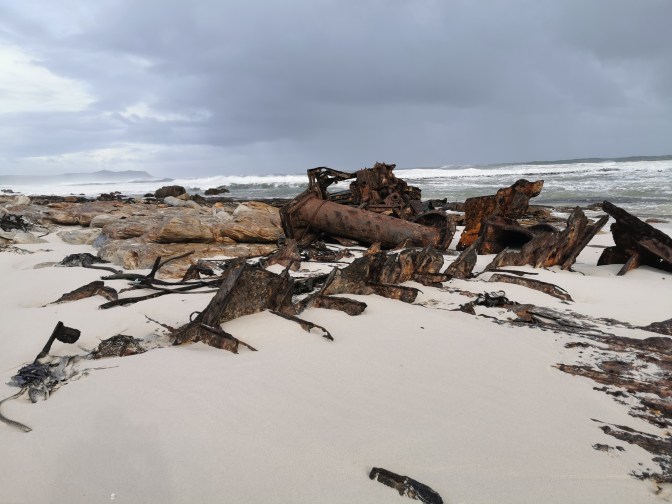
If you want to see our route using the Relive App, then please click here.
Keep an eye out for wildlife – Even in our limited time outside in the Cape Point National Park, we still managed to have some nice wildlife sightings. From the car we passed small herds of Bontebok and saw a couple of bedraggled Ostriches.
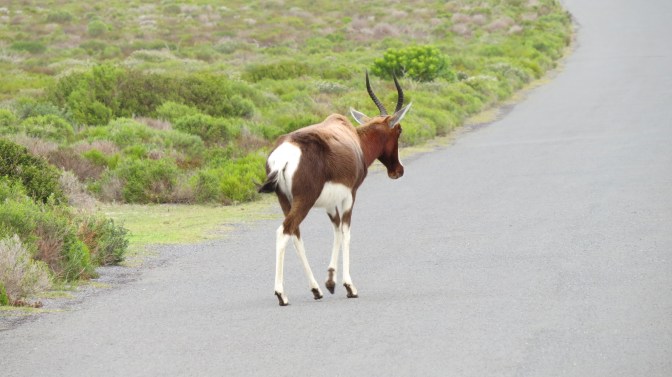
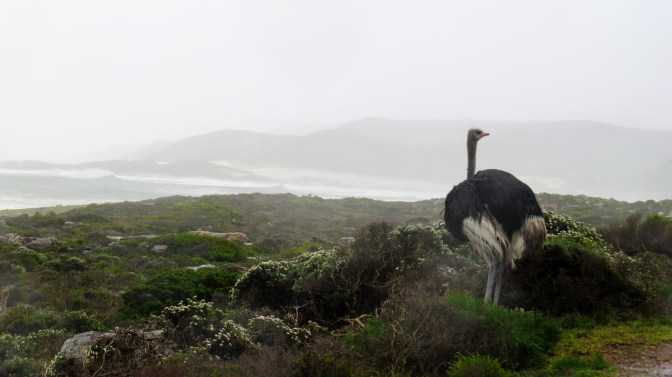
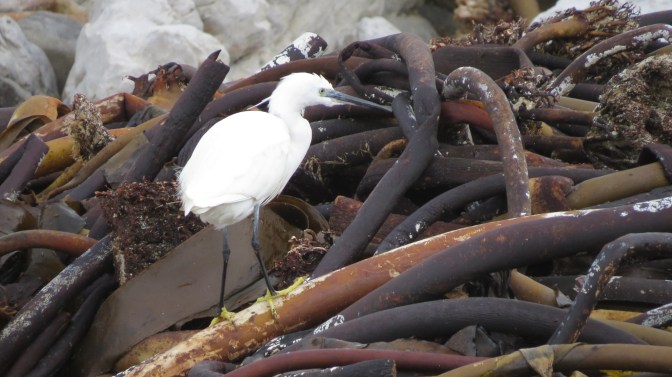
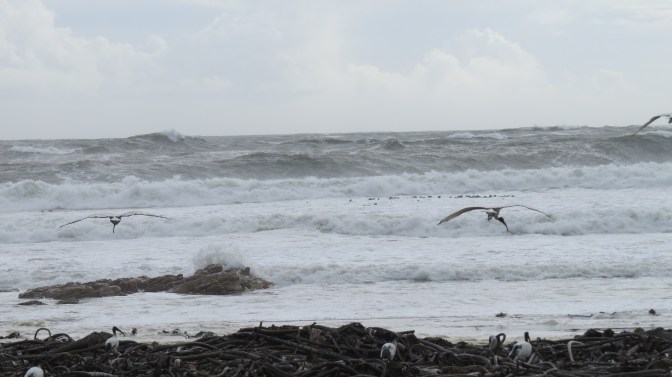
Along the shoreline during the Shipwrecks Trail, we saw more Bonteboks and also Little Egrets and Sacred Ibises.
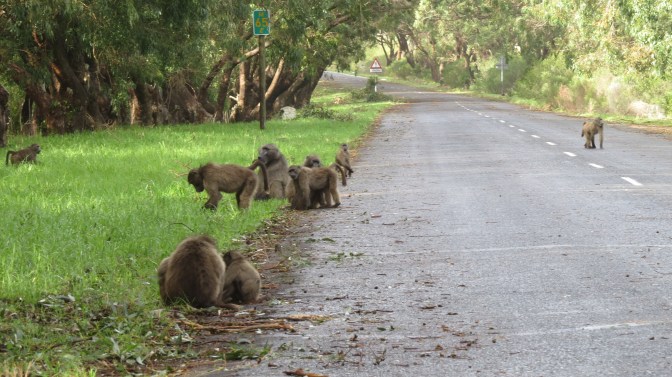
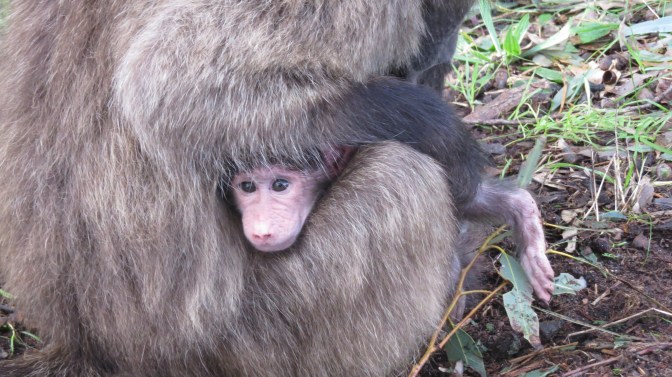
Then on the road near to the entrance, were another troop of Baboons.
Inside the national park you are also able to spot the rare endangered Cape Mountain Zebra, but despite keeping a keen eye out we weren’t lucky enough this time. I have no doubt that if we had been able to spend more time outside in the park we’d have been able to increase our sightings as there are lots of wide open spaces.
Boulders Beach
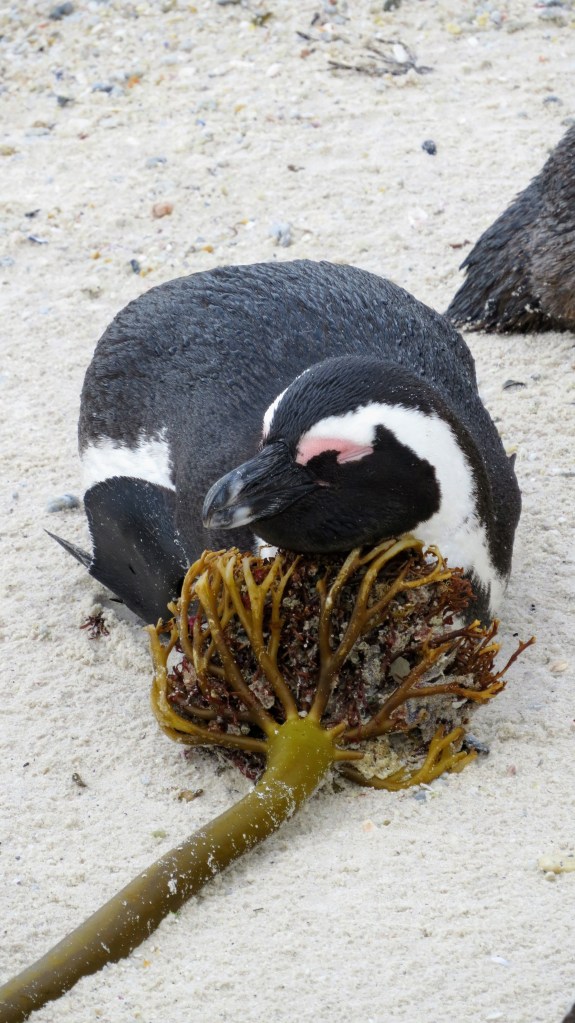
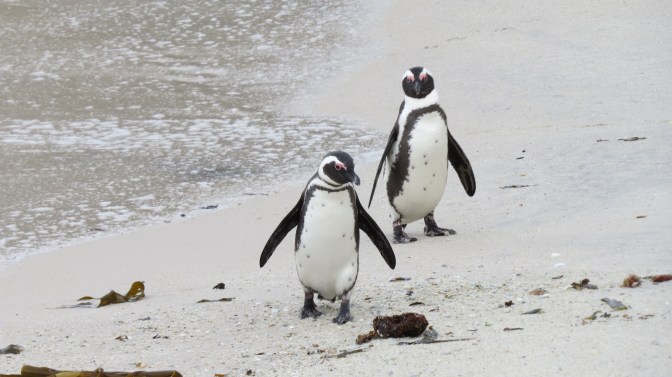
A must-do for any nature lovers visiting Cape Town (especially those with a Wildcard) is heading to Simon Town and visiting Boulders Beach. We did this both times whilst heading back from the Cape Point National Park towards the city. After parking we had to pay the ‘car guard’ before walking 200m to the entrance. There are a couple of little wooden walkways that lead down to the beach and either in the shrubbery or on the beach itself, there were dozens, if not hundreds, of the cute African Penguins. Despite having already seen a load at Betty’s Bay, that in no way diminished the excitement at being able to watch them again. As at Betty’s Bay, there were also lots of young ones of varying ages and sizes. Whilst they are very adorable, you can see why they used to be called ‘Jackass Penguins’ as their braying does sound like a donkey. Just before we had to leave, more penguins were swimming to shore for the night, skipping through the surface a bit like a dolphin. They were so fast and streamlined. Being able to watch them all certainly made up in part for the activities that we weren’t able to do in Cape Town.

Final Thoughts
Whilst we weren’t able to do everything we’d originally planned, we still had an amazing time on our road trip from Gqeberha (formally Port Elizabeth) to Cape Town. The route is now a well worn track for tourists, and thus there is a good infrastructure in place to cater for them. This includes lots of options for accommodation and food. We went during the South African winter, so had no problems booking accommodation and activities (the ones that were running), even last minute. It also meant that when we went for hikes we barely saw anyone else. But I can imagine that some places would fill up a lot more during high season, so maybe try and book more in advance if that is the case. If you are also wanting to go during July, however, please be aware that the weather might not be on your side, especially around Cape Town. So you might want to remain more flexible so that you can dodge the worst of the weather on a day-by-day basis.
The highlights for us were probably our time in Addo Elephant Park and Storms River Mouth. Addo was a brilliant introduction to doing a South African safari with its size and terrain being much more manageable than a larger park. It also helped us in terms of trying to find wildlife for when we then went to Kruger National Park later on in our trip. But there were also many amazing wildlife sightings just in Addo, including Rhinos, which we didn’t see in Kruger. Storms River Mouth was just a beautiful place. Even though the accommodation in the National Park itself was a bit more expensive it was worth it to be able to sit on your patio and watch whales out to sea. The hikes along the coastline were also great, with impressive scenery. Another highlight was seeing the Southern Right Whale at Plettenberg Bay; it was just such an amazing moment. Although, under normal circumstances I’m not sure we would recommend whale watching at this point. We heard from multiple sources that both Hermanus and Algoa Bay are normally more reliable places for spotting wildlife out at sea (do head to Plettenberg Bay to swim with the Sea Lions though!).
Things that we missed out on, which we’d consider if we ever come back, include:
- Trying to spot whales and sharks at Algoa Bay and Hermanus.
- More hikes around Storms River and Tsitsikamma Forest.
- The Cango Caves at Oudtshoorn.
- Point of Human Origins Cave at Mossel Bay.
- Clarence Drive Coastal Route – a scenic drive from Gordon’s Bay to Kleinmond.
- Hiking on Table Top Mountain and to Lion’s Head in Cape Town.
- Robben Island.
I hope that helps provide a little inspiration for when you’re planning your trip to South Africa. If you want to read about our time in Kruger National Park, then please click here.
 Brit and Czech Abroad