20th – 24th November 2021
Our final stop before departing from Ecuador was to the impressive city of Cuenca. Or should I say, Santa Ana de los Cuatro Rios de Cuenca, if I were to give it its full name (I think I’ll just stick with Cuenca…). As well being Ecuador’s third largest city, Cuenca has been a cultural hub for much longer than its colonial architecture might suggest. This architecture, along with its commitment to traditional town planning, has seen Cuenca given UNESCO World Heritage status, and for anyone who is interested in the history of Cuenca, the UNESCO website is a great place to start.
We were only there for a few days, and a lot of that time was spent organising the first few days in our next destination, but we were still able to explore a bit. So if you’d like to get some ideas for what you can do in Cuenca, then please read on.
Contents:
Climb to the viewing platform at the Cathedral
Walk along by the Rio Tomebamba riverfront
Delve into the history of the area at Pumapungo Museum and Archaeological Site
Learn about making traditional hats
A taste of home at the Golden Prague Pub
Explore the Old Town
Whilst the old town of Cuenca is lovely to just stroll around by yourself, I do find that you’ll get more from it if you partake in a ‘free walking tour’. I’ve mentioned these regularly in my posts, but to anyone who is unfamiliar, a free walking tour is generally like any other walking tour, except that there is no fixed fee. The tour guide is working solely for tips and I’ve generally found that this makes the guide go out of his or her way to make the tour interesting and enjoyable. If you search on the internet for ‘free walking tours Cuenca’ you’re bound to find something suitable.
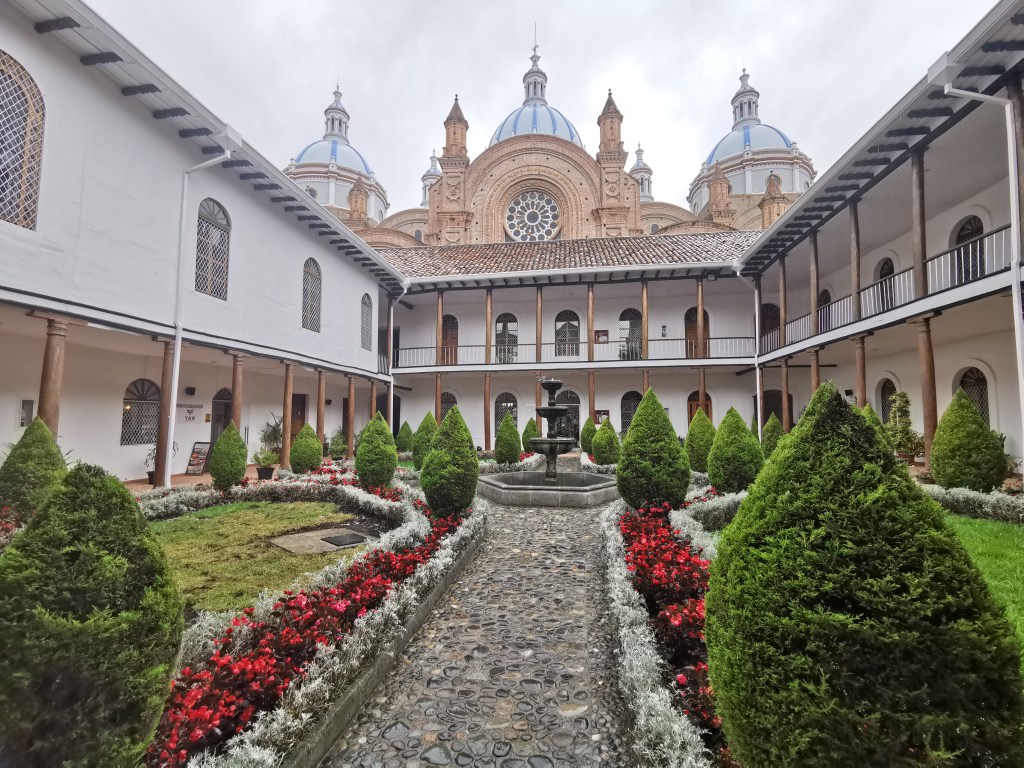
I met the guide in a courtyard just off the main square, Parque Calderon. As well as being a very pleasant courtyard in its own right, it had lovely views of the Catedral de la Inmaculada Concepción. This is the most impressive structure in Cuenca and I’ll mention it in a bit more detail later on in the post.
From the courtyards we went through the aforementioned Parque Calderon and had a look at the front of the cathedral. If you look closely, you can spot the reason that there are no bells in the bell towers. I’ll mention this again when I talk about the cathedral in more detail…
At the corner of the park is the Corte Provincial de Justicia del Azuay, which is the Provincial Court. This is one of the places that you are unlikely to find by yourself, but is free for visitors to just wander in and have a look around. The building is beautiful inside, with impressive architecture and murals lining the walls. Even though I felt like I shouldn’t be intruding, it was absolutely fine (and legal) to wander up the stairs and get a better view.

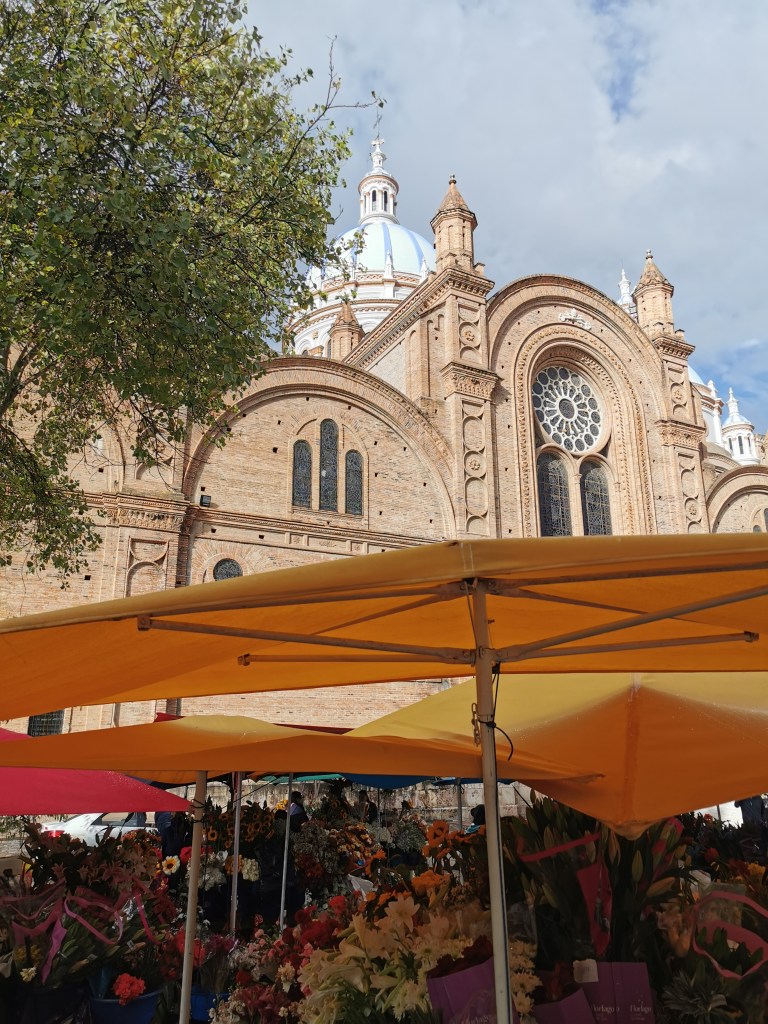
We next went back along the side of the cathedral to the Mercado de las Flores. This flower market fills the plaza with stalls upon stalls of bright colours. and having the cathedral as the backdrop just adds to the picture. This market actually made it into the ‘Top 10 Outdoor Flower Markets’ in an article in the National Geographic, which is pretty impressive!
Whilst at the market, our guide took us to the opposite side to the cathedral and we were looking upon the entrance to Del Convento de La Asuncion. Nuns at this convent live in complete seclusion but one thing they do provide for the outside world is Agua de Pitimas. This is a herbal drink made from dozens of herbs and flowers and is supposed to aid relaxation as well as helping to cure a range of ailments. Apparently only the nuns know the actual recipe and they leave the drink behind a wooden panel, which is then collected by the people actually selling the drink. This means that the nuns do not have to come into contact with anyone from outside the convent. One cup of the drink is very cheap and, whilst it won’t win any awards for taste, it was an interesting thing to do and who knows, it might have stopped me from getting sick. It actually had a slight resemblance to the drink we were given in the Amazon by the shaman.
From the market we headed to another of the plazas that are dotted about the city, this time to Plaza de San Francisco. This plaza is often home to markets filled with different crafts-men and women, specialising in areas ranging from leatherwork and textiles, to jewellery and metalwork. Another reason to head to this plaza is that it provides a nice view of the cathedral, where you can see all three major domes. To add to this site they have added the name of the city in big letters to make it into an almost official photo-spot. That is Plaza de San Francisco in the photo at the top of the page.
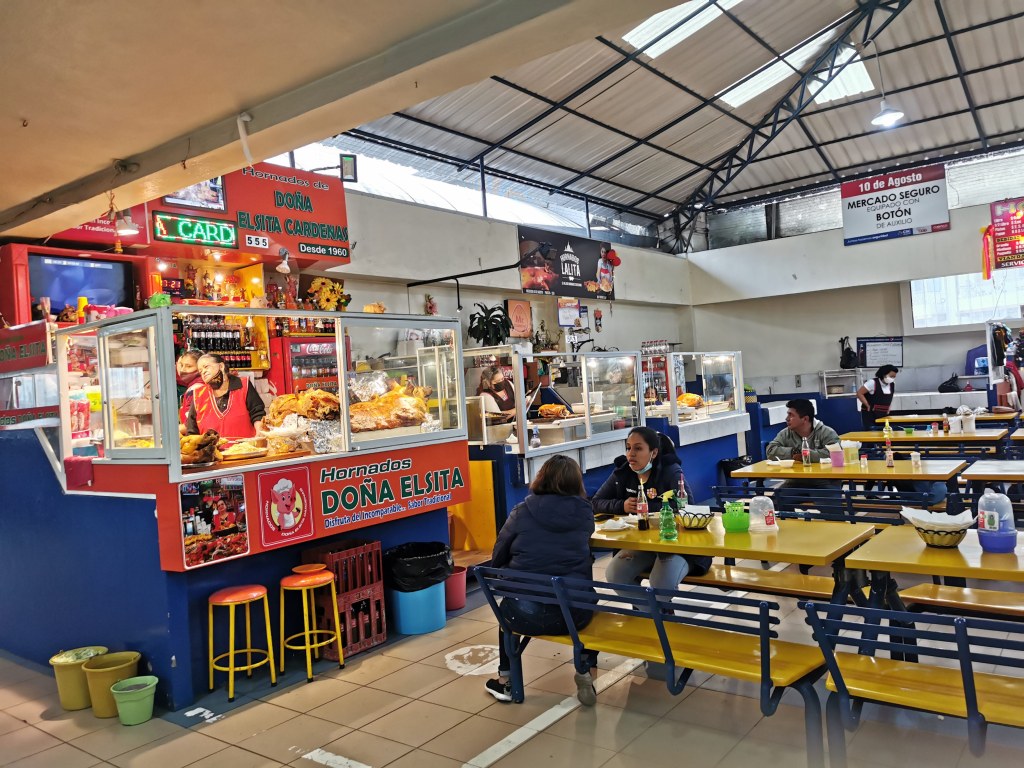
Next on the tour was a trip to the Mercado 10 de Agosto. This is the stereotypical bustling South American market that you find everywhere. Locals come here to pick up fruit and vegetables in one section and then meat in another, or to eat a meal at one of the variety of food stalls set up upstairs. One of the stalls had apparently won the competition for best ‘Hornado‘ in Cuenca for the couple of years prior to our arrival. Hornado (whole-roost pig) is a popular local delicacy in Cuenca. In another area of the market there is something a bit different. You can experience a ‘limpia’. This is a traditional cleansing, and has been passed down for generations. The purpose is to rid the body and spirit of anything bad. There was not time to watch or see it in any detail but apparently it is fine for tourists to also participate, along with the regular queues of locals, who take the process very seriously.
The tour finished by looking at some street art next to Cruz del Vado. Whilst the tour hadn’t been as long as most that I’d experienced on my travels, it was still very informative and well worth doing. Given that Cuenca is pretty safe, you can also wander round yourself and seeing it in the evening gives you a different perspective.
Visit Amaru Bioparque
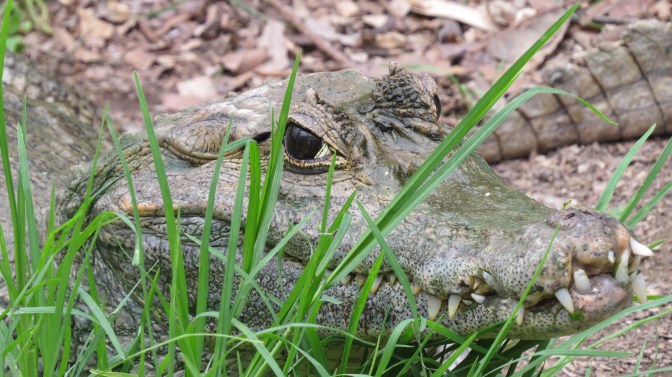
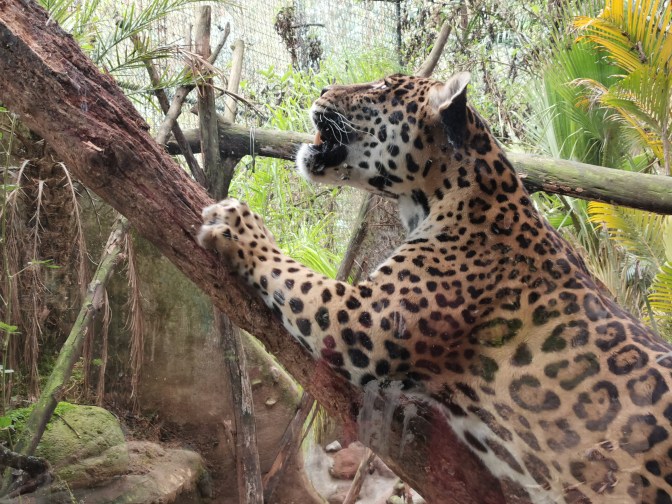
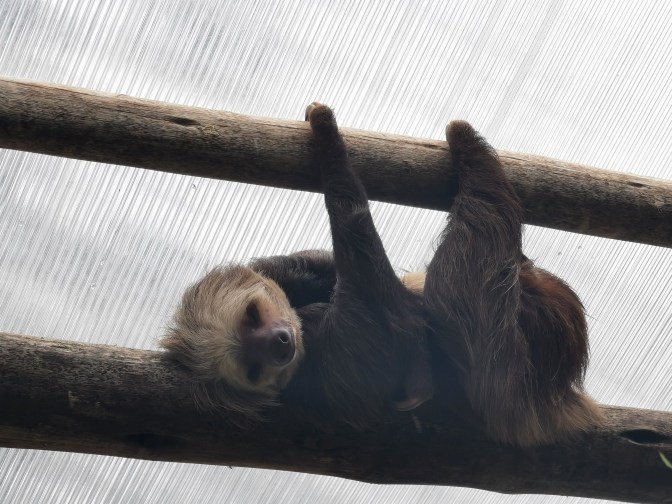
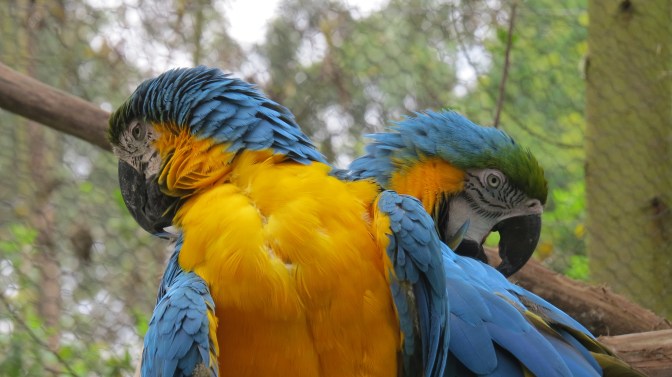
From when I was younger I have had an uncomfortable relationship with zoos. Whilst I love seeing different wildlife I do not like seeing birds and large animals in cages. So I generally avoided zoos as it was not something I wanted to support. As I have gotten older, however, I’ve come to realise that not all zoos should be tarred with the same brush. There are some that have large well-built enclosures for the animals and play important roles in conservation and education. Amaru Bioparque would fall into this category and was probably our favourite thing to do in Cuenca.

One thing that made me happier to go was that a lot of these animals have been rescued, either from circuses or from being pets. Some were also taken from illegal trafficking, hence why some of the animals are not native to South America (e.g. the lions). Other animals are unable to be re-released back into the wild, such as the bears, who now link humans to providing food, or the condors, who were shot by hunters and are now unable to fly properly and thus would not be able to survive in the wild. Amaru Bioparque also works hard on its education commitments. Each enclosure has large boards giving lots of information about the animals inside. Whilst you can interpret a lot just from the diagrams, the writing is in Spanish, so maybe have Google Translate Spanish downloaded on the app so that you can quickly scan the boards. There are also visual exhibits dotted about the park that bring your attention to major issues affecting our environment and wildlife. These include forest fires, problems with plastic, and the illegal pet trade.

The park itself is a short taxi ride away from the centre and is situated on the side of the hill overlooking Cuenca. This means that there are also great views looking down onto the city. The enclosures are built onto this hillside and the paths are more like walking trails – so make sure you have some proper shoes and be aware that if you have any mobility issues, this is probably not the activity for you. This layout and organisation does make it feel a bit more natural.
The thing we liked the most about the park was being able to get a good look at animals that we’d only seen from a distance whilst we’d been travelling, such as sloths, toucans and macaws. It was also very interesting to see animals that are native to the area that we were not lucky enough to have spotted, such as the capybaras, tapirs, jaguars and Andean bears.

We ended up spending a good 3 hours wandering around the trails. So if you decide to go then make sure you devote a whole morning or afternoon to make sure you are not rushing. When you’re finished, the staff at the entrance will call you another taxi to take you back to the centre.
Climb to the viewing platform at the Cathedral
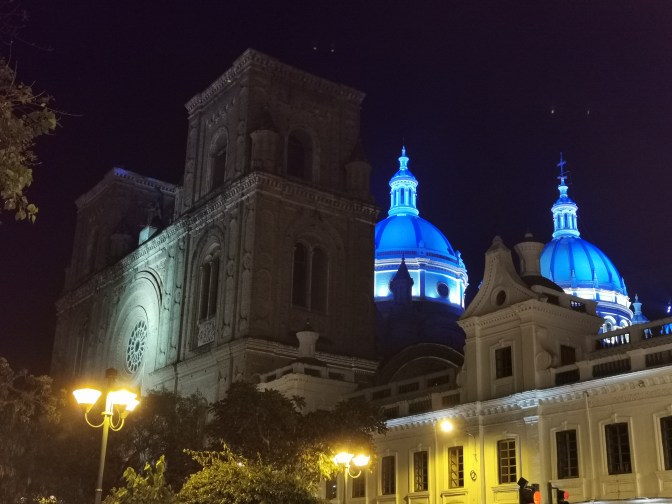
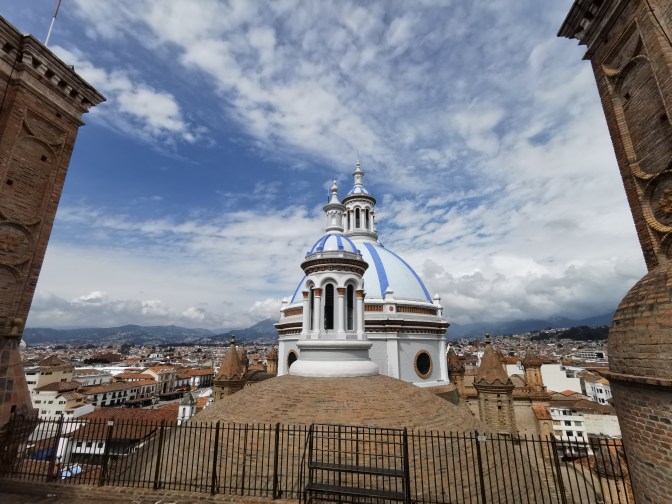
If you are in Cuenca it is really hard to miss the striking new cathedral, or the Catedral de la Inmaculada Concepción to give it its full name. I’ve already mentioned it a few times in this post and it really is a spectacular building, which you walk around when there are not services taking place. One thing that might be missed, however, is the fact that you can walk up the towers to a viewing platform. There is a small fee and a lot of narrow stairs to climb, but if you are able then it’s definitely something we’d recommend doing.
You get a closer look at the blue domes and also there is a nice view over the rooftops of Cuenca. There is also a board explaining why there are no bells in the bell towers, but I’m not going to tell you why – you’ll have to visit Cuenca to find out.
Walk along by the Rio Tomebamba riverfront
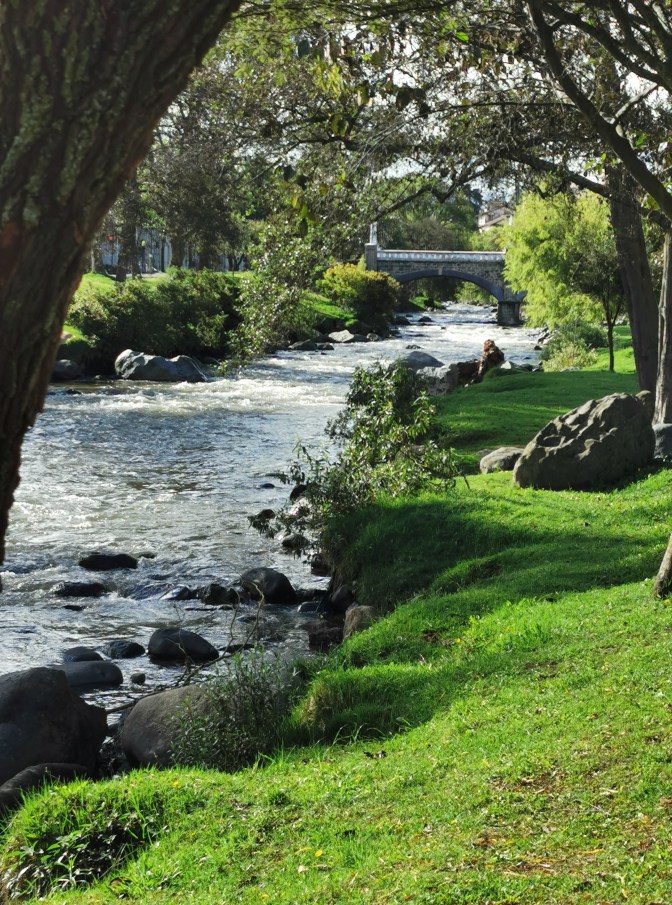
The full name for Cuenca, which I wrote at the beginning of the article, is actually based on the four rivers that intersect at the point where the city is situated. One of them, Rio Tomebamba, runs next to the old town and it is very pleasant to walk along or to sit underneath one of the ample amount of trees and have a picnic. The nice natural area around the river is framed by pretty colonial buildings, giving the whole setting a relaxing feel. We actually combined this activity with a visit to Cuenca’s premier museum…
Delve into the history of the area at Pumapungo Museum and Archaeological Site
This museum is Cuenca’s biggest and displays exhibits looking at the indigenous culture and history of the area. Unfortunately, when we were there the whole of the bottom floor was closed for renovations, but there were still some interesting things to find on the second floor.
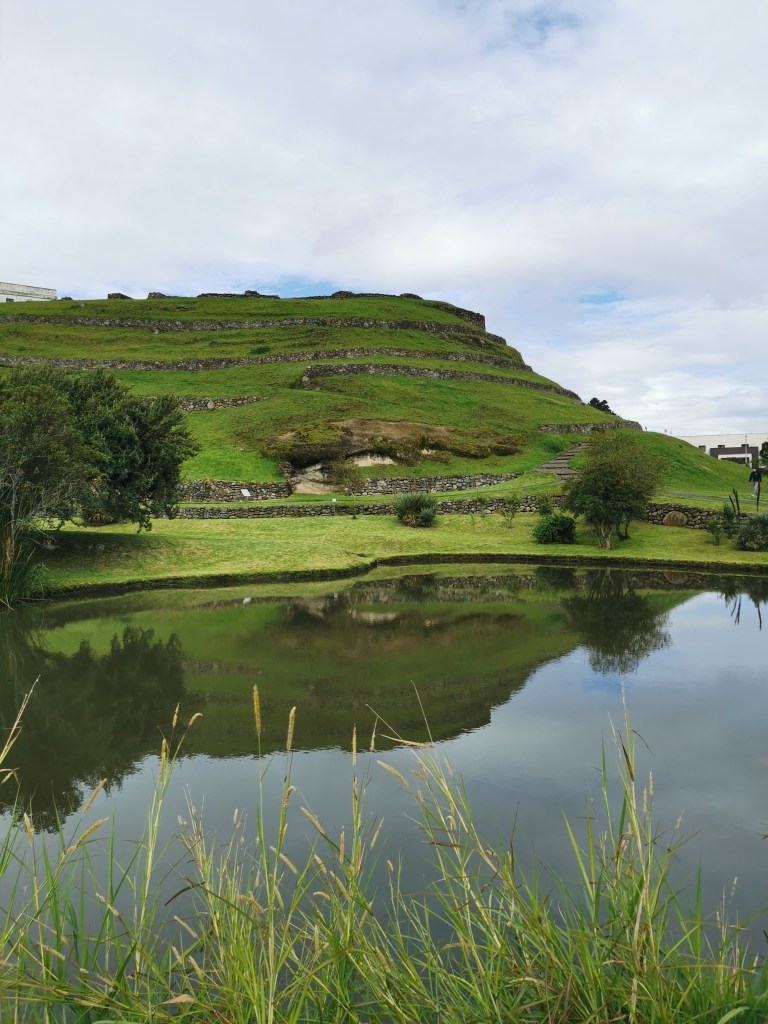
When you have finished looking through the exhibits, you can make your way out of the back doors to the Archaeological Park. You then proceed to walk along ruined foundations of what is believed to be part of the pre-Incan city of Tomebamba. Whilst pleasant, I do feel more could be done to help visitors try and imagine what the place would have looked like at its peak, as I found it hard to visualise when walking around.
If you walk down the hill, you come to a kind of large garden where crops are grown that would have been present in the traditional civilisation. From here, you also get a good view looking back over the archaeological site. A bit further along is a little aviary. The bird enclosures at the Amaru Bioparque were already at the limit of what I was comfortable with in terms of caging birds, but this aviary was way too small. So that put a bit of a dampener on the visit here.
Overall, this is a reasonable place to visit. We have been lucky in that we had already visited multiple historical sites on our travels and thus we were not overly impressed with what we found at Pumapungo. But if you were newly arrived to South America then this would be a good place to start learning about some of the fascinating history of the area.
Learn about making traditional hats
It turns out that ‘Panama Hats‘ are not actually from Panama. Weird right? But the story goes that large amounts of these traditional hats were exported to Panama for the workers during the construction of the Panama Canal in the early 1900s. US President Roosevelt then visited the construction and was pictured wearing one of the hats, and the name ‘Panama Hat’ took off to become the common term we know today. But the origins and production are firmly based in Ecuador.
Cuenca is now the biggest area of production and there are a couple of places where you can go to learn about how the hats are made. We decided to visit the Homero Ortega Museum. Whilst based a bit out of the centre, it is still only a short taxi ride away. Apparently, you are normally given a free guided tour, but when we went there, there was no one available. This was a shame but not fatal to our visit, as there are plenty of boards that go through information about the history of the hand-made hats and the actually step by step process for producing them. The museum is linked to the actual factory, so at one point you view hats that are midway through the process. Nearer the end there is an exhibit about people from all over the world who have worn Homero Ortega hats.
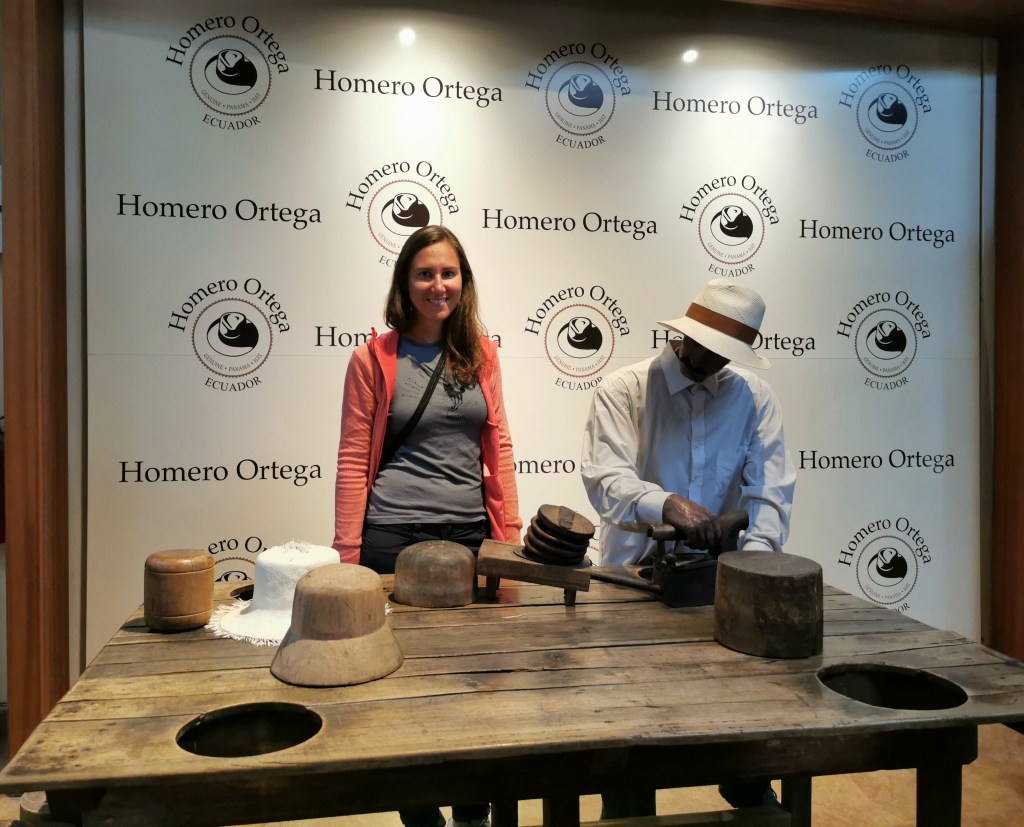
You end the trip by going through a store, where you can view the different ranges of hats. Far from it being a ubiquitous product, there is a large range in terms of quality of the final product. The best can take months to painstakingly weave and thus can go for thousands of dollars. There are, of course, hats available for much less than this and the staff will help you find something suitable. One tip if you are looking to get a hat is to ask about the ‘outlet items’. These are hats that have small errors in their production and thus cannot be sold at full price. I ended up getting a nice hat to replace my tatty straw one, that had been destroyed during the rains on the Quilotoa Loop. This hat was at a large discount for its quality and yet the only issue was that there was a tiny area at the back where the straw was slightly discoloured (it was a bit yellowy rather than white). Whilst still not cheap for a hat, it brought it to a level that I was able and willing to pay. The fact that we’d just gone through the exhibit showing how difficult and time-consuming it is to make the hats probably also had an effect on how much I thought the hats were worth!
This activity wouldn’t be for everyone, but I enjoyed it. The exhibits are interesting, and even with the tour it would have been free, but obviously they make up the money by people buying things at the end. The vast majority of our time in South America at that point had been based around either nature or older history and culture. It was nice to do an activity more linked to the modern culture of the region.
Relaxing at Piedra de Agua
A short taxi ride away (maybe 10 minutes or so from the centre) is the community known as Baños. This is obviously different from the main Baños that we visited earlier in our trip but is also know for its natural thermal springs. Hence, there are several spas in this area. We decided to try out Piedra de Agua. One of the reasons that we chose this spa is that they do special offers at various times during the week. So if you are wanting to go to a spa, you should definitely check out the deals on their website and plan accordingly.
We ended up getting a 2-for-1 deal on the ‘spa circuit’. This involved spending time at a number of stations before being directed to the next one. The treatments included two types of volcanic mud bath; contrast pools in an underground cave; and a weird steam room where they trap you in a wooden box with your head sticking out and then fill the box with steam. I didn’t think it would be allowed to take a phone into the spa but given that it was a private circuit it would have been fine. And it’s a shame I didn’t, as I would definitely have wanted photos of the amusing situations you ended up in.
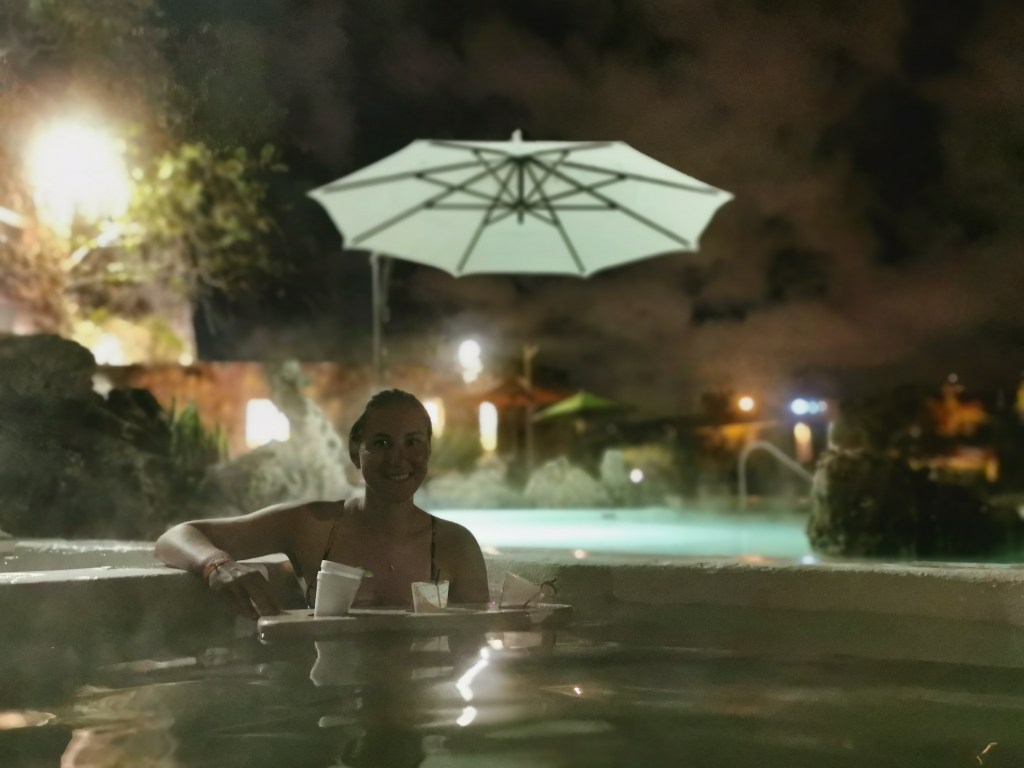
Despite spas being more Radka’s thing, I definitely enjoyed myself and after you are finished the circuit, you can spend as long as you like in the normal thermal pools. To add to the experience, there were 2-for-1 cocktails that they would deliver to you by floating them along on a wooden boat. This was a really nice way to finish our time in Ecuador.
A taste of home at the Golden Prague Pub
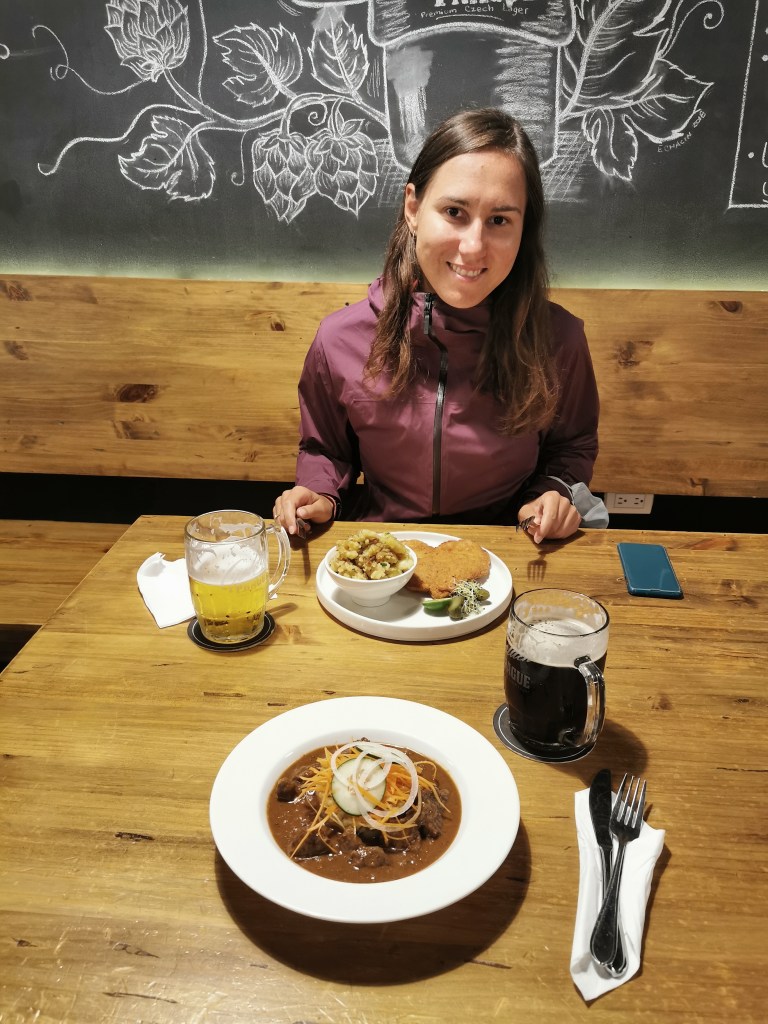
When I say home, I mean Radka’s home. At this point we had been travelling for about 3 months and the first tinges of being home-sick were starting to creep in. To help with this, we went for a meal at the Golden Prague Pub. Whilst the pub had been opened by people from the Czech Republic, the meals were more catering for what international tourists might associate with central European cuisine, rather than real traditional Czech meals. However, we still thoroughly enjoyed our schnitzel and goulash meals and washing them down with bitter beers. As much as we enjoyed trying the local dishes, it was still nice to have food that we were more comfortable with now and again. Just bear in mind that it is based in a massive old warehouse – so it can get quite chilly in there.
Things we missed out on
I tend to think we did pretty well considering we only had three full days in Cuenca, but there were still a couple of things that had been in our original plans that we were unable to manage.
The main one was hiking in the near-by El Cajas National Park. It is supposed to be very beautiful there, but when we arrived in Cuenca and checked at the bus station, the buses to the national park had been cancelled due to damage to the road. This was unfortunate but could not be helped.
The second activity was walking up the ancient Incan road to get to the ruins at Ingapirca. This site is even further from Cuenca and if we hadn’t run out of time, we would probably have tried to fit it in en route from Quito to Cuenca. Ingapirca is the largest and best preserved Incan site in Ecuador and would be of interest to anyone who is keen to learn about the local history.
Final thoughts
Cuenca is a very pleasant city to visit and would have made a much nicer (and safer) place to base ourselves in. Ideally, we would have had more time to explore the surrounding area rather than cramming it in at the end of our trip. But we still managed to have plenty of fun here. I hope that this post has provided some inspiration for visiting Cuenca. If you want a bit more detail to help with your planning, the following is an excellent blog post that we used to help with our own trip:
https://www.roamingaroundtheworld.com/best-things-to-do-in-cuenca-ecuador-travel-guide/
Thank you for taking the time to read!
 Brit and Czech Abroad